

How to Verify Ingredient Purity in Sleep Supplements
I wouldn’t trust the word “pure” on a bottle without proof. A sleep supplement can match the label, have the right dose, and still fail on contaminants - or it can be clean but poorly dosed. The fastest way I check a product is simple: read the full label, confirm third-party listing, match the lot number to a batch COA, and verify the lab.
Here’s the short version:
- Start with the Supplement Facts panel, not the front label
- Avoid proprietary blends because they hide ingredient amounts
- Check the exact form of each ingredient, like magnesium glycinate vs. generic magnesium
- Look for lot number, expiration date, and company contact info
- Verify seals in the certifier’s own database, not just on the bottle
- Ask for a batch-specific COA with numeric results, not just “passes” or “complies”
- Match the lot number on the bottle to the COA
- Confirm the lab is ISO/IEC 17025 accredited
- Walk away if the brand won’t share sourcing or test details
One stat stands out: a 2017 study found melatonin content varied by as much as 465%, and 26% of products contained undeclared serotonin. That’s why I treat label claims as a starting point - not proof.
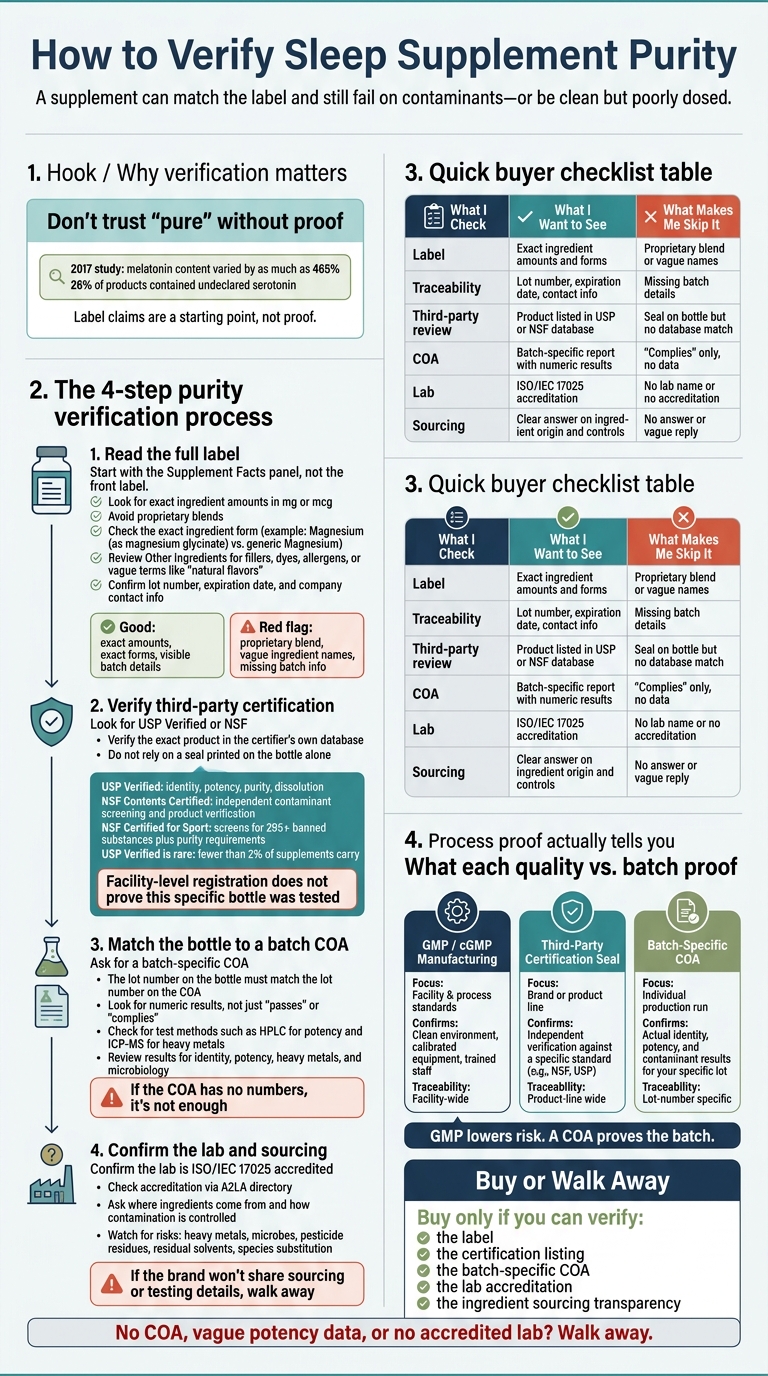
How to Verify Sleep Supplement Purity
How to detect a scam supplement (3 easy tests) | Dr. Jen Gunter
sbb-itb-5106bd1
Quick check before I buy
| What I check | What I want to see | What makes me skip it |
|---|---|---|
| Label | Exact ingredient amounts and forms | Proprietary blend or vague names |
| Traceability | Lot number, expiration date, contact info | Missing batch details |
| Third-party review | Product listed in USP or NSF database | Seal on bottle but no database match |
| COA | Batch-specific report with numeric results | “Complies” only, no data |
| Lab | ISO/IEC 17025 accreditation | No lab name or no accreditation |
| Sourcing | Clear answer on ingredient origin and controls | No answer or vague reply |
If I can’t verify the label, the seal, and the batch report, I don’t buy it.
Step 1: Read the Supplement Facts panel and full label
Start with the Supplement Facts panel, not the front label. That’s usually the best spot to check the dose and see what’s actually disclosed in the formula.
Check for exact names, amounts, and full ingredient disclosure
Each active ingredient should have a clear amount listed next to it in mg or mcg. If you spot a proprietary blend, take that as a red flag. These blends list ingredients from highest to lowest by weight, but they don’t show the dose of each one. So you can’t tell whether an ingredient is there at a clinical dose.
You’ll also want to check the exact chemical form listed in parentheses. For example, Magnesium (as magnesium glycinate) tells you much more than just Magnesium. That matters because the form affects absorption, and a generic name can cover up a cheaper, less absorbable version.
Then scan the Other Ingredients section. This is where you’ll find fillers, binders, coatings, dyes, and allergens. If the label uses vague wording like “natural flavors,” it deserves a closer look.
Look for traceability details on the package
A clear label does more than list ingredients. It should also include the manufacturer or distributor name, a lot or batch number, an expiration date, and contact information. These aren’t just box-checking details. They’re what let you tie one bottle to its test results. If any of that is missing or hard to read, you can’t match the bottle to its COA or report a batch issue.
What a transparent label looks like in practice
RST Sleep is one example. Its label lists each active ingredient on its own and doesn’t use proprietary blends.
| Label Element | Transparent Practice | Red Flag |
|---|---|---|
| Ingredient amounts | Exact mg/mcg listed for every component | “Proprietary Blend” with a single total weight |
| Ingredient form | Specific form listed, e.g., Magnesium (as magnesium glycinate) | Generic name only, e.g., Magnesium |
| Inactive ingredients | Full disclosure of all binders, fillers, and coatings | Vague terms like “natural flavors” without detail |
| Traceability | Clear lot or batch number and expiration date | Missing or illegible batch information |
If the label looks good, the next step is third-party testing.
Step 2: Look for third-party certification seals
Once the label looks good, the next step is to check whether an outside group tested the product itself. That distinction matters. A seal only means something if you know exactly what it covers. And the proof doesn't come from the logo on the bottle. It comes from the certifier.
Identify recognized certification marks
In the U.S., two seals worth checking first are USP Verified and NSF. USP Verified confirms identity, potency, purity, and dissolution. NSF has more than one seal, and they don't all mean the same thing:
- NSF Contents Certified covers independent contaminant screening and product verification
- NSF Certified for Sport adds screening for 295+ banned substances
Don't stop at the logo. Look up the exact product in the certifier's database. For USP, search quality-supplements.org. For NSF, use info.nsf.org. If the product shows up there, then you can move on to batch testing and manufacturing records.
USP Verified is rare. Fewer than 2% of supplements carry it. So if a sleep supplement has that seal, that's a strong sign.
What each seal typically verifies
These seals are not interchangeable. Each program checks different things, and none of them tell you whether a supplement will work for your health goal. USP is clear on this point: its verification program does not address efficacy.
The table below shows what the most common seals cover, along with their limits.
| Certification | What It Verifies | What It Does NOT Confirm |
|---|---|---|
| USP Verified | Identity, potency, purity, and dissolution; annual audits, documentation reviews, and product testing | Efficacy or clinical results; drug interactions |
| NSF Contents Certified | Independent contaminant screening and product verification | Banned substances unless "Certified for Sport" is also listed |
| NSF Certified for Sport | 295+ banned substances plus purity requirements | Primarily relevant for athletes; does not replace basic purity checks |
One more thing: facility-level registration only shows that the site was audited. It does not prove that this specific bottle was tested. A seal helps, but batch documents are the paper trail behind it.
Step 3: Check manufacturing quality and batch testing documents
After you check the label and third-party seals, look at how the product was made and how that batch was tested.
Verify GMP or cGMP manufacturing claims
GMP and cGMP refer to FDA dietary supplement manufacturing rules under 21 CFR Part 111. These rules cover manufacturing, packaging, labeling, and holding operations.
That includes basics like:
- cleanliness
- equipment calibration
- staff training
- recordkeeping
A GMP claim means the company says it follows controlled production rules. It does not mean the batch is pure.
To check the claim, look for wording like "Manufactured in a GMP-certified facility" on the label or on the brand's website, often under an About or Quality page. RST Sleep, for example, says its supplements are made in GMP-certified facilities.
That tells you the process may be in good shape. But the COA tells you whether this batch is clean.
Review Certificates of Analysis and test results
A Certificate of Analysis (COA) gives batch-specific lab results. Check for identity, potency, heavy metals, and microbiology.
Be careful with vague COAs. If a document only says "Complies" and gives no numbers, that's a red flag. A proper assay should show an actual result plus the test method, such as HPLC for potency or ICP-MS for heavy metals.
One detail people often miss: match the lot number.
The lot number on the bottle must match the lot number on the COA. If it doesn't, that COA does not apply to that bottle.
You should also check whether the lab is ISO/IEC 17025 accredited through the A2LA directory at a2la.org.
If the brand doesn't post a COA on its website, email the quality team or customer service team and ask for a batch-specific COA from a product made within the past year.
Process quality vs. batch proof of purity
GMP lowers risk. A COA proves the batch.
| Method | Primary Focus | What It Confirms | Traceability |
|---|---|---|---|
| GMP / cGMP Manufacturing | Facility & process standards | Clean environment, calibrated equipment, trained staff | Facility-wide |
| Third-Party Certification Seal | Brand or product line | Independent verification against a specific standard (e.g., NSF, USP) | Product-line wide |
| Batch-Specific COA | Individual production run | Actual identity, potency, and contaminant results for your specific lot | Lot-number specific |
One clean COA does not promise the next batch will look the same. GMP is required by the FDA under 21 CFR Part 111, and a COA is required for batch release, but brands often don't share it with shoppers unless someone asks.
Step 4: Confirm sourcing, contamination controls, and when to walk away
Check source transparency and contamination risk
Batch testing matters. But raw-material sourcing still shapes what ends up in the bottle. A COA can't rescue poor sourcing. Under cGMP rules, manufacturers have to qualify suppliers before production starts.
Pay close attention to heavy metals, microbes, pesticide residues, residual solvents, and species substitution. Products with botanical blends or long ingredient lists need a harder look. They tend to face more risk of contamination and dose drift.
That 26% figure matters because undeclared serotonin can add safety risk. A brand you can trust should be able to name its ingredient sources and explain its contamination controls if you ask. If it can't, that's your sign to stop.
Pre-purchase checklist
Use this checklist before you buy any sleep supplement:
- Third-party certification - Is the product listed in the certifier's searchable directory, such as USP or NSF?
- Batch-specific COA - Does the lot number match the COA, and does the report show numeric results from an accredited lab?
- Sourcing transparency - Can the brand explain where the ingredients come from and how it controls contamination? If not, that's a gap worth flagging.
If any step leads nowhere - no COA, vague potency data, or no way to verify lab accreditation - walk away. As Sam Carlson of Nutricel Supplements put it:
"A COA is only as credible as the lab that issued it. ISO/IEC 17025 accreditation from an independent body like A2LA is the one credential that separates a real third-party lab result from a document any brand can generate on its own."
Conclusion: How to choose a cleaner, more trustworthy formula
Pure formulas need proof, not promises. Look for brands that publish COAs, name their labs, and disclose sourcing. If those details are hard to find, don't buy.
FAQs
How do I read a COA?
Check the lab details, accreditation, and contact info first. Then make sure the product name and lot number on the COA match your supplement exactly.
Next, look at the test methods and compare the results with the listed specs. The potency should line up with the label, contaminant levels should stay below the stated limits, and the COA should include a pass/fail result, a signature, and a recent test date.
If anything looks off, is missing, or feels vague, contact the manufacturer and ask for clarification.
What if a brand won’t share test results?
If a brand won’t share test results, that’s a red flag. It can point to weak quality checks and a lack of openness.
Legitimate third-party testing usually means sharing batch-specific certificates or lab reports that you can verify on your own.
Are third-party seals enough?
Third-party seals are a strong sign of product purity and label accuracy. But on their own, they don't tell the whole story.
You should also verify the seal in the certifier’s official database. That helps confirm the certification is current and tied to the specific batch, not just the product name or brand as a whole.