

5 Tips for Managing Light Exposure During Night Shifts
Working night shifts can disrupt your body's natural sleep-wake rhythm, making it harder to stay alert at work and sleep during the day. Light exposure plays a major role in this. Here's how to use light strategically to improve alertness at night and sleep quality during the day:
- Start your shift with bright blue light: Boost alertness and shift your internal clock by using blue-enriched light early in your shift.
- Switch to dim, warm light later: Reduce blue light exposure in the second half of your shift to prepare your body for rest.
- Wear blue-blocking sunglasses after work: Protect your melatonin levels by blocking morning light on your commute home.
- Make your bedroom completely dark: Use blackout curtains, eye masks, and remove light sources to promote better daytime sleep.
- Consider sleep supplements: Pair light management with melatonin-based supplements to further support your circadian rhythm.
1. Use Bright Blue Light Early in Your Shift
How It Helps Adjust Your Internal Clock
Starting your night shift with exposure to bright blue light can help shift your body's natural sleep-wake cycle, known as the circadian rhythm. This adjustment moves your sleepiest period (the circadian nadir) away from work hours and into the daytime, making it easier to stay awake and alert during your shift and sleep better afterward. Essentially, it helps your body adapt to a schedule that doesn't align with the typical day-night cycle.
In controlled studies simulating night-shift conditions, 100% of participants exposed to high-intensity light (around 5,700 lux) and 85% exposed to medium-intensity light (around 1,230 lux) successfully delayed their circadian rhythms to align with daytime sleep. At Brigham and Women's Hospital, researchers led by Dr. Charles Czeisler tested the effects of bright light (7,000–12,000 lux) on night-shift workers. After just four nights of exposure during work hours (12:15 AM to 7:45 AM) and complete darkness during the day, participants experienced a 9.6-hour shift in their internal temperature nadir, along with better cognitive performance and alertness compared to those working under standard indoor lighting (150 lux).
Why Blue Light Works
The circadian system is especially sensitive to blue light at a wavelength of around 480 nanometers, which stimulates melanopsin-containing retinal cells (ipRGCs). This makes blue-enriched light far more effective than traditional warm lighting for resetting your internal clock.
"For most people, bright light (1,000 lux of white light at eye level) between 18:00–04:00 h delays the phase of the circadian system. This means that sleep and alertness rhythms... occur later." - Working Time Society Consensus Statement
Timing is crucial. Exposure to bright light during the first half of your shift - typically between 6:00 PM and 4:00 AM - can create the desired phase delay. Studies also show that this approach can extend daytime sleep by 40 to 60 minutes, making it easier to recover from night work.
Making It Practical
You don’t need to sit under bright light continuously. Research shows that intermittent pulses of bright light - lasting 15 to 30 minutes and spaced throughout the first half of your shift - can be 60% to 90% as effective as constant exposure . Blue-enriched light sources, which work well even at lower intensities, make this method more practical. For example, a study at Monash University found that 89 lux of 17,000 K blue-enriched light improved alertness during melatonin peaks.
This strategy is easy to implement and highly effective for night-shift workers. Next, we’ll look at how switching to dim, warm light later in your shift can further fine-tune your circadian rhythm.
sbb-itb-5106bd1
2. Switch to Dim Warm Light in the Second Half of Your Shift
Scientific Backing
Your body's "crossover point" - the moment when light exposure starts to advance your internal clock instead of delaying it - typically happens 2–3 hours before your usual wake time. This timing is critical because light exposure after this point can make it harder for you to sleep during the day.
"The 'crossover point' - when light exposure transitions from causing phase delays to phase advances - usually occurs near the body temperature minimum, around 2–3 h before the habitual wake time." - ScienceDirect
In simpler terms, light before this temperature minimum pushes your sleep schedule later, while light after it shifts your rhythm earlier. Research also shows that night workers exposed to higher levels of light at night face a 22% higher chance of sleep disturbances. This makes adjusting your light exposure in the second half of your shift a key tactic for better sleep.
Effectiveness in Managing Circadian Rhythm
Warm lighting is your ally here. Unlike bright blue light, which disrupts your circadian rhythm, warm light emits very little blue light. Since melanopsin-expressing neurons - key players in regulating your body clock - are most sensitive to blue light at around 480 nm, switching to warm light significantly reduces this disruption.
"Bright light during the first half of the night followed by light avoidance in the morning can induce phase delays, in which circadian rhythms are shifted later to delay sleep times." - Sleep Medicine Reviews
By making this switch, you allow melatonin production to kick in during the final hours of your shift, setting the stage for better sleep once you're off the clock, following a sleep schedule checklist for irregular workers.
Ease of Implementation
This strategy is straightforward and doesn’t require major changes. Move to areas with dim, warm lighting or wear orange-tinted blue-blocking glasses that filter out wavelengths below 525 nm. Research shows these glasses can improve sleep efficiency by up to 4.6% and reduce sleep fragmentation by 4.2% for those working permanent night shifts .
"In order to make it easier to sleep when you get home, reduce your light exposure during the second half of the shift. Try to avoid bright light, unless you are very sleepy." - NIOSH
If you're not driving, wearing dark sunglasses on your commute home can also help limit light exposure.
Impact on Sleep Quality
By cutting down on blue light and lowering overall light intensity before the end of your shift, you're signaling to your body that it's time to start producing melatonin. This makes it much easier to fall asleep during daylight hours and stay asleep longer. Simple adjustments, like dimming screens and enabling "night mode" filters on devices, can further reduce blue light exposure and improve your sleep quality.
3. Wear Blue-Blocking Sunglasses After Your Shift
Scientific Backing
Morning light during your commute can disrupt your circadian rhythm, making it harder to sleep during the day. Blue-blocking sunglasses help mitigate this by filtering out wavelengths below 525 nm, which are known to promote alertness.
Research from the University of Toronto revealed that wearing blue-blocking glasses under bright light conditions helps maintain melatonin levels close to those seen in dim-light environments. This is crucial because even brief exposure to bright light can completely suppress melatonin production.
"Orange glasses (blue light blockers that block light below 525 nm) worn between 06:00–09:00 h will block the advancing effects of bright light and assist the circadian system to delay."
– Working Time Society
This highlights the importance of reducing light exposure during the morning hours to protect your daytime sleep.
Impact on Sleep Quality
Blue-blocking sunglasses have been shown to significantly improve sleep. Studies indicate they can help you fall asleep 11 minutes faster, reduce nighttime awakenings by 24 minutes, and increase sleepiness at bedtime by 33%. For permanent night workers, wearing these glasses has led to a 4.6% improvement in sleep efficiency during fall and winter, along with a 4.2% reduction in sleep fragmentation. A systematic review further supports these findings, showing moderate improvements in sleep efficiency and total sleep time, and a large boost in self-reported sleep quality.
Ease of Implementation
Timing is everything when it comes to using blue-blocking sunglasses. To maximize their benefits, put them on immediately after your shift and wear them until you are in a completely dark indoor space. Wraparound styles are ideal for blocking peripheral light.
Keep in mind, blue-blocking sunglasses are not safe for driving. If possible, use public transportation or arrange for someone else to drive you .
"Put on a pair of blue-light-blocking sunglasses (wraparound style is best). Keep them on until you are in darkness in your bedroom at home."
– NIOSH
Effectiveness in Managing Circadian Rhythm
By blocking the effects of morning light, blue-blocking sunglasses help maintain your body's natural melatonin production. This prevents the phase-advancing effects of light exposure, allowing your body's temperature minimum - the point when you feel the most tired - to align with your daytime sleep period.
For best results, choose amber or orange lenses that block 99% of light in the 450–510 nm range. Entry-level glasses start at around $36, while premium options from brands like BlockBlueLight or Swanwick cost between $90 and $100 . This simple yet effective strategy prepares you for the next step: creating an ideal sleep environment during the day.
4. Keep Your Bedroom Completely Dark During Daytime Sleep
Scientific Backing
Darkness plays a crucial role in helping your body produce melatonin, the hormone that promotes sleep. Even with your eyes closed, light can penetrate and signal your brain to stay alert, disrupting the natural sleep process. This is why simply shutting your eyes isn't enough to ensure quality rest.
"The light/dark cycle of the sun has a powerful effect on the circadian clock, sleep, and alertness. Your body's circadian clock responds to light, as a signal to be awake, and dark, as a signal to fall asleep."
– National Institute for Occupational Safety and Health (NIOSH)
Direct sunlight, even through closed eyelids, can significantly interfere with sleep. By removing light from your sleeping environment, you can create conditions that support better rest.
Effectiveness in Managing Circadian Rhythm
Research highlights the strong impact of darkness on resetting the body's internal clock. One study found that near-total darkness during sleep shifted participants' body temperature nadir (a key circadian marker) by almost 10 hours, effectively realigning their rhythms.
"Maladaptation of the human circadian system to night work, with its associated decline in alertness, performance, and quality of daytime sleep, can be treated effectively with scheduled exposure to bright light at night and darkness during the day."
– Charles A. Czeisler, M.D., Ph.D., Brigham and Women's Hospital
When combined with bright light exposure during work hours, complete darkness during sleep can help reset your circadian clock by up to 12 hours in just a few days. This approach complements other strategies to improve your overall sleep-wake cycle.
Impact on Sleep Quality
Sleeping in complete darkness can make a noticeable difference in how well-rested you feel. Studies show that shift workers who sleep in near-total darkness during the day get an average of 2 extra hours of sleep - 7.7 hours compared to 5.7 hours. This extra rest not only aids recovery but also boosts alertness for the next shift.
Even small amounts of light can disrupt deep sleep. For example, research found that women who slept with a light or TV on were significantly more likely to gain 10 pounds or more over five years. This underscores the importance of eliminating even low-level light exposure for better restorative sleep.
Ease of Implementation
Creating a completely dark bedroom may sound challenging, but it’s relatively simple with a few adjustments:
- Block outside light: Use blackout curtains or even aluminum foil to cover windows .
- Seal gaps: Place a rolled-up towel or draft stopper under the door to block light seepage .
- Turn off electronics: Eliminate light from devices like clocks and charging stations .
- Use red light for night navigation: If you need light to move around, opt for a dim red nightlight, as red wavelengths are less disruptive.
- Consider an eye mask: For an extra layer of darkness, try a high-quality sleep mask like the Manta Sleep Mask ($35) .
- Ensure safety: Clear pathways of tripping hazards like cords or rugs.
These adjustments can make a significant difference in creating the ideal environment for daytime sleep.
5. Combine Light Management with RST Sleep Supplement
Scientific Backing
Once you've got light exposure under control, consider adding a natural sleep supplement to your routine. Pairing light management with the RST Sleep supplement can give your circadian rhythm an extra boost. Research supports this combo: a 2013 study by Burke et al. found that 36 participants who combined 3 hours of bright light exposure (around 3,000 lux) with 5 mg of melatonin experienced a stronger phase shift compared to using either method alone. This works because light promotes wakefulness, while melatonin helps signal your body that it's time to sleep.
Effectiveness in Managing Circadian Rhythm
Light exposure keeps you alert during your shift, but the RST Sleep supplement steps in to improve the quality and length of your daytime sleep. Together, they provide consistent signals to your body: bright light during work hours tells your body to stay awake, and RST Sleep before your rest period signals that it's time to wind down. Research shows that melatonin can extend daytime sleep by 15–20 minutes for shift workers, which is especially helpful for the 7.3 million Americans working night shifts. This approach builds on earlier light strategies, helping to stabilize your overall sleep cycle.
Ease of Implementation
Incorporating RST Sleep into your routine is straightforward. The supplement includes extended-release melatonin, glycine, phosphatidylserine, magnolia bark, and apigenin - ingredients known to promote relaxation and support healthy sleep patterns. Take it just before your daytime sleep, after using blue-blocking glasses during your commute. Be cautious about exposing yourself to bright outdoor light without protection, as this could disrupt your circadian rhythm and reduce the supplement's effectiveness. Stick to your routine: bright light early in your shift, dim warm light later, blue blockers on the way home, total darkness during sleep - and let RST Sleep reinforce your body's natural sleep signals.
Crush the Night Shift
Comparison Table
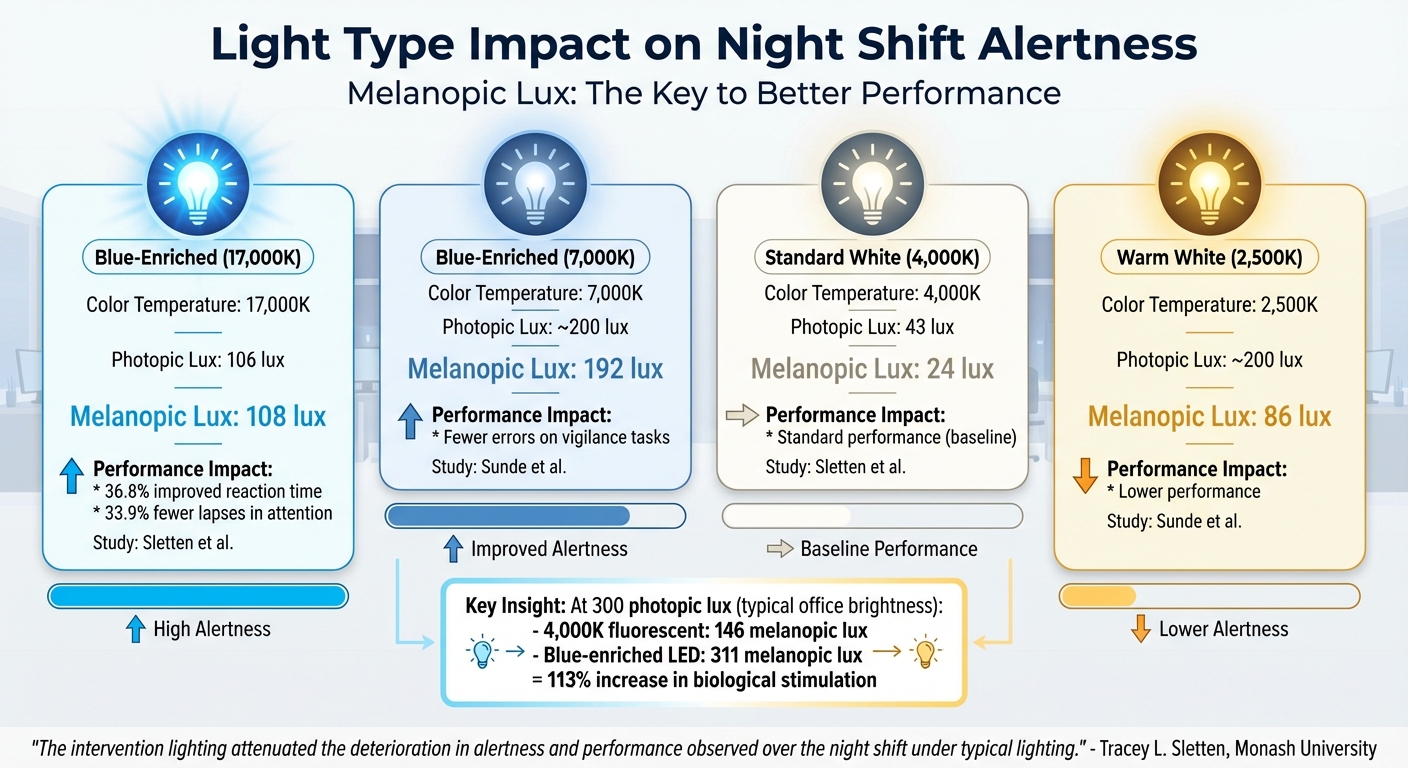
Light Type Effects on Night Shift Alertness: Melanopic Lux Comparison
The table below highlights how different light settings influence alertness, emphasizing the importance of melanopic lux, which measures how a light source affects your internal clock. Even at the same visual brightness (measured in photopic lux), the biological impact of light can vary significantly.
For instance, at 300 photopic lux (a typical office brightness), a 4,000K fluorescent light produces just 146 melanopic lux. In contrast, a blue-enriched LED at the same brightness delivers 311 melanopic lux - a 113% increase in biological stimulation. This boost can directly enhance alertness and performance.
A May 2021 study conducted at a chemical plant in Melbourne, Australia, demonstrated this effect during 12-hour night shifts. Workers exposed to a 17,000K blue-enriched light at 106 photopic lux (producing 108 melanopic lux) showed a 36.8% improvement in reaction times and a 33.9% reduction in lapses in attention compared to standard 4,000K lighting, which delivered only 24 melanopic lux at 43 photopic lux.
"The intervention lighting attenuated the deterioration in alertness and performance observed over the night shift under typical lighting." – Tracey L. Sletten, Monash University
| Light Type | Color Temp | Photopic Lux | Melanopic Lux | Alertness Impact | Study Reference |
|---|---|---|---|---|---|
| Blue-Enriched | 17,000K | 106 lux | 108 lux | 36.8% improved reaction time; 33.9% fewer lapses | Sletten et al. |
| Blue-Enriched | 7,000K | ~200 lux | 192 lux | Fewer errors on vigilance tasks | Sunde et al. |
| Standard White | 4,000K | 43 lux | 24 lux | Standard performance | Sletten et al. |
| Warm White | 2,500K | ~200 lux | 86 lux | Lower performance | Sunde et al. |
Another study, conducted between January and April 2018 at the University of Bergen, tested 30 participants during three simulated night shifts. The results showed that a 7,000K LED light at around 200 lux significantly reduced errors on performance tests compared to 2,500K warm light at the same brightness . The key factor here was the higher melanopic output, not the apparent visual brightness.
These findings underscore the importance of choosing the right type of light to maintain alertness during night shifts. By understanding how different light settings affect the body, workplaces can optimize lighting to support better performance and overall well-being.
Conclusion
Managing light exposure is a key step in adjusting your internal clock to fit an unconventional sleep schedule. The strategies discussed earlier help shift your body's natural rhythm so that your most restful sleep happens during daytime hours instead of when you're on shift.
To make this adjustment, focus on strategic light use. Start your shift with bright, blue-enriched light to promote alertness, transition to dim, warm light as your shift winds down, wear blue-blocking sunglasses during your commute home, and ensure your bedroom is completely dark while you sleep. Studies show that workers who implemented these methods improved their sleep efficiency by up to 4.6% and reduced sleep fragmentation by 4.2%.
However, light management alone might not be enough for everyone. Research from Rush University Medical Center suggests that while tools like caffeine can temporarily boost alertness, they don't address the root issue of circadian misalignment. Pairing controlled light exposure with natural sleep aids offers a more comprehensive solution, especially for those who find it hard to sleep during the day.
RST Sleep's natural supplement, featuring ingredients like extended-release melatonin, glycine, phosphatidylserine, magnolia bark, and apigenin, is designed to help you fall asleep more easily and realign your sleep cycle. This combination of strategies helps lay the groundwork for long-term adaptation.
Consistency is also crucial. Stick to a regular sleep–wake schedule, even on your days off, to avoid disrupting your progress. By integrating these methods, you can enhance your daytime sleep quality and stay alert during nighttime hours.
FAQs
What light level should I use at work?
To stay alert during your shift, use bright light with an intensity of up to 2000 lux. However, if you want to support your natural sleep cycle, avoid exposing yourself to bright light in the final two hours before bed. This simple adjustment can help your body wind down and improve the quality of your sleep.
Can I use blue blockers and still drive home safely?
Yes, you can wear blue light blocking glasses while driving home. However, some lenses might reduce visibility or create glare, which can be a safety concern, especially at night. To stay safe, opt for blue blockers specifically designed for nighttime driving and test them beforehand to ensure they don’t interfere with your vision on the road.
How do I sleep in daylight without waking up?
To get quality sleep during daylight hours, it's all about keeping light at bay and setting up a relaxing sleep environment. Start by wearing dark sunglasses on your way home to cut down on sunlight exposure, which can disrupt your body's natural rhythm. Once home, use blackout curtains or a sleep mask to ensure your room stays dark - this signals your body that it's time to wind down. Limiting daytime light exposure can make a big difference in maintaining uninterrupted, restful sleep.