

10 Tips for Better Sleep on Night Shifts
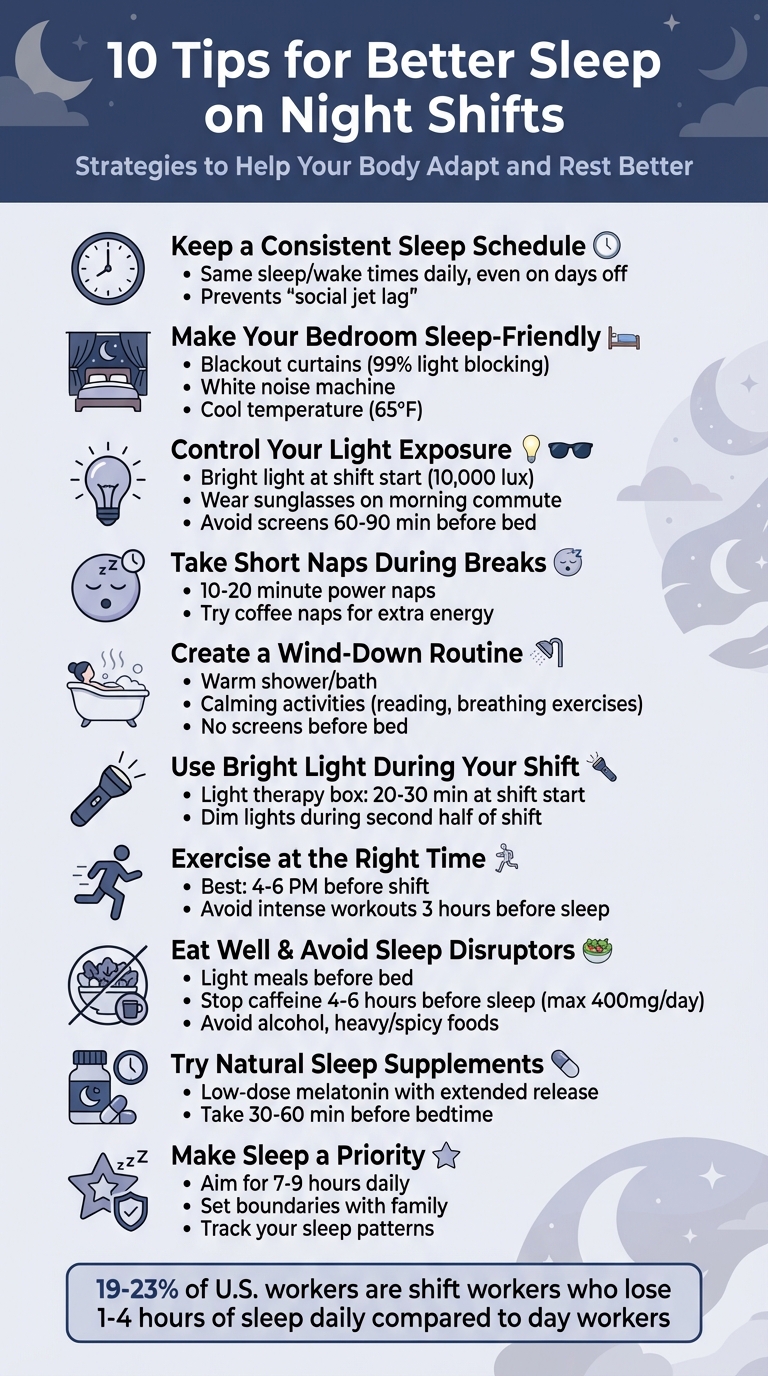
Working night shifts can wreak havoc on your sleep, making it difficult to rest during the day. But with the right strategies, you can improve your rest and feel more refreshed. Here's a quick rundown of the top tips:
- Stick to a consistent sleep schedule: Keep your sleep and wake times the same, even on days off.
- Optimize your bedroom: Use blackout curtains, white noise machines, and keep the room cool (around 65°F).
- Manage light exposure: Bright light during your shift boosts alertness; block light after work with sunglasses.
- Take short naps: 10–20 minute naps during breaks can help you stay alert.
- Wind down after work: Use calming routines like warm showers, reading, or breathing exercises.
- Use bright light strategically: Start your shift with bright light but reduce exposure later.
- Exercise at the right time: Late afternoon or early evening workouts work best.
- Eat wisely: Avoid heavy meals before bed and limit caffeine intake.
- Consider natural sleep supplements: Low-dose melatonin and other ingredients can promote better rest.
- Prioritize sleep: Set boundaries and make rest non-negotiable.
These tips can help you realign your sleep cycle and protect your health while working night shifts.
10 Essential Sleep Tips for Night Shift Workers
How to Survive Night Shifts from a Sleep Expert | Management of Shift Work Sleep Disorder
sbb-itb-5106bd1
1. Keep a Consistent Sleep Schedule
Switching between day and night routines - even on your days off - can throw your body into a state of "social jet lag." This makes it tough for your internal clock to find a steady rhythm.
"The timing of our internal clock doesn't change very quickly; it really can't change by more than an hour in either direction per day." – Catherine McCall, MD, UW School of Medicine
The best approach? Stick to the same sleep and wake times every single day, even on weekends or days off. For instance, if your night shift schedule has you sleeping from 9:00 AM to 5:00 PM, try to keep that pattern going, even when you're not working. Sure, it might feel odd to sleep while the rest of the world is buzzing, but it helps reinforce your body's night shift rhythm.
If your lifestyle demands more flexibility, a split-sleep schedule might work better. This involves dividing your rest into two blocks - like a consistent "anchor" sleep (say, 9:00 AM to 1:00 PM) paired with a second block later in the day (maybe 6:00 PM to 9:00 PM). This setup can help you balance daytime responsibilities while still maintaining overall sleep regularity.
Make sure your household understands your sleep routine. Simple things like a door sign or silencing your phone can help set boundaries and protect your rest. After all, your sleep is just as vital as anyone else's nighttime rest.
Starting with a consistent sleep schedule lays the groundwork for the other sleep strategies we'll explore next.
2. Make Your Bedroom Sleep-Friendly
Creating the right environment in your bedroom can make a big difference in how well you sleep during the day. The key factors to focus on are darkness, noise, and temperature - and achieving the right balance takes more than just pulling the blinds shut.
Darkness matters more than you think. Even small amounts of light - just 5–10 lux - can suppress melatonin production by 20–30%. To keep light levels under 1 lux, invest in 99% blackout curtains instead of standard 95%, which may not block enough light. Cover up LED lights on chargers, alarm clocks, and smoke detectors using black electrical tape. Seal any light gaps around windows with weather stripping and use a door sweep to block light from the hallway. Roger Sutherland, a certified shift work coach, suggests a simple way to check your room’s darkness:
"If you can see your hand in front of your face while lying in bed, the room is too light".
If blackout curtains aren’t enough, a 100% blackout eye mask can provide an extra layer of darkness. Once you’ve tackled light, it’s time to address sound.
Daytime noise can be tricky to manage. Intermittent sounds - like traffic, lawn mowers, or noisy neighbors - are more likely to disturb your sleep than steady background noise. A white noise machine can help mask these unpredictable sounds. Foam earplugs with a Noise Reduction Rating (NRR) of 32 are another great tool for blocking noise. Set your phone to "Do Not Disturb" mode, and coordinate with family or roommates to avoid loud activities like vacuuming or dishwashing while you're sleeping. Even a polite sign on your front door asking delivery drivers not to knock can reduce disruptions. After dealing with noise, don’t forget to fine-tune the temperature.
Temperature plays a huge role in sleep quality. The ideal bedroom temperature for sleep is around 65°F. Use fans, breathable bedding, and blackout curtains to keep the room cool. Taking a hot shower before bed can also help by triggering a drop in your core body temperature, which is essential for sleep. For shift workers who need to sleep during the day - when temperatures are often warmer - keeping the bedroom cool becomes even more important.
3. Control Your Light Exposure
Light plays a huge role in managing your sleep–wake cycle, especially if you're working night shifts. By using light in the right way, you can help your body adjust and improve your overall sleep quality. Pairing light management with a sleep-friendly environment can better align your internal clock.
Start your shift with bright light to boost alertness and suppress melatonin. This can make a big difference in adjusting your circadian rhythm. Try using a 10,000-lux light therapy box for 20–30 minutes at the beginning of your shift, or sit near bright overhead lights. As your shift progresses, gradually dim the lights during the second half to allow your melatonin levels to rise, signaling your body that it’s time to start winding down.
Your morning commute matters. After your shift, it’s crucial to limit light exposure to help your body prepare for daytime sleep. Wear dark wraparound sunglasses to block blue light during your commute. This small step can make a big difference. As Jamuna Jones and Brooks McAuliffe from University of Utah Health explain:
"Blocking out those blue wavelengths of light can help you sleep longer during the day".
However, if you’re feeling drowsy, avoid driving altogether for safety.
Limit screen time before bed. Spending 60–90 minutes away from screens can prevent melatonin suppression and help your brain transition to rest mode. If you can’t avoid screens, enable "night mode" or blue-light filters on your devices, lower the brightness, or wear blue-light-blocking glasses.
4. Take Short Naps During Breaks
Short naps are a great way to combat fatigue and stay alert during night shifts. The trick is to keep them brief - about 10 to 20 minutes works best. This duration helps you recharge without slipping into deep sleep, which can leave you groggy.
Set an alarm to make sure you wake up on time. For instance, during a 30-minute break, allow yourself 5 minutes to fall asleep and aim for a 20-minute nap. Avoid naps longer than 30 minutes, as they might lead to deep slow-wave sleep, leaving you disoriented and potentially disrupting your main sleep later.
For an added energy boost, try a coffee nap. Here's how it works: drink around 150–200 mg of caffeine right before a 15–20 minute nap. Since caffeine takes about 20 minutes to kick in, you'll wake up just as it starts working, giving you an extra jolt of energy.
Find a quiet and comfortable spot to nap, like a break room, your parked car, or a designated quiet area. Using an eye mask and earplugs can help block out distractions and make it easier to fall asleep, even in less-than-ideal surroundings. Just be cautious about napping too close to your main sleep - aim to avoid naps within 4–6 hours of bedtime to prevent trouble falling asleep later.
Incorporating short, well-timed naps into your routine can be a game changer for managing fatigue and maintaining focus during night shifts.
5. Create a Wind-Down Routine
After working a night shift, learning how to sleep better after working nights and getting your body to switch gears can feel like an uphill battle. Even though you're physically tired, your mind may still be racing, making it hard to drift off. A structured wind-down routine can help signal to your body that it's time to rest.
"Something that's not talked about enough is having a wind-down routine where you're getting ready for bed. That's just as important to do during the day as it is at night because if we don't have that wind-down routine, we're still sending signals to our brain to be active", said Dr. Catherine McCall, sleep physician and assistant professor at UW School of Medicine.
The idea is simple: ease the transition from the high-energy demands of your shift to a calm, sleep-ready state. Start by creating a clear boundary between your commute and home life. This shift in mindset is key to preparing for rest.
Once home, block out sunlight to reduce alertness. A warm shower or bath can work wonders by triggering a natural drop in body temperature, which promotes sleep. Follow this with calming activities - read a book, write in a journal, or play some soothing music. Steer clear of screens, as the blue light they emit can keep your brain wired and awake.
For those who struggle to relax, breathing exercises like the 4-7-8 technique can help. This involves inhaling for 4 seconds, holding your breath for 7 seconds, and exhaling for 8. Studies show that mindfulness practices can cut down the time it takes to fall asleep by about 12 minutes. Another effective tool is a quick 5-minute body scan meditation when you first get home. This can help you shift from alertness to relaxation more smoothly.
Consistency is key. Stick to your routine, even on your days off. Over time, your body will recognize the pattern, making it easier to fall asleep when you need it most.
6. Use Bright Light During Your Shift
Light plays a key role in signaling your body when to stay awake and when to sleep. Bright light, in particular, helps you stay alert during night shifts by suppressing melatonin - the hormone responsible for making you feel drowsy. This suppression improves reaction time, sharpens focus, and sustains energy levels, especially if you expose yourself to bright light early in your shift.
"Light is the main signal that tells your brain whether it's daytime or nighttime", explains Shift Sleep Well. "Bright light suppresses melatonin, boosting alertness and reaction time - something research consistently supports in shift workers."
If your workplace lighting is dim, using a light therapy box rated at 10,000 lux can help. Just 20–30 minutes of exposure at the start of your shift can significantly enhance your wakefulness. Position yourself near bright overhead lights and avoid spending breaks in dark areas to maintain your energy. This approach not only helps you stay alert but also supports your body's adjustment to a night shift schedule.
However, it's important to reduce bright light exposure during the latter half of your shift. Dr. Catherine McCall, a sleep physician at UW School of Medicine, explains, "The timing of our internal clock doesn't change very quickly; it really can't change by more than an hour in either direction per day". If you're exposed to bright light too late, it can disrupt your ability to fall asleep when you get home. Treat light as a tool to align your alertness with your work hours, working in tandem with other strategies to adjust your sleep cycle effectively.
7. Exercise Regularly at the Right Time
Staying active can improve your sleep quality, but for night shift workers, when you exercise matters just as much as the activity itself. The best time to work out is in the late afternoon or early evening - around 4:00 to 6:00 PM - before your shift starts. Exercising during this window can help shift your circadian rhythm, keeping you more awake during work hours and promoting better daytime sleep.
On the flip side, avoid intense workouts right after your shift or within three hours of your planned sleep time. Vigorous exercise raises your core body temperature, which can take hours to return to normal. Since your body needs to cool down to fall asleep, late-night workouts might make it harder to rest. This approach ties into earlier tips about managing light exposure and sticking to a regular sleep routine.
If you need to exercise after your shift, stick to low-intensity activities like stretching, yoga, or a relaxed walk. For moderate-intensity workouts, aim to finish at least 90 minutes before bedtime to give your body time to cool down and your endorphin levels to settle. Properly timed exercise works hand-in-hand with light exposure and a consistent sleep schedule to support your body's rhythm. On your days off, consider a morning workout to help reset your internal clock to a more typical schedule.
During work breaks, short bursts of movement - like a quick walk or a few stretches - can give you an energy boost and improve focus without interfering with your post-shift sleep. Tailoring your exercise routine to your sleep schedule can make a big difference in how well-rested and alert you feel.
8. Eat Well and Avoid Sleep Disruptors
Your eating habits can play a big role in how well you sleep, especially if you work night shifts. During overnight hours, your body processes food differently - digestion slows down, and insulin sensitivity drops, making it harder to handle heavy fats and carbs effectively.
To keep your energy levels steady, try having an anchor meal about 1–2 hours before your shift. A balanced option like grilled chicken with brown rice or salmon with quinoa works well. Throughout your shift, snack on small amounts of protein every 3–4 hours - think Greek yogurt with berries. After your shift, stick to a light meal, such as oatmeal topped with nuts, within 30–60 minutes.
Avoid heavy, fried, or spicy foods before bed. These can slow digestion, increase gastric pressure, and even trigger acid reflux. Spicy foods, in particular, can raise your core body temperature, making it harder to fall asleep. Sugary snacks are another no-go; they cause blood sugar spikes followed by crashes, which can wake you up during the night. Additionally, diets high in ultra-processed foods are linked to poorer sleep quality overall.
Be mindful of caffeine. Limit caffeine intake to the early part of your shift and stop consuming it at least 4–6 hours before you plan to sleep. For example, a cup of coffee at 3:00 AM can still affect you until 7:00–8:00 AM. Stick to no more than 200 mg per serving and cap your daily intake at 400 mg.
When it comes to alcohol, skip the nightcap. While it might help you fall asleep initially, it disrupts REM sleep and acts as a stimulant as your body metabolizes it. This can wake you up later, as Robon Vanek, APRN, CNP, from Cleveland Clinic explains:
"It might help you fall asleep, but it interferes with REM sleep. Then, as it metabolizes out of your system, it turns to a stimulant that can wake you up".
Instead, stay hydrated with water during your shift but taper your intake in the final 2–3 hours. This helps minimize bathroom trips, which can interrupt your sleep during the day. By pairing these nutritional strategies with other sleep tips, you can create a well-rounded approach to improving your daytime rest.
9. Try Natural Sleep Supplements Like RST Sleep
Sometimes, making lifestyle changes isn’t enough to fix sleep issues, especially for night shift workers. That’s where a natural sleep supplement can help. Unlike typical sleep aids that often rely on high doses of melatonin or antihistamines, RST Sleep was created by medical doctors with over 25 years of experience in shift work. It’s specifically designed to address the unique challenges faced by those working irregular hours.
The formula combines glycine, phosphatidylserine, magnolia bark, apigenin, and an extended-release, low-dose melatonin. Together, these ingredients help lower your core body temperature, balance cortisol levels, encourage relaxation, and maintain steady melatonin levels throughout the night. Unlike standard supplements that deliver a large 3–10 mg melatonin spike, which often wears off quickly, RST Sleep avoids this issue, reducing the likelihood of waking up in the middle of the day.
"A giant spike [of melatonin] knocks you out but fades in a few hours. That's why you're wide awake again at 2 PM."
The results speak for themselves. Users like Brian, 38, saw his sleep score jump from 47 to 95, describing the supplement as a "game changer". Jennifer, 40, shared that she felt relaxed within 30–45 minutes and slept through the night without interruptions. Importantly, RST Sleep is non-habit forming and doesn’t include sedatives that can interfere with the deep sleep stages essential for memory and recovery. It works seamlessly with other sleep strategies to improve rest quality for night shift workers.
For the best results, take RST Sleep 30–60 minutes before bedtime. Pair it with blackout curtains, white noise, and a cool room (65–68°F). By combining RST Sleep with these proven sleep environment tips, you’ll support your body’s natural ability to recover and recharge after demanding night shifts.
10. Make Sleep a Priority
Once you've fine-tuned your environment, adjusted your light exposure, and established healthy routines, the next step is to treat sleep as non-negotiable. Night shift work can throw your internal clock off balance, making quality sleep essential for both your health and safety. In the U.S., roughly 19% to 23% of the workforce are shift workers, and those on rotating shifts lose between 1–4 hours of sleep each day compared to traditional day workers. To put it into perspective, staying awake for 24 hours can impair your cognitive performance as much as having a blood alcohol level of 0.10.
To protect your sleep, start by setting clear boundaries with those around you. For instance, displaying your shift calendar at home can help signal when you'll be resting. Encourage family or roommates to avoid noisy activities like vacuuming, running the dishwasher, or blasting the TV during your sleep hours.
"Prioritize getting seven to nine hours of sleep every day. For the majority of people, getting six hours or fewer will lead to sleep deprivation."
– Robon Vanek, APRN, CNP, Cleveland Clinic
It's also important to say no to daytime social plans or errands that interfere with your rest. If possible, delegate household chores to others to ensure your sleep isn't compromised. This isn't just about feeling rested - it's about protecting your long-term health. Chronic sleep deprivation among shift workers has been linked to higher risks of heart disease, stroke, diabetes, obesity, and even certain types of cancer.
"Prioritizing sleep isn't a luxury, it's a necessity if you want to thrive in the challenging world of shift work."
– Roger Sutherland, Coach and Advocate for Shift Workers
Conclusion
Working night shifts doesn't mean you have to sacrifice your health or quality of sleep. By applying the strategies discussed - like managing light exposure, sticking to a consistent schedule, crafting a sleep-friendly environment, and trying natural sleep aids - you can help your body adapt to your work hours. The key here is consistency, as your circadian rhythm adjusts gradually, often by no more than one hour per day[14,18].
Take it step by step and give your body time to adapt. It might take anywhere from a few days to two weeks to settle into a new routine. Not every method will work for everyone, so experiment to find what suits your lifestyle best. Tracking your sleep patterns can also help you identify which habits are most effective.
If you're still struggling after trying these approaches for three months or more, it might be time to consult a sleep specialist. Persistent issues like insomnia or excessive daytime sleepiness could point to Shift Work Sleep Disorder (SWSD), which affects 10% to 40% of shift workers, or another condition that needs professional attention.
Getting quality sleep is more than just a luxury - it's essential for your long-term health. Chronic sleep deprivation can lead to serious health risks, so prioritizing your rest is one of the most important forms of self-care.
As Roger Sutherland, a Shift Work Coach, wisely puts it:
"If you create the environment, your body will take care of the rest."
– Roger Sutherland
FAQs
How long does it take to adjust to night-shift sleep?
Adjusting to a night-shift sleep routine typically takes about 1 to 2 weeks. To help your body adapt during this period, it's important to set a consistent sleep schedule and carefully manage your exposure to light. Creating a dark and quiet space for rest, along with maintaining regular sleep patterns, can make the transition smoother.
What’s the best way to handle rotating shifts and days off?
To handle rotating shifts and days off efficiently, stick to a schedule that minimizes consecutive night shifts - ideally no more than three in a row - and allows for at least three days of recovery afterward. Rotating shifts in a clockwise pattern (day to evening to night) can better align with your natural circadian rhythm. Also, avoid sudden schedule changes and ensure there’s enough recovery time between shifts to promote better sleep and maintain a healthier work-life balance.
When should I see a doctor for shift-work sleep problems?
If you're dealing with ongoing issues like severe insomnia, constant fatigue, trouble concentrating, or health concerns linked to poor sleep, it's time to see a doctor. When adjustments like controlling light exposure, setting up a comfortable sleep space, or trying natural remedies don't improve your situation, reaching out to a healthcare professional is essential. These problems could signal shift work disorder or another condition that needs medical attention and care.