

Checklist for Choosing GMP-Certified Sleep Supplements
A “GMP Certified” label alone is not enough. If I were buying a sleep supplement, I’d check three things first: the GMP claim, the batch testing, and whether the formula fits my sleep schedule.
Here’s the short version:
- Verify the GMP claim with the named certifier, current status, and the exact facility address.
- Check lot testing for potency plus screens for heavy metals, microbes, and residual solvents.
- Read the Supplement Facts panel for exact ingredient names, serving size, and doses in mg or mcg.
- Match the formula to your sleep window, especially if you sleep during the day or work rotating shifts.
- Ignore vague label lines like “made to GMP standards” unless the brand can show proof.
One stat stands out: in a 2017 review of 31 melatonin supplements, actual melatonin content ranged from 83% below to 478% above the label. That’s a big gap for something taken night after night.
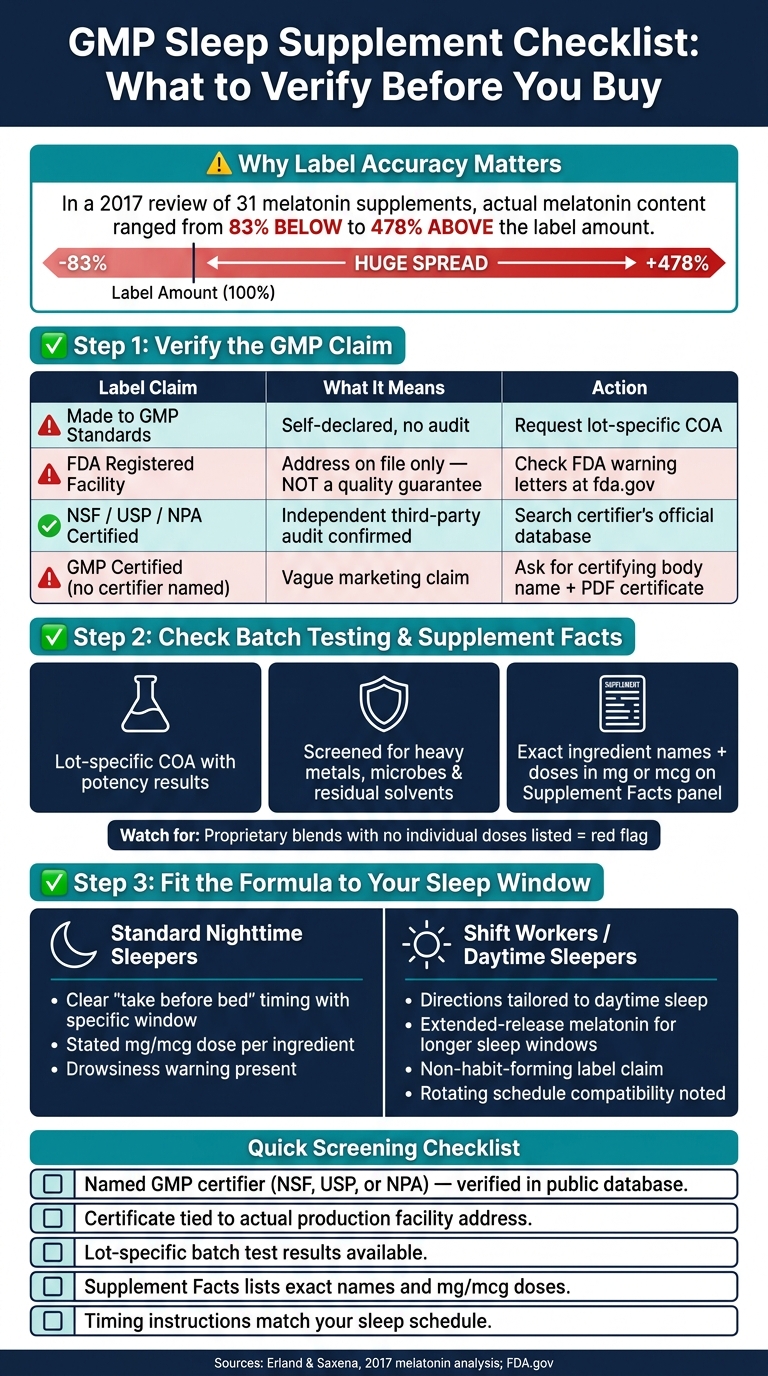
GMP Sleep Supplement Checklist: What to Verify Before You Buy
Sleep Scientist Reveals the BEST Supplements for Sleep (and Which 2 to Avoid)
sbb-itb-5106bd1
Quick comparison
| Check | What I’d look for | Red flag |
|---|---|---|
| GMP claim | Named certifier like NSF, USP, or NPA | “GMP Certified” with no certifier named |
| Facility details | Current certificate tied to the actual production site | Corporate office listed instead of the plant |
| Testing | Lot-specific results for potency and contaminants | No batch proof available |
| Label details | Exact ingredients and doses in mg/mcg | Blends or missing amounts |
| Sleep fit | Clear timing directions and warnings | Generic “take before bed” wording |
If I wanted a fast way to screen a product, this is the checklist I’d use before I buy.
Checklist Item 1: Confirm Real GMP Certification
Not every "GMP Certified" claim means much. Some labels use fuzzy wording like "made to GMP standards". That line is self-declared. It does not mean an outside group checked the facility.
A real GMP certification is different. It means a named third party - such as NSF, USP, or NPA - audited the manufacturing site on its own. That's the line between a checked claim and a marketing line.
Check the Certifier Name, Facility Scope, and Audit Status
Start with the certifier's name on the label or product page. If you see a generic "GMP Certified" badge with no group named, treat that as a red flag.
Then check the date. A current certification matters. An expired one doesn't tell you much about how the facility is operating now.
You also need to check the scope. This part gets missed all the time. A facility might be GMP-certified for one dosage form, like capsules, but not for another, like gummies or softgels. So if you're buying a sleep gummy, make sure the certificate says it covers gummies. Don't assume one format covers every product coming out of that building.
Next, look in the certifier's public database. And match the facility address on the certificate to the actual production site. A corporate office or sales address doesn't count.
"FDA Registered Facility" is another phrase people often read the wrong way. It is not a quality guarantee. It only means the facility's address is on file with the FDA for inspection purposes.
Label Verification Table: GMP Claims Side by Side
Use the table below for a fast label check.
| Label Claim | Meaning | Check |
|---|---|---|
| "Made to GMP standards" | Self-declared; no independent audit required | Request a lot-specific COA |
| "FDA Registered Facility" | The facility address is on file with the FDA, but this is not a quality guarantee | Check for FDA warning letters at fda.gov |
| "NSF/USP/NPA Certified" | An independent body audited the facility's quality systems | Search the certifier's official online database using the brand or facility name |
| "GMP Certified" (no certifier named) | Vague marketing; often refers to internal policies only | Ask the brand for the certifying body's name and a PDF of the certificate |
Why does this matter so much? Because label accuracy can swing a lot. In a 2017 analysis of 31 melatonin supplements, actual melatonin content ranged from 83% below to 478% above the labeled amount.
That's a huge gap for something people take night after night. The goal here is simple: stick with labels you can verify, not labels that ask you to take their word for it.
Checklist Item 2: Review Third-Party Testing and the Supplement Facts Panel
GMP tells you how a supplement was made. Finished-product testing tells you what’s actually in the bottle. So after you verify the GMP claim, move to the finished batch itself.
Look for Lot Testing, Potency Checks, and Contaminant Screening
Start with the basics: look for a lot number and proof of batch testing. Then confirm the product was checked for potency and screened for heavy metals, microbes, and residual solvents. After that, compare those results with the Supplement Facts panel.
Read the Label for Exact Ingredient Names and Doses
Read the Supplement Facts panel closely. Check the serving size and servings per container first. Then review each active ingredient to make sure its exact name and dose appear in mg or mcg.
Also check Other Ingredients for allergens. For melatonin, confirm both the amount and the release type. That detail matters more than many people think.
Example: What to Verify on an RST Sleep Label
A label like RST Sleep's should make this pretty simple. RST Sleep lists its ingredients one by one, including glycine, phosphatidylserine, magnolia bark, extended-release melatonin, and apigenin.
The label should clearly state extended-release melatonin, not just melatonin in general. Then review Other Ingredients to verify the allergen-conscious formula, and confirm the GMP-certified manufacturing claim by using the steps from Checklist Item 1. Last, use lot-specific test results to match the label to the batch.
Checklist Item 3: Make Sure the Formula Fits Your Sleep Schedule and Safety Needs
After you check the label, make sure the formula fits your actual sleep routine and safety needs. A GMP-certified product can still be the wrong pick if its timing, sleep quality vs. duration, or side effects don't line up with your day.
Check Timing Instructions, Dose Clarity, and Non-Habit-Forming Claims
The label should tell you exactly when to take it based on your sleep window. Vague directions like "take before bed" don't help much, especially if you sleep during the day.
You also want a stated dose in mg or mcg for each active ingredient. If the dose isn't clear, it's hard to know what you're taking or compare one product to another.
Check for:
- a clear drowsiness warning
- a non-habit-forming label claim if you may need to wake up, drive, or work soon after sleeping
Once the dosing and warning details look good, the next step is simple: does the formula help you fix your sleep cycle for a day-sleep or rotating-shift routine?
Look for Support for Daytime Sleep or Rotating Schedules
Shift workers need formulas built for daytime sleep and rotating schedules, not just standard nighttime use. That's a big deal. A product made with only nighttime sleepers in mind may not line up with the kind of rest shift workers are trying to get.
For irregular schedules, extended-release melatonin can help support a longer daytime sleep window. RST Sleep is designed for night shift workers and irregular sleep schedules, with extended-release melatonin in its formula.
When a formula matches your schedule, it's simply easier to use on a steady basis.
Conclusion: A Simple Buying Checklist for Better Sleep Support
Use these three checks to make the final call: verified quality, clear labeling, and a formula that fits your sleep window.
Start with third-party testing. You want proof of potency and screening for contaminants. Then look at the Supplement Facts panel and make sure each active ingredient appears by its exact name and dose in mg or mcg. If you see vague blends or missing doses, treat that as a red flag, no matter what the front label says.
For shift workers, that often means a formula made for daytime sleep and irregular schedules. The goal is simple: match the formula to your actual sleep window. RST Sleep is formulated for night shift workers, irregular sleep schedules, and GMP-certified manufacturing.
Use this checklist to compare labels fast:
| What to Check | What to Look For |
|---|---|
| GMP Certification | Clear, verifiable GMP certification |
| Third-Party Testing | Potency verification and contaminant screening |
| Supplement Facts Panel | Exact ingredient names and mg/mcg doses per serving |
| Timing, dose, safety | Clear dosing instructions and non-habit-forming formula |
| Fit for daytime sleep or rotating shifts | Daytime sleep support and options suited to shift work |
Quality and transparency aren't extras. They're the baseline for any supplement you plan to use on a regular basis. A little checking up front can save a lot of guesswork later.
FAQs
How do I verify a GMP certificate?
Ask the manufacturer for the official GMP certification documents. Valid certificates come from regulatory bodies or recognized third-party auditing groups.
Make sure the certificate is current, covers the exact manufacturing facility, and lists a registration number that matches the issuer’s official database. You can also confirm the details with the manufacturer’s quality assurance or compliance team.
What should a batch test report include?
A batch test report should show that a product meets set quality and safety standards. In plain terms, it tells you which batch was tested, what standards were used, and what the lab found.
The report should make it clear that the supplement meets specs for purity, potency, and safety under GMP-certified manufacturing protocols.
How do I choose a formula for shift work?
For shift work, pick a formula made for circadian misalignment - when you’re trying to sleep at times your body clock doesn’t expect.
That matters because irregular sleep-wake cycles can clash with your internal body clock and make it harder to wind down when you need to.
Look for ingredients that support relaxation and help you fall asleep on demand. It also helps to choose a product made in GMP-certified facilities so quality stays consistent. RST Sleep is designed for night shift and irregular schedules, and it’s made in GMP-certified facilities.