

Sleep Deprivation in Shift Work: Causes and Effects
Shift work disrupts your body's natural sleep-wake cycle, leading to chronic sleep deprivation. This can cause serious health problems, including heart disease, diabetes, and mental health challenges like depression and anxiety. Night shift workers are especially vulnerable, with over 60% reporting insufficient sleep. Key causes include circadian rhythm disruption, demanding schedules, and environmental factors like noise and light exposure during daytime rest.
Key Takeaways:
- 25% of U.S. workers have non-traditional schedules; 4.4% work night shifts.
- 61.8% of night shift workers get less than 7 hours of sleep.
- Sleep deprivation increases risks for heart disease, diabetes, and cognitive decline.
- Effective strategies include forward-rotating schedules, blackout curtains, and melatonin supplements.
Addressing these challenges requires changes at both the workplace and personal levels. Employers can adjust schedules and lighting, while workers can improve sleep hygiene and consider natural sleep aids, like melatonin, to support better rest.
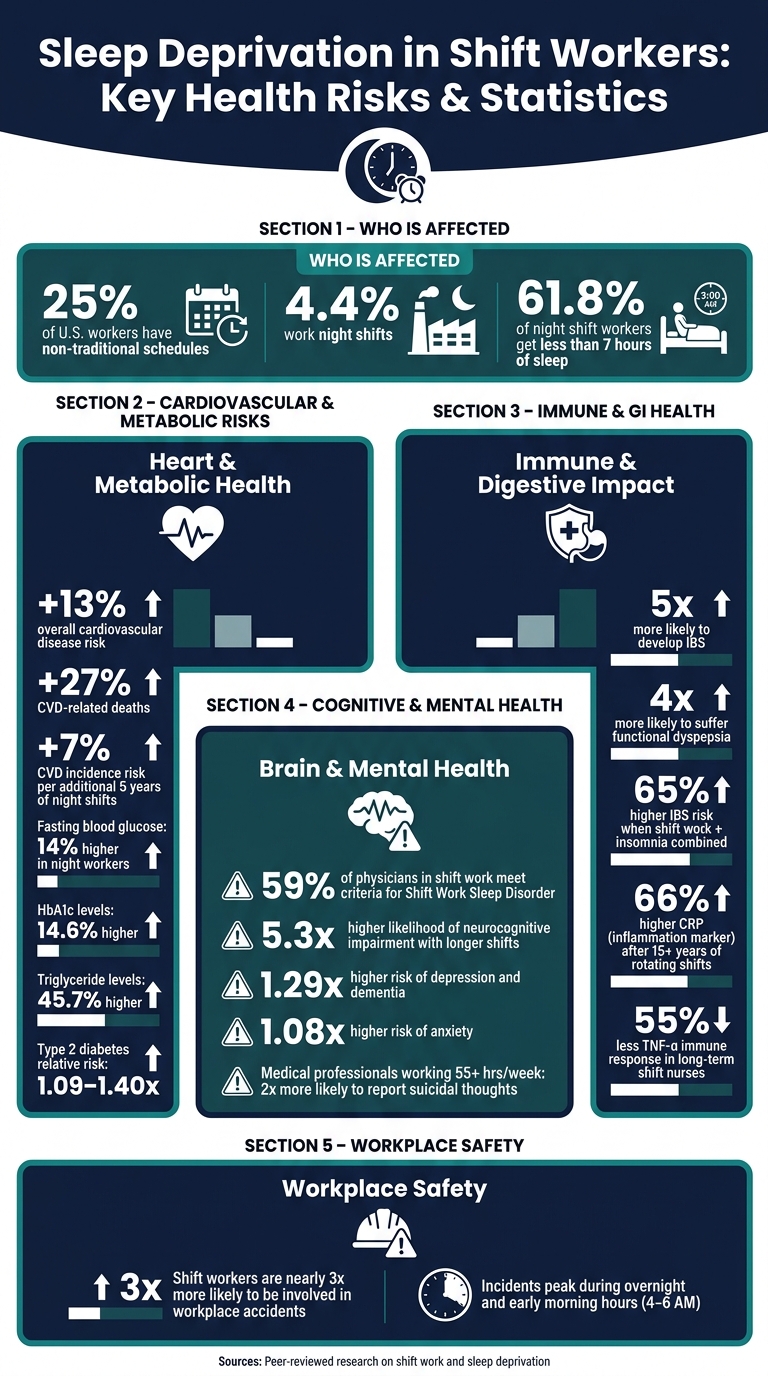
Sleep Deprivation in Shift Workers: Key Health Risks & Statistics
Sleep and Shift Work: Implications for Worker Health and Safety
sbb-itb-5106bd1
Causes of Sleep Deprivation in Shift Work
Let's dig into why sleep deprivation is so common among shift workers. It boils down to three main culprits: biological rhythms, demanding schedules, and environmental challenges.
Circadian Rhythm Disruption
The body’s internal clock, managed by the suprachiasmatic nucleus (SCN) in the brain, operates on a 24-hour cycle and relies heavily on light cues to regulate sleep and wakefulness. Shift work, especially at night, throws this system completely off track.
Night shifts expose workers to artificial light, which suppresses melatonin - the hormone that signals it’s time for sleep. Over consecutive shifts, this suppression builds up. Meanwhile, cortisol, the hormone that helps us wake up, gets out of sync. Rotating shift workers often experience a weaker cortisol awakening response.
And here’s the kicker: the circadian system can only adjust by about one hour per day. So, while the central clock in the brain might partially adapt, other body systems lag behind, causing internal desynchronization.
"The circadian system is resistant to adaptation from a day- to a night-oriented schedule, as determined by a lack of substantial phase shifts over multiple days in centrally controlled rhythms, such as those of melatonin and cortisol."
This biological struggle is only made worse by the structure of shift schedules.
Work Schedules and Job Demands
Not all shifts are created equal when it comes to disrupting sleep. Night shifts, which typically run from 11:00 PM to 7:00 AM or 7:00 PM to 7:00 AM, are especially tough because they force workers to stay awake during the circadian nadir. This is the period between 3:00 AM and 5:00 AM when the body’s natural urge to sleep is strongest.
Rotating schedules add even more complexity. These schedules don’t allow the body to settle into a consistent rhythm. Backward rotations - switching from nights to evenings to days - are especially tough, as they go against the body’s natural adjustment pattern. Another issue is "quick returns," where workers have less than 11 hours between shifts. These tight turnarounds are linked to higher risks of insomnia and shift work disorder. Following a sleep schedule checklist for irregular workers can help mitigate these risks. Research involving 288 nurses revealed that working more than 24 hours of shifts over four weeks significantly worsened sleep quality.
Environmental and Social Barriers to Sleep
Even when shift workers carve out time to rest, their surroundings often work against them. Why you can't sleep after night shifts is a common struggle when sunlight, traffic noise, and household activity disrupt the dark, quiet environment the brain craves for quality sleep. The commute home after a night shift doesn’t help either - exposure to morning sunlight lowers melatonin levels just when workers need it most.
Once home, many face additional hurdles like family responsibilities - childcare, chores, or social commitments - that eat into their already limited sleep window. As one clinical review pointed out:
"Shift work commonly leads to challenges in maintaining social and family involvement due to scheduling conflicts. The deterioration of family and social involvement, coupled with the effects of circadian misalignment and sleep disruption, sets the stage for many mental health concerns."
On top of that, irregular hours disrupt eating habits. Workers often turn to convenience foods during overnight shifts, as healthier options are usually unavailable. These combined factors not only rob shift workers of sleep but also set the stage for broader health issues - both physical and mental.
Effects of Sleep Deprivation on Physical Health
The physical toll of disrupted sleep patterns goes far beyond simple tiredness, often leading to serious health problems. For shift workers, environmental and social factors not only interfere with sleep but also trigger long-lasting physiological changes that may persist even after their night shifts end.
Cardiovascular and Metabolic Risks
Night shift work is linked to a 13% increase in overall cardiovascular disease (CVD) risk and a 27% rise in CVD-related deaths. For every additional five years of night shifts, the risk of CVD incidence grows by 7%, and mortality risk increases by 4%. Even a short-term disruption, such as a three-day inverted sleep–wake cycle, can raise systolic blood pressure by 3.0 mmHg, diastolic pressure by 1.5 mmHg, and inflammatory markers by as much as 29%.
"Circadian misalignment per se increases blood pressure and inflammatory markers... [which] may help explain why shift work increases hypertension, inflammation, and cardiovascular disease risk." - PNAS
Metabolic health takes a hit too. Night workers show fasting blood glucose levels that are 14% higher, HbA1c levels that are 14.6% higher, and triglyceride levels that are a staggering 45.7% higher compared to day workers. The relative risk of developing type 2 diabetes for shift workers ranges between 1.09 and 1.40, and these risks can linger even after night shifts are discontinued.
These cardiovascular and metabolic changes often ripple out to affect other systems, including digestive and immune functions.
Gastrointestinal and Digestive Problems
Circadian disruption also wreaks havoc on gastrointestinal health. Night shift workers are about five times more likely to experience irritable bowel syndrome (IBS) and four times more likely to suffer from functional dyspepsia compared to the general population.
"Night shift workers experience substantially higher rates of irritable bowel syndrome and functional dyspepsia than those reported in the general population." - C. Pennaneach, Faculty of Health, Institut Agro Rennes-Angers
Sleep deprivation weakens the intestinal barrier by reducing key tight junction proteins like Claudin, Occludin, and ZO-1, leading to increased gut permeability - commonly referred to as "leaky gut". It also disrupts gut microbiota, depleting beneficial bacteria such as Akkermansia and Faecalibacterium. Workers juggling both shift work and insomnia face a 65% higher risk of developing IBS compared to those with regular schedules and healthy sleep patterns.
Weakened Immune Function
Chronic sleep loss can also compromise the immune system. Rotating shift workers with more than 15 years of exposure show 66% higher concentrations of C-reactive protein (CRP), a marker of persistent low-grade inflammation, compared to day workers.
A 2025 study revealed that immune cells from long-term rotating-shift nurses produced 55% less TNF-α when challenged, compared to those from day-shift workers.
"Altogether, our results point to intricate response patterns of immune rhythms to circadian misalignment and sleep debt in night shifters. Specifically, these altered pattern expressions of immune cells may increase vulnerability to infections and reduce vaccination efficiency in night workers." - Brice Faraut, Université Paris Cité
Additionally, mistimed increases in IL-6 levels could promote autoimmune responses, while gradual rises in neutrophil and monocyte counts over the years indicate sustained systemic immune activation.
Effects of Sleep Deprivation on Cognitive Function and Mental Health
Chronic sleep deprivation doesn't just take a toll on physical health - it also deeply impacts cognitive abilities and mental well-being. For shift workers, whose schedules often conflict with natural sleep rhythms, the effects can be even more pronounced, affecting their mood, focus, and overall performance.
Declines in Cognitive Performance
When sleep is compromised, so is the brain's ability to function effectively. Sleep deprivation disrupts focus, slows down the processing of information, and interferes with memory formation. Shift workers are particularly at risk because their schedules often require them to stay awake during the biological night, a time when the body naturally craves rest.
"Shift work is associated with increased human operational errors, presumably due to the circadian timing system that inhibits optimal cognitive function during the night." - Scientific Reports
The hours between 4:00 AM and 6:00 AM are especially challenging. During this period, workers experience "wake-state instability", a phenomenon characterized by brief lapses in attention, slower reaction times, and an uptick in errors. Interestingly, reaction speed tends to suffer more than accuracy, as individuals unconsciously slow down their responses to maintain precision.
One study involving 230 physicians revealed that 59% met the criteria for Shift Work Sleep Disorder. Moreover, those working longer shifts with more than two on-call duties had a 5.3 times higher likelihood of experiencing neurocognitive impairments.
What’s troubling is that many shift workers feel alert despite measurable declines in their performance. This disconnect between perceived and actual performance not only exacerbates cognitive challenges but also contributes to mental health struggles. Emotional stability and resilience to stress are often the first to falter under sleep deprivation.
Mental Health Effects
The impact of sleep deprivation on mental health goes far beyond mere tiredness. Shift work has been strongly linked to increased rates of depression, anxiety, burnout, and even suicidal thoughts. For instance, shift workers face a 1.29 times higher risk of both depression and dementia, along with a 1.08 times higher risk of anxiety. These mental health challenges are particularly pronounced among those with rotating or irregular work schedules.
"The depressive symptoms of shift workers are associated with sleep problems. The effects of sleepiness on depression were more prominent in shift workers than non-shift workers." - Journal of Psychiatric Research
Burnout, which manifests as emotional exhaustion and detachment, is another major concern. Medical professionals working over 55 hours per week are twice as likely to report suicidal thoughts compared to those with shorter schedules. Long-term exposure to irregular work hours has even been linked to structural changes in parts of the brain that govern decision-making, emotional control, and memory.
Workplace and Public Safety Risks
The combined effects of cognitive and mental health impairments create serious risks, not just for workers but for the public as well. Shift workers are nearly three times more likely to be involved in workplace accidents than their daytime counterparts, with incidents peaking during overnight and early morning hours. High rates of insomnia among shift workers further increase the likelihood of errors on the job.
What’s particularly concerning is that workers often underestimate how impaired they are. This overconfidence can lead them to take on critical, safety-sensitive tasks despite being in a compromised state, turning their personal challenges into broader public safety hazards.
Ways to Reduce Sleep Deprivation in Shift Work
Tackling sleep deprivation in shift work demands a mix of organizational changes and personal adjustments. The serious health risks - like heart issues, cognitive struggles, and mental health challenges - highlight the need for practical, research-backed strategies.
Workplace Schedule and Environment Changes
Employers play a major role in improving sleep for shift workers. One effective approach is adopting forward-rotating schedules. This means workers transition from day shifts to evening shifts, then to night shifts (rather than the reverse). This pattern aligns better with the body's natural rhythm, reducing fatigue during shifts.
Limiting work shifts to no more than 16 hours can also help. Studies show this can add about 0.73 hours of sleep per day - a small but meaningful boost over time.
Lighting adjustments can make a huge difference too. Using blue-enriched lighting (1,500–10,000 lux) during the first half of night shifts keeps workers alert and helps their bodies adapt. Toward the end of the shift, dimming the lights signals the body to wind down for sleep. Research has shown light therapy can significantly improve sleep quality for night shift workers (effect size: Hedges' g = 0.86).
Scheduled naps during long shifts are another effective strategy. For example, medical residents who incorporated naps extended their total sleep from 1.98 to 2.86 hours per shift. However, workers should account for the grogginess, or "sleep inertia", that can occur immediately after waking before tackling critical tasks.
While these workplace changes are important, individual habits also play a key role in improving sleep quality.
Personal Sleep Hygiene Practices
Good sleep hygiene is essential for shift workers to get restorative rest, especially during the day. Small adjustments can make a big difference.
Blocking light is one of the simplest and most effective strategies. Wearing sunglasses on the way home after a night shift reduces exposure to sunlight, which can suppress melatonin and make falling asleep harder. At home, blackout curtains and a quiet environment can help mimic nighttime conditions, creating an ideal sleep setting.
Caffeine and alcohol consumption also need careful timing. Since caffeine stays in the body for 6–8 hours, it’s best avoided at least 6 hours before bedtime. Alcohol, though it might seem relaxing, disrupts deep sleep and should be avoided within 3 hours of sleep.
On days off, completely switching back to a daytime routine can disrupt circadian rhythms. Instead, maintaining a slightly adjusted schedule - even on rest days - helps support the body’s internal clock.
"A shift worker should try to obtain at least 7 h of sleep in a dark and quiet environment, except for the morning on his 1st day off after consecutive night shifts, when he should sleep somewhat shorter to build up sleep pressure for the following night." - Alexandros Kalkanis, Department of Respiratory Diseases, University Hospitals Leuven
How Nutraceuticals Can Support Sleep
When schedule changes and sleep hygiene aren’t enough, natural supplements can help regulate sleep cycles. Melatonin is one of the most researched options for shift workers.
A 2023 study at Roozbeh Psychiatric Hospital (Tehran University of Medical Sciences) tested 5 mg of immediate-release melatonin taken 30 minutes before sleep after shifts. The results were striking: by week four, 75.8% of participants taking melatonin reported remission of sleep disorders, compared to only 34.4% in the placebo group. The melatonin group also showed fewer memory lapses, better attention, and improved motor function at work.
"Melatonin was safely and tolerably superior to placebo in treating patients with sleep disorders following shift work in the short term. Evidence also shows its effects on improving occupational cognitive performance in the medium term." - Sajad Khanjani, Research Center for Cognitive & Behavioral Sciences in Police
Melatonin isn’t just a sleep aid - it acts as a chronobiotic, meaning it helps adjust the body’s internal clock. Taken in the morning after a night shift, it can shift the circadian rhythm to better align with an irregular sleep schedule.
For a more comprehensive approach, products like RST Sleep offer specialized formulas for people with erratic schedules. Their blend includes extended-release melatonin, glycine, phosphatidylserine, magnolia bark, and apigenin - all chosen for their roles in promoting relaxation and improving sleep. The extended-release format is particularly useful for sustaining sleep throughout a full rest period. Plus, it’s non-habit forming and produced in GMP-certified facilities, ensuring quality and safety.
Conclusion
Sleep deprivation among shift workers is a pressing health concern, stemming from the clash between irregular work hours and the body’s natural circadian rhythms. Around 25% of U.S. adults work in shifts, and this group faces nearly three times the risk of workplace accidents, alongside increased rates of cardiovascular disease, metabolic syndrome, and mental health challenges. These statistics highlight the importance of addressing this issue through a mix of organizational and individual strategies.
There’s no single fix for this problem. Research indicates that lasting improvements come from a comprehensive approach that combines workplace policies, personal habits, and natural sleep aids. Key elements include adjusting work schedules for better alignment with natural sleep patterns, creating conducive sleep environments, and maintaining consistent routines.
Amber F. Tout from Warwick Medical School emphasizes the importance of this dual approach:
"Organisation-level (e.g., shift schedules, workplace culture) and individual-level factors (e.g., cognitions and behaviours) contribute to sleep problems, early interventions addressing both are likely to be of greater benefit for this population." - Amber F. Tout, Warwick Medical School
In addition to these strategies, natural sleep supplements can play a supportive role in improving sleep quality. For instance, RST Sleep offers a specially formulated product designed for those with irregular schedules. It combines extended-release melatonin with ingredients like glycine, phosphatidylserine, magnolia bark, and apigenin, all aimed at promoting relaxation and restorative sleep. By integrating optimized scheduling, consistent sleep hygiene, and supplements like RST Sleep, shift workers can take meaningful steps toward achieving better sleep and overall well-being.
FAQs
How do I know if I have shift work sleep disorder?
Shift work sleep disorder occurs when your work schedule interferes with your natural sleep-wake cycle, leading to persistent insomnia, excessive tiredness, or both. For this to be considered a disorder, symptoms must last for at least three months and have a noticeable impact on your daily life. To diagnose this condition, healthcare providers often recommend keeping a detailed sleep journal for two weeks. This helps track your sleep patterns, wake times, and overall restfulness while also ruling out other potential causes.
What’s the best way to adjust my sleep on days off?
To keep your sleep pattern steady on your days off, try to limit changes in your schedule to just 1–2 hours. Avoid drastically flipping your routine, especially if you'll be back on night shifts soon. If you're transitioning to a daytime schedule, adjust your bedtime and wake time gradually. Morning light exposure can also help reset your internal clock. You might also explore natural supplements, such as those containing extended-release melatonin and apigenin, to promote relaxation and support a healthy sleep cycle.
When should I take melatonin after a night shift?
Research indicates that taking melatonin roughly 30 minutes before your intended bedtime after a night shift can help you fall asleep faster and improve sleep quality, even with an irregular schedule. Studies have tested doses ranging from 1 to 10 mg, but the focus should be on aligning with your body's natural sleep-wake rhythm. RST Sleep provides a natural supplement featuring extended-release melatonin combined with other science-supported ingredients designed to encourage relaxation and maintain healthy sleep patterns.