

Can Shift Workers Restore Circadian Rhythms?
Yes - but for most shift workers, the goal is not a full reset. It’s reducing the mismatch between your work hours and your body clock.
If you work nights or rotating shifts, here’s the short answer:
- Full circadian recovery is often hard
- Fixed schedules work better than rotating ones
- Light timing matters more than most people think
- Daytime sleep needs protection
- Melatonin may help, but timing matters more than taking more
The numbers help show the problem. About 50% to 62% of shift workers have sleep disorders, compared with 5% to 11% of day workers. And even with bright light treatment in lab studies, more than 30% of people did not make large body-clock shifts.
So if you’re asking, “Can I get my sleep back to normal?” my answer is: sometimes partly, not always fully.
Here’s what matters most:
- If you work permanent nights, you have a better shot if your sleep and light pattern stay steady on workdays and days off
- If you work rotating shifts, full realignment is less likely because your schedule changes faster than your body clock
- If you’re moving back to a daytime schedule, morning light and steady sleep timing usually help more than trying to force a full night-shift pattern
A short side-by-side view:
| Situation | What to expect | Main focus |
|---|---|---|
| Permanent night shift | Partial or sometimes stronger adjustment | Keep the same sleep pattern every day, block morning light |
| Rotating shifts | Full reset is less likely | Reduce misalignment, protect sleep, use anchor sleep |
| Returning to day schedule | Often easier than staying on nights | Get morning sunlight, avoid bright light before bed |
What I’d take from this article is simple: shift workers can often feel better, sleep better, and function better - but that usually comes from steady light control, sleep timing, and daily habits, not from a fast fix.
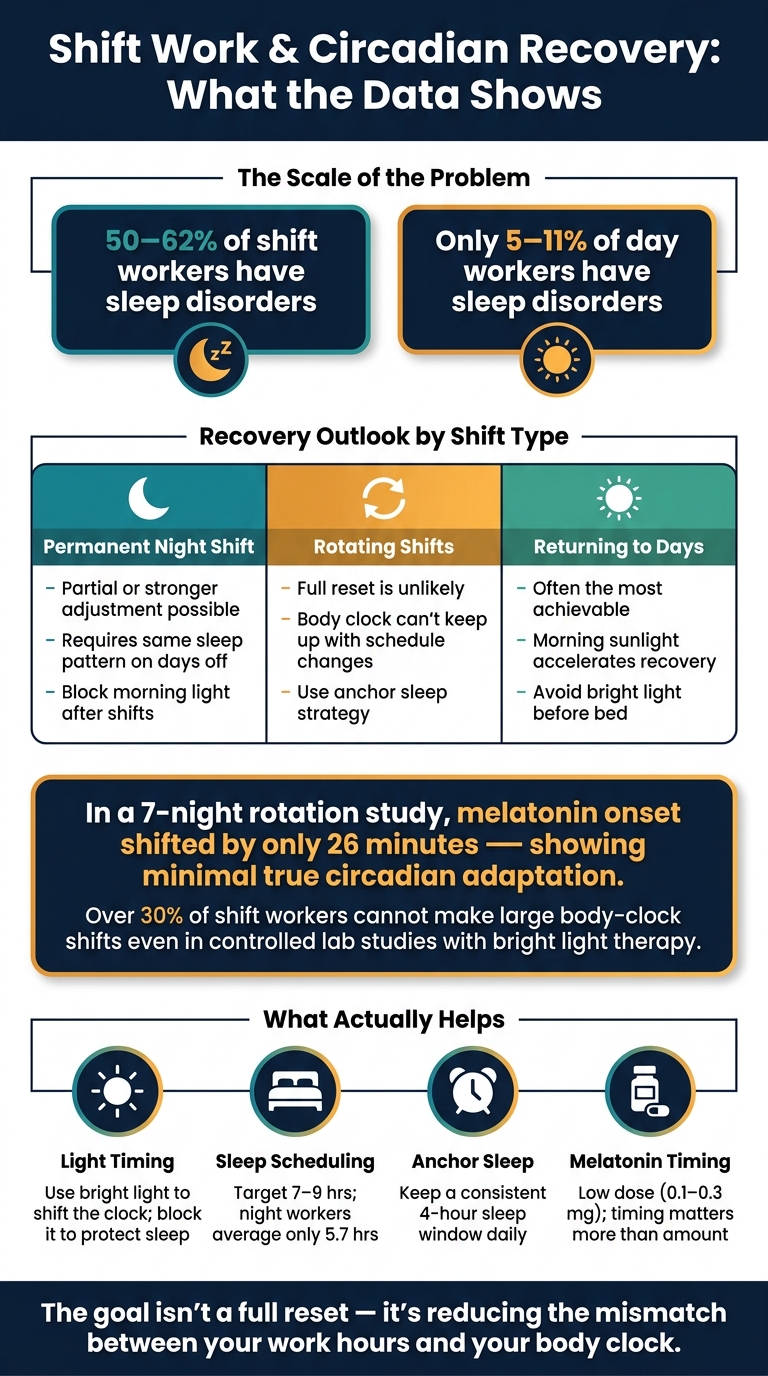
Shift Work Sleep Recovery: What to Expect by Schedule Type
How to Defeat Jet Lag, Shift Work & Sleeplessness | Huberman Lab Essentials
sbb-itb-5106bd1
What Restoring Circadian Rhythms Actually Means for Shift Workers
Shift workers can sometimes realign their body clocks. But full restoration usually comes down to two things: how stable the work schedule is and how light exposure is managed.
Your circadian rhythm is your body's 24-hour clock. It affects sleepiness, alertness, hormone release, body temperature, and digestion. When work hours push that clock in the opposite direction, you get misalignment.
Sleep researcher Timothy Roehrs describes shift work as a mismatch between sleep-wake schedules and the body's internal rhythm. After a night shift, daylight suppresses melatonin, while the body is still primed for daytime alertness. That makes sleeping during the day much harder.
Circadian Rhythm vs. Circadian Misalignment
The clearest sign of misalignment isn't just fatigue. It shows up in biological markers you can measure. In a seven-night rotation, melatonin onset shifted by only 26 minutes, which shows how little the body clock actually moved. That gap between what the schedule demands and what the body is doing leads to shorter, lighter sleep, slower reaction times, and a mismatch between biological time and social time.
Adapting to Night Shifts vs. Returning to a Day Schedule
These are two different goals, and that changes the path forward.
Adapting to a permanent night schedule means trying to move the body's expected sleep period into daytime hours. On paper, that sounds simple. In real life, it's tough. As Timothy Roehrs noted:
"Difficulty limiting light exposure to appropriate times of day is a major reason why most shift workers, even those on permanent night shifts, do not fully [adapt]."
Returning to a daytime rhythm after leaving shift work fits better with how the body naturally runs. Morning sunlight can help shift the rhythm back toward a daytime schedule. That's the more realistic path for many people, though the transition can still bring sleep problems and dips in performance.
Permanent night schedules are hard to match fully because light and social cues keep pulling the body back toward daytime. Returning to a day schedule is more doable, but rotating shifts make steady alignment especially hard.
That distinction matters because the best recovery plan depends on whether someone is trying to adapt to nights, move back to days, or deal with a rotating schedule.
When Shift Workers Can Realign Their Body Clocks
Realignment depends a lot on how predictable the schedule is. The body clock moves slowly, and it needs steady signals to shift in a new direction. That’s why schedule stability matters more than the shift label itself.
Why a Stable Schedule Improves the Odds
A fixed night schedule can help, but it can also fall apart fast if days off swing back to daytime hours. Permanent night work tends to work ONLY when that same night schedule continues on days off too. Family plans, social events, and daylight during the trip home can all pull the body in the other direction and create a mismatch between workdays and days off. When sleep hours change on days off, progress can stall or even reverse.
Natural sleep preference also plays a big part in how fast someone adjusts. People who naturally lean toward later bedtimes often adapt to night shifts more easily. Early risers usually have a harder time staying alert at night and sleeping during the day, even when the schedule stays fixed.
Why Rotating Shifts Make Full Recovery Harder
Rotating shifts keep the body in catch-up mode. Most rotation cycles change faster than the body clock can follow, so workers end up chasing a target that keeps moving.
That gap shows up in research. In a study of mining operators on a seven-day/seven-night rotation, melatonin onset shifted by only 26 minutes across the whole week. As researcher Drew Dawson noted:
"The small magnitude of the change [in melatonin onset] indicates a lack of true circadian rhythm adaptation to the lifestyle."
And here’s the tough part: more than 30% of shift workers can’t make large body-clock shifts even in tightly controlled lab studies that use bright light. So for rotating workers, full realignment usually isn’t a realistic goal.
A better target is partial alignment. One common approach is keeping a consistent four-hour anchor sleep window at the same time every day, no matter which shift is on the schedule.
Once the schedule is set, light exposure, sleep timing, and daily habits become the main tools for recovery.
How Light, Sleep Timing, and Daily Habits Support Circadian Recovery
Once the schedule is set, the job becomes pretty simple in theory, even if it’s hard in practice: either shift your body toward nights or move it back toward days. That’s where light, sleep timing, and day-to-day habits do most of the heavy lifting. The goal is to line up those signals so your body gets the same message over and over.
Using Bright Light and Darkness on Purpose
Light is the main circadian time cue for the body. As Timothy Roehrs noted in the Journal of Clinical Sleep Medicine:
"Late evening light will phase delay rhythms while morning light will advance them."
Put plainly, light can push your body clock later for night work or pull it earlier when you’re going back to a daytime routine.
| Goal | Light Strategy | Darkness Strategy |
|---|---|---|
| Adapting to night shift | Bright light during the first half of the shift | Sunglasses on the morning commute; blackout curtains for daytime sleep |
| Returning to day schedule | Bright outdoor light right after waking | Avoid screens and bright light 2 hours before bedtime |
Light moves the clock. A protected sleep window helps hold that position.
Building a Sleep Schedule the Body Can Follow
Aim for 7 to 9 hours of sleep across 24 hours. That target matters because night-shift workers often come up short. In one study, they averaged 5.7 hours.
The sleep setup matters more than a lot of people think. Blackout curtains, eye masks, earplugs, and white noise machines can help make the room dark and quiet. Just as important, family or housemates need to know when sleep hours are off-limits for noise and interruptions. The gear helps, but the household routine often makes or breaks it.
Once that sleep window is protected, the next step is making sure caffeine, naps, meals, and exercise aren’t pulling in the other direction.
Adjusting Caffeine, Naps, Meals, and Exercise
Each of these acts like a time signal. Use them on purpose, and they back up the schedule instead of fighting it.
| Behavioral Lever | Effect on Circadian Recovery | Practical Action |
|---|---|---|
| Caffeine | Reduces sleep pressure and can push melatonin later | Stop intake 6 hours before the planned sleep window |
| Naps | Reduces fatigue but can lower sleep drive | Limit to about 20 minutes during the shift; avoid long naps before the main sleep block |
| Meals | Food timing acts as a signal that tells the body when to be active | Eat the largest meal during active hours; avoid heavy meals right before sleep |
| Exercise | Raises core temperature and alertness; can phase-shift the clock | Finish vigorous workouts at least 3 hours before the sleep window to avoid higher body temperature delaying sleep onset |
This is where small choices add up. A late coffee, a long nap, a heavy meal before bed, or a hard workout too close to sleep can all nudge the body the wrong way. When those habits match the planned sleep window, circadian recovery gets a lot easier.
How Melatonin and Natural Sleep Support Can Help
Once light exposure and sleep timing are set, melatonin can help lock that schedule in.
Here’s the big idea: melatonin doesn’t just make you feel sleepy. In shift workers, light at night can disrupt the body’s own melatonin production. So when you take exogenous melatonin, it can work as a clock-shifting aid. That means it may help move sleep timing into the right window, not just help you doze off. It can also shorten the time it takes to fall asleep and may give sleep quality a modest bump.
When Melatonin Timing May Support Adaptation or Recovery
Timing matters more than dose alone.
| Scenario | Goal | Suggested Timing Window | Key Caution |
|---|---|---|---|
| After a night shift | why you can't sleep after night shifts | 30–60 minutes before intended daytime sleep | Light exposure can override the effect |
| Returning to a day schedule | Move the body clock earlier | Early evening, 30–60 minutes before the desired bedtime | Evening light can interfere with the shift |
| To adapt to night work | Delay the sleep phase | Soon after waking | Can cause grogginess at work if taken too close to the shift |
Dose matters too, but not in the way many people think. Low doses of 0.1–0.3 mg can support sleep and help shift the body clock, while doses above 0.3 mg may interfere with circadian mechanisms.
Where a Product Like RST Sleep Fits In

If you want an option made with shift workers in mind, RST Sleep lines up with this timing-first approach. Its formula combines dual-release melatonin with glycine, phosphatidylserine, magnolia bark, and apigenin to support shift-work sleep timing. For more tips, see our guide on how to sleep better after working nights.
Conclusion: The Most Effective Way to Restore a Shift Worker Sleep Cycle
The plain answer is this: most shift workers won’t fully reset their circadian rhythm. That’s just the reality. The better goal is to cut down the mismatch between work hours and the body clock.
The biggest lever is light control. Use bright light when you need to shift your body clock, block unwanted light after night shifts, and keep your sleep schedule as steady as you can. Get those basics right first. Once they’re in place, other tools tend to work better.
Melatonin and natural sleep supports like RST Sleep may help when you use them at the right time, but they’re best treated as backup - not the main plan. In that role, support products make more sense as part of a larger circadian approach.
Rotating shifts usually don’t give people enough time to fully realign. So the practical target stays the same: reduce misalignment and protect sleep quality wherever possible.
Better sleep usually comes from doing the simple things again and again. With the right light, timing, and support, shift workers can still feel better and function better.
FAQs
How long does circadian adjustment usually take?
Circadian adjustment is not guaranteed for shift workers. A lot of people never fully reset their internal clocks for night shifts. They stay awake at night, but their bodies still run on a daytime schedule.
When adjustment does happen, it depends on the person, their light exposure, and how steady their work schedule is. RST Sleep offers a natural sleep supplement made to support healthy sleep cycles and improve sleep quality.
What if I can’t keep the same sleep schedule on days off?
Keeping a steady sleep and wake schedule - even on your days off - can help support your body clock and cut down some of the strain that comes with shift work.
If you want extra help, RST Sleep offers a natural, non-habit-forming supplement made for irregular sleep schedules. It includes ingredients like extended-release melatonin, glycine, and apigenin to help you relax and support healthy sleep cycles.
When should I talk to a doctor about shift-work sleep problems?
Talk to a doctor if your sleep problems might be caused by more than your work schedule. A lot of shift workers assume fatigue and sleepiness just come with the job.
But if you’ve had trouble falling asleep or staying asleep for more than three months, get checked out. A doctor can look for Shift Work Sleep Disorder (SWSD) or other conditions, such as obstructive sleep apnea.