

Shift Work Sleep Disorder: Light Therapy Solutions
Shift Work Sleep Disorder (SWSD) affects up to 40% of shift workers, disrupting sleep and causing excessive fatigue. This condition stems from misaligned work hours and the body's natural circadian rhythm. Light therapy offers a practical way to reset the internal clock and improve sleep quality without medications. Here's how it works:
- What is SWSD? A condition tied to irregular work schedules causing insomnia and daytime sleepiness.
- The Role of Light Therapy: Exposure to bright light at specific times adjusts the body's internal clock, improving alertness and reducing errors.
- Key Tools: Light boxes, wearable glasses, and workplace lighting systems can be tailored to individual schedules.
- Safety Tips: Time sessions carefully, block morning sunlight after night shifts, and start with short exposure periods.
- When to Seek Help: Persistent symptoms or workplace accidents may require a sleep specialist's intervention.
Huberman: Cortisol and Red Light Aids Sleep for Night workers and Shift workers. #rickrubin
sbb-itb-5106bd1
Light Therapy: How It Helps Shift Workers Sleep Better
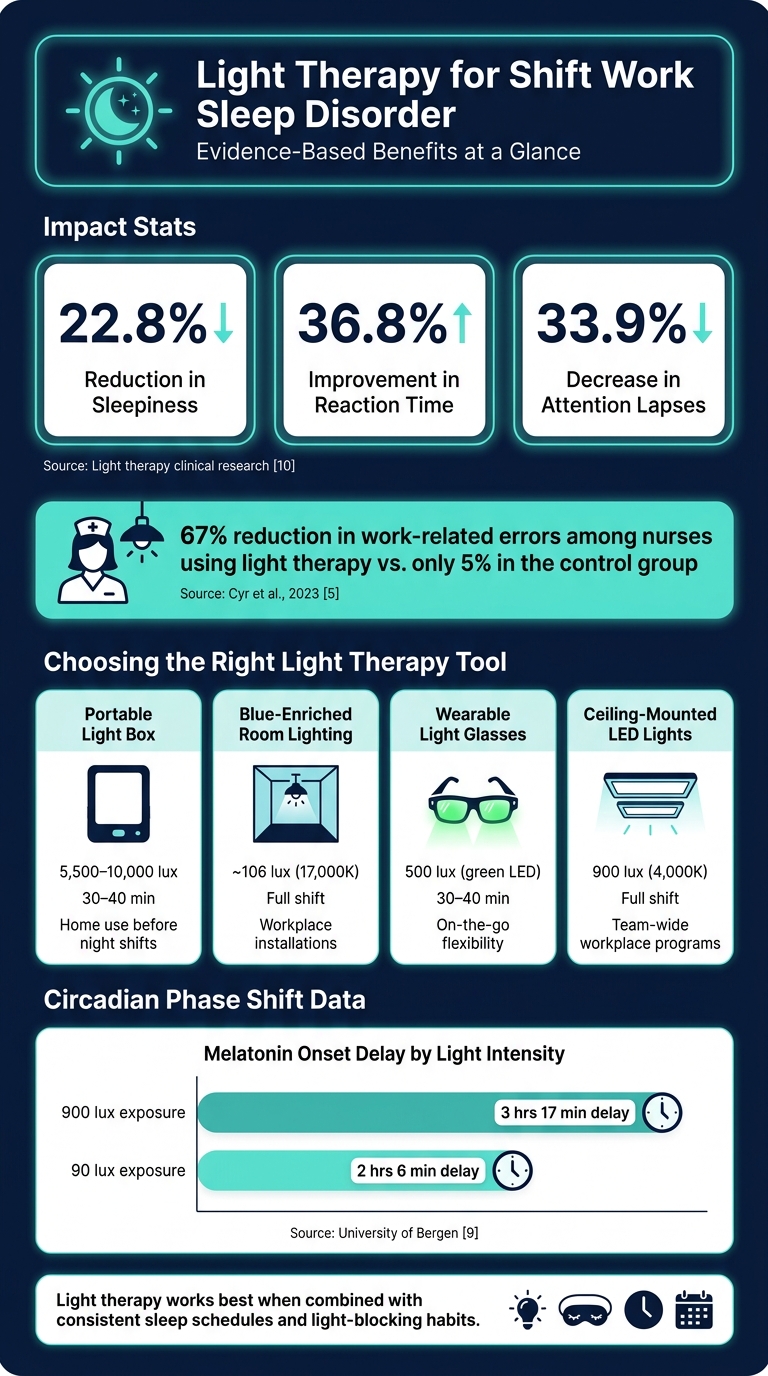
Light Therapy for Shift Workers: Key Stats & Benefits
How Light Therapy Works
Shift workers often struggle with disrupted sleep patterns, but light therapy offers a way to reset their internal clocks. When light enters your eyes, it signals the brain's master clock, the suprachiasmatic nucleus (SCN), helping to regulate your sleep-wake cycle.
For shift workers, light therapy focuses on phase shifting - adjusting your sleep schedule to align with your work hours. Bright light exposure at specific times suppresses melatonin production, effectively shifting your circadian rhythm. Research from the University of Bergen demonstrated that exposure to 900 lux for three consecutive night shifts delayed melatonin onset by 3 hours and 17 minutes, compared to just 2 hours and 6 minutes at 90 lux.
"Bright light improved performance and alertness during simulated night shifts and improved adaptation to night work." - Erlend Sunde, Department of Psychosocial Science, University of Bergen
The benefits are clear. Light therapy reduces sleepiness by 22.8%, improves reaction times by 36.8%, and decreases attention lapses by 33.9%. One study of rotating shift nurses found that using light therapy reduced work-related errors by 67%, compared to only a 5% reduction in the control group.
These effects highlight why light therapy tools are becoming essential for shift workers.
Types of Light Therapy Tools
Finding the right light therapy tool depends on your schedule, budget, and work environment. Here’s a breakdown of some popular options:
| Tool Type | Light Intensity / Spectrum | Session Length | Best For |
|---|---|---|---|
| Portable light box | 5,500–10,000 lux | 30–40 minutes (pre-shift) | Home use before night shifts |
| Blue-enriched room lighting | ~106 lux (17,000 K) | Full shift | Workplace installations |
| Wearable light glasses | 500 lux (green LED) | 30–40 minutes daily | On-the-go flexibility |
| Ceiling-mounted LED lights | 900 lux (4,000 K) | Full shift | Team-wide workplace programs |
Wearable devices, like light glasses, are especially useful when workplace lighting can't be controlled. A study led by Shu-Fen Niu in Taiwan tested the Re-Timer® wearable light device on 80 female shift-working nurses. After using the device for 30–40 minutes daily over four weeks, participants reported less daytime sleepiness and better sleep quality within 14 to 28 days.
"The study supports light intervention as a safe, low-cost, and non-pharmacological approach to reduce daytime sleepiness and enhance sleep in shift-working nurses." - Shu-Fen Niu, Applied Nursing Research
Safety Guidelines for Light Therapy
To get the most out of light therapy while staying safe, follow these tips:
- Time sessions carefully. For night shift workers, bright light exposure is most effective during the first half of your shift. Avoid exposure in the hours leading up to sleep.
- Block morning sunlight. After a night shift, morning sunlight can disrupt your adjusted clock. Wearing blue-blocking sunglasses during your commute helps maintain the shift.
- Start small. Begin with 20–30 minute sessions and adjust based on your response. Overdoing it with long, high-intensity sessions can sometimes lead to errors due to overstimulation.
If you have eye conditions, bipolar disorder, or are sensitive to light, consult a doctor before starting light therapy. In some cases, bright light can cause adverse effects, so it’s better to proceed with caution.
Light Therapy Plans for Different Shift Schedules
Light Therapy for Night Shift Workers
Adjusting your internal clock is key when working night shifts. The goal is to delay your sleep phase to stay alert during work hours and rest effectively during the day.
The best time for bright light exposure is between 1:00 AM and 5:00 AM, during the first half of your shift. Using lights in the 4,000–6,000 lux range for about four hours during this period can improve alertness and reduce mistakes. If overhead lighting isn’t available, a portable light box with about 5,500 lux for 40 minutes is a convenient alternative. Additionally, filtering out blue light (wavelengths below 480 nm) during your shift can help you sleep longer - on average, adding 40 minutes to your rest time.
To maintain your adjusted schedule, wear dark sunglasses on your commute home to block morning light exposure.
"A compromise circadian phase position improved performance during night shifts, allowed sufficient sleep during the daytime after night shifts and during the late nighttime on days off." - Mark R. Smith, Biological Rhythms Research Laboratory
On your days off, getting some natural light in the afternoon can prevent your sleep schedule from drifting too far. This keeps your internal clock in check, making it easier to return to a normal routine while boosting daytime alertness and overall energy.
Light Therapy for Early Morning Shifts
For early shifts, the focus shifts to waking up earlier and preparing your body to perform during early hours. Timing is everything.
Expose yourself to bright light right after waking up or at the start of your shift. This exposure, timed after your body's temperature minimum (Tmin) - which occurs about seven hours after melatonin starts in the evening - helps shift your sleep-wake cycle earlier. This adjustment makes waking up early less of a struggle and keeps you alert during your shift.
Evening habits also play a big role. Avoid bright light in the late afternoon or evening, as it can delay your ability to fall asleep early. Wearing sunglasses with reduced light transmission (around 15% or less) while outdoors in the afternoon can help. Combine this with blackout curtains to create a dark, sleep-friendly environment for early evening rest.
Light Therapy for Rotating Shifts
Rotating shifts require a flexible approach, balancing both delaying and advancing your internal clock depending on the schedule.
When transitioning to night shifts, focus on bright light exposure during the first three nights of the rotation. Use a light therapy lamp for 20 to 40 minutes during the first half of your shift, and wear blue-blocking glasses on your morning commute home. When switching back to day shifts, the strategy flips: spend 20 minutes in natural outdoor morning light to help your body return to a daytime schedule.
Red light can also be a helpful tool during these transitions. According to research by Mariana G. Figueiro, PhD, red light can enhance workplace alertness without interfering with melatonin production or disrupting your circadian rhythm. This makes it especially useful when you need to stay awake but don’t want to throw off your internal clock.
"Red light would be useful for promoting workplace alertness without negatively affecting the sleep and the circadian system." - Mariana G. Figueiro, PhD, Icahn School of Medicine at Mount Sinai
If you experience discomfort like headaches or nausea, try increasing the distance from the light source or shortening your exposure time. Position the light in your peripheral vision rather than looking directly at it to reduce eye strain.
Combining Light Therapy with Good Sleep Habits
Light therapy isn't a magic fix for shift work sleep disorder. It works best when paired with habits that help stabilize your internal clock.
Using Darkness to Support Sleep
To get the most out of light therapy, it's important to adopt other sleep-friendly practices. After a night shift, exposure to morning sunlight can confuse your body's natural sleep signals. Even a brief encounter with bright light during your commute can nudge your circadian rhythm toward wakefulness, making it tougher to fall asleep when you get home. To counter this, wear sunglasses on your way home and use blackout curtains or a sleep mask to block out light indoors. This helps maintain melatonin production, which is essential for quality sleep. Research backs this up, showing that combining bright light exposure during shifts with strict light-blocking afterward significantly improves both sleep quality and duration.
"Bright light exposure and wearing sunglasses led to significant improvements in the studied variables [alertness, performance, and morning sleep]." - Yoon et al.
Keeping a Consistent Sleep Schedule
A steady sleep schedule is key, even on your days off. Your circadian rhythm thrives on predictability, and changing your sleep times frequently can throw it off - almost like traveling to a new time zone. A 2023 study by Cyr et al. examined 57 nurses working rotating shifts over 30 days. Those who followed a structured light exposure and sleep routine saw a 67% reduction in work-related errors compared to just 5% in the control group. They also reported better mood and lower fatigue levels. To keep your rhythm aligned with your light therapy routine, try to limit variations in your sleep schedule to no more than two hours on your days off.
Using Natural Sleep Supplements Alongside Light Therapy
Supplements can also play a role in supporting your sleep. RST Sleep is designed specifically for night shift workers and those with irregular schedules. If you're already blocking light and sticking to a consistent sleep routine, a supplement like this can help reinforce those efforts. It features extended release melatonin, along with ingredients like glycine, phosphatidylserine, magnolia bark, and apigenin - all chosen to promote relaxation and support your body's natural melatonin production without causing dependency. The extended release format ensures melatonin levels stay steady throughout your sleep period, making it a helpful addition to your light therapy strategy rather than a replacement.
Tracking Progress and Knowing When to Get Help
How to Track Your Sleep and Light Therapy Sessions
To get the most out of light therapy, it’s essential to track both your sleep patterns and therapy sessions. Start by keeping a log of your bedtime, how long it takes to fall asleep, any awakenings during the night, and how refreshed you feel in the morning. Include details about your light therapy sessions - like when you use the light and for how long. This combined log gives you a clearer picture of how your routine is working over time.
If you want more precise data, actigraphy devices are a great option. These wearable trackers monitor your movement and rest cycles, providing objective insights into your sleep patterns without relying on memory. You can also use the Insomnia Severity Index (ISI), a tool that evaluates the seriousness of your sleep issues. Clinically, an ISI score above 14 often indicates the need for professional intervention. Tracking this score over a period of 4–10 weeks can help you see if you’re making progress.
Don’t forget to observe how your work performance changes. Noticeable improvements in reaction time, alertness, or fewer small mistakes can signal that your sleep and light therapy plan is on the right track.
| Tracking Tool | What It Measures | Best Use |
|---|---|---|
| Sleep Diary | Total sleep time, sleep efficiency, wake-ups | Daily habit tracking |
| Actigraphy | Movement and rest cycles | Objective sleep timing data |
| ISI Scale | Insomnia symptom severity | Measuring clinical improvement |
| Psychomotor Vigilance Test (PVT) | Reaction time and alertness | Monitoring work safety and performance |
By keeping track of these metrics, you’ll also be able to spot warning signs that it might be time to seek professional help.
Signs You May Need Professional Support
While light therapy can be helpful for many shift workers, it’s not a universal fix. One critical sign that you might need expert assistance is persistence - if insomnia or excessive sleepiness lasts for three months or more, it could meet the clinical criteria for Shift Work Disorder. This would warrant a professional evaluation.
Other red flags include ongoing mood changes, like irritability or low energy, trouble focusing, or frequent headaches. Near-miss accidents at work or on your commute are especially serious signals that your current approach isn’t enough and you need professional support. These challenges can be even more pronounced for rotating shift workers, whose varying schedules might make it harder to stick to a consistent light therapy plan.
If these issues persist, consulting a sleep specialist can help refine your approach.
What a Sleep Medicine Specialist Can Do
A sleep medicine specialist brings advanced tools and expertise to fine-tune your strategy. For instance, Dim-Light Melatonin Onset (DLMO) testing uses a saliva sample to pinpoint your circadian rhythm. This allows the specialist to create a light therapy plan tailored specifically to your body’s natural clock.
Specialists also check for other conditions that might be complicating your sleep, such as sleep apnea, which can mimic the symptoms of Shift Work Disorder. Without identifying and treating such conditions, you could end up focusing on the wrong problem. In some cases, they may prescribe FDA-approved wake-promoting medications like Modafinil (Provigil®) or Armodafinil (Nuvigil®) to complement your sleep routine - not replace it.
Before your appointment, prepare by keeping a 14-day sleep log. Include details like your sleep and wake times, caffeine intake, and how rested you feel. This information gives the specialist a solid foundation to develop a plan tailored to your specific schedule and needs.
Conclusion: Getting Better Sleep as a Shift Worker
Getting quality sleep as a shift worker can be tough, but it’s not impossible. Light therapy offers a proven way to tackle the underlying causes of sleep challenges tied to shift work, rather than just addressing the symptoms.
The key lies in managing light exposure. By using light strategically during your shift and limiting it afterward, you can significantly improve your sleep after night shifts. For example, a 2023 study found that nurses who paired light therapy with structured sleep routines cut workplace errors by an impressive 67%, compared to only a 5% reduction in the control group. This shows just how effective this combination can be.
Pairing light therapy with consistent sleep habits can amplify the benefits. To take it a step further, consider natural sleep aids designed for night shift workers, like RST Sleep. With ingredients such as extended-release melatonin, magnolia bark, and phosphatidylserine, it’s formulated to promote deep, restorative sleep for those with irregular schedules.
Track your progress over at least ten shifts. Pay attention to your sleep quality and alertness, and tweak your routine if needed. If progress slows, reaching out to a sleep specialist can help. By combining timed light exposure, steady sleep habits, and supportive tools like RST Sleep, you can boost both your alertness and safety on the job.
FAQs
How fast does light therapy work for shift work sleep?
Light therapy has shown to be effective in helping shift workers adjust their circadian rhythms within just 2 to 4 days when applied at the appropriate times. This adjustment can lead to improved alertness during work hours and promote healthier sleep patterns. However, outcomes may differ based on personal routines and how consistently the therapy is used.
What light brightness (lux) should I use for my shift?
Shift workers can see improvements in alertness and better adapt their circadian rhythms by being exposed to bright light levels of 4,000 to 6,000 lux during night shifts. Research also indicates that exposure to levels as high as 9,000 lux could be beneficial. These light exposure sessions generally range from 1 to 4 hours in duration.
Can I use light therapy with melatonin (like RST Sleep)?
Yes, combining light therapy with melatonin can help night shift workers adjust their circadian rhythm. While bright light therapy is more strongly supported for delaying sleep phases, melatonin can complement this approach, aiding in adaptation and improving overall sleep quality.