

Shift Work Sleep Disorder: Causes and Symptoms
If you work nights, rotating shifts, or very early mornings, your sleep problems may not be “just part of the job.” Shift Work Sleep Disorder happens when your work hours clash with your body clock, and the main signs are trouble sleeping and feeling very sleepy when you need to be awake.
Here’s the short version:
- SWSD is tied to your schedule, not just a bad night of sleep
- It often affects people on night shifts, rotating shifts, and 4:00 a.m. to 7:00 a.m. starts
- Symptoms usually include insomnia, daytime sleep loss, poor focus, irritability, and sleepiness at work or while driving home
- In many cases, symptoms need to last at least 3 months before doctors diagnose it
- Shift workers face nearly 3x the accident risk of daytime workers
- About 25% of U.S. adults work non-daytime hours, and about 14% of night workers meet SWSD criteria
- Long-term circadian disruption is linked to heart disease, Type 2 diabetes, obesity, depression, anxiety, and stomach issues
What helps most is simple in theory: keep your sleep time as steady as you can, control light exposure, protect daytime sleep, use caffeine early in the shift, and use short naps when needed. If symptoms keep going, a doctor may check for SWSD and rule out problems like sleep apnea or narcolepsy.
In other words: SWSD is what happens when your job keeps telling your body to do the opposite of what its internal clock wants.
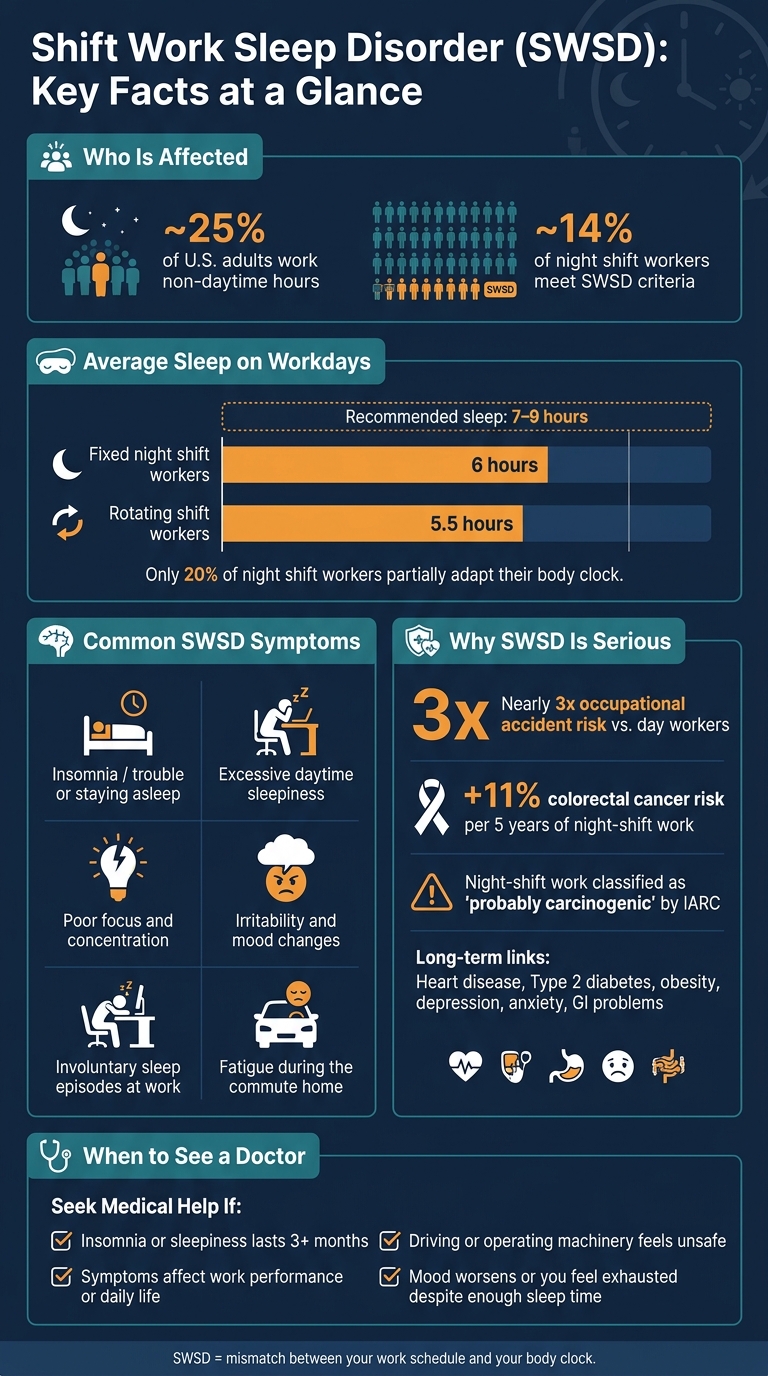
Shift Work Sleep Disorder: Key Stats, Symptoms & Health Risks
How shift workers can avoid bad sleep
sbb-itb-5106bd1
How Shift Work Disrupts the Body Clock
Shift work disorder starts when a work schedule asks the body to do the opposite of what it wants to do: stay awake when it expects sleep, and sleep when it expects wakefulness. The main driver is light. It tells the brain what time it is, even when the clock on the wall says something else.
Circadian Rhythm, Melatonin, and Nighttime Light Exposure
Your body runs on a roughly 24-hour internal clock called the circadian rhythm. That clock is directed by a small brain region called the suprachiasmatic nucleus (SCN). Light is the main cue that sets the SCN.
When it gets dark, the brain increases melatonin to signal that it's time to sleep. When light reaches the eyes, that signal shuts off. That's where night shifts get messy. Bright light at work and screen use overnight can suppress melatonin. Then morning sunlight during the commute home can nudge the body even more toward wakefulness.
Cortisol makes this harder. It usually peaks in the morning to help you wake up and falls in the evening. For people working nights, that rhythm can clash with the hours when they need to sleep and stay alert.
Only about 20% of night shift workers show even partial adjustment of their body clock to their schedule. Many never fully adapt.
Why Daytime Sleep Is Often Shorter and Lighter
Even after a long shift, daytime sleep is often shorter, lighter, and less restorative than sleep at night. The reason is pretty simple: daytime cues keep telling the body to stay awake.
Daylight promotes alertness. Then the setting makes things worse. Sunlight slips through windows, traffic starts up, and people in the house keep moving around. It's hard to get deep sleep when the world outside is basically saying, "time to be up."
Fixed night shift workers average about 6 hours of sleep on workdays. Rotating shift workers average about 5.5 hours.
When that pattern keeps showing up, clinicians start looking for SWSD.
How Clinicians Diagnose SWSD
Because SWSD is tied to work timing, diagnosis depends on linking symptoms to the person's schedule. It usually starts with a symptom history matched to work hours. After that, clinicians use sleep logs and actigraphy to confirm the pattern and help rule out other sleep disorders.
They also rule out sleep apnea and narcolepsy first, since both can cause similar symptoms.
Causes and Symptoms of Shift Work Sleep Disorder
Work Schedule Factors That Raise SWSD Risk
SWSD is most often tied to schedules that push against the body’s internal clock. The main troublemakers are permanent night shifts, rotating shifts, early morning starts - usually between 4:00 a.m. and 7:00 a.m. - split shifts, and too much overtime.
Rotating shifts tend to be the hardest. If your schedule keeps moving around, your circadian rhythm never gets a steady cue to adjust. It’s like trying to reset a watch while someone keeps changing the time on you. Short gaps between shifts make things worse too. When workers get less than 11 hours off between shifts, the risk of insomnia and excessive sleepiness goes up.
Long shifts add more strain. Working more than 12 hours at a time, or more than 48 hours in a week, pushes risk even higher. Put simply: the less steady the schedule, the harder it is for the body clock to keep up.
Symptoms During Sleep, Work Hours, and the Commute Home
SWSD symptoms don’t stay in one part of the day. They show up during sleep, at work, and even on the drive home.
During sleep, insomnia is the complaint people report most often. Workers with early morning starts usually struggle to fall asleep, while workers on evening shifts more often wake up during sleep and have trouble staying asleep. Sleep also tends to be shorter, lighter, and less refreshing - especially when daylight and daytime noise get in the way.
At work, excessive sleepiness is common. Some workers have brief, involuntary sleep episodes. Others notice poor focus, irritability, and a drop in job performance. That’s not a small issue. Shift workers face nearly 3 times the occupational accident risk of day workers.
The commute home can be just as risky. Fatigue slows reaction time, and motor vehicle collision risk is highest during overnight and early morning hours, when many workers are heading home. Over time, these problems can spill far beyond feeling tired.
Long-Term Health Effects of Circadian Disruption
Repeated sleep loss and circadian misalignment can affect the whole body, not just energy levels. Long-term shift work is linked to cardiovascular disease, Type 2 diabetes, obesity, depression, anxiety, gastrointestinal problems, and weaker immune function.
The International Agency for Research on Cancer classifies night-shift work as "probably" carcinogenic for humans.
There’s also a dose effect. Risk of colorectal cancer rises 11% for every five years of night-shift work exposure.
What Can Help: Evidence-Based Steps for Night Shift Workers
Once you know why SWSD happens, the next move is simple: reduce the gap between when your body wants to sleep and when your job needs you awake.
Sleep Timing, Light Control, and Protecting Daytime Sleep
Try to keep the same sleep window every day. That gives your body a steadier rhythm, even if your work hours are upside down. Use bright light early in your shift, then wear dark sunglasses on the drive home to cut down morning light exposure.
When it's time to sleep, make the room feel as close to night as you can. Block daylight with blackout curtains or an eye mask. Cut noise with a cool room, white noise, or earplugs.
Behavioral Habits That Reduce Insomnia and Daytime Sleepiness
After light and sleep timing, caffeine and naps are often the most useful day-to-day tools.
Use caffeine early in your shift, then stop several hours before bedtime.
A 20-minute nap before or during your shift can help you stay alert while keeping sleep inertia in check. If you're too sleepy to drive home safely after work, take a short nap before you leave the workplace.
It also helps to train your brain to link bed with sleep, not scrolling, snacking, or watching shows. Use your bed only for sleep. Pair that with a wind-down routine you can repeat each time: dim the lights, stay off screens before bed, and follow the same steps in the same order. Skip heavy meals within 2 hours of bedtime.
Natural Sleep Support for Irregular Schedules
Some shift workers use melatonin-based support to help with daytime sleep. If you're going to bed right after a night shift, a morning dose can help tell your body that it's time to sleep, even when it's already light outside.
For shift workers who want extra support, RST Sleep is made for irregular sleep schedules and combines extended-release melatonin, glycine, phosphatidylserine, magnolia bark, and apigenin to support relaxation and daytime sleep.
When to See a Doctor and Key Takeaways
Signs That Self-Help May Not Be Enough
If these steps don't improve your sleep or alertness, it's time to get medical care. If insomnia or excessive sleepiness lasts 3 months or longer, talk to a doctor. You should get checked sooner if symptoms continue even after self-help or treatment.
You should also seek medical help if sleepiness keeps showing up, starts affecting work or daily life, or makes driving or using machinery unsafe.
See a doctor if your mood gets worse, or if you still feel exhausted or unrefreshed even when you're giving yourself enough time to sleep. That can point to another condition, such as obstructive sleep apnea.
Before your appointment, bring a 14-day sleep log with:
- when you slept
- caffeine use
- how alert or sleepy you felt
That gives your clinician a clearer view of what's going on.
Conclusion: What to Remember About SWSD
The main point is simple: SWSD is a mismatch between your work schedule and your body clock. It can lead to insomnia and sleepiness, and it can affect both safety and health.
If changes to sleep timing, light control, and naps don't help, a medical evaluation can check for other sleep disorders and guide treatment. A professional evaluation can help confirm SWSD and rule out other causes.
FAQs
How do I know if I have SWSD or just poor sleep?
A key difference comes down to pattern and timing.
SWSD usually means insomnia, excessive sleepiness, or both for at least three months. And those symptoms need to be clearly linked to a work schedule that keeps you awake during the hours when most people are normally asleep.
A doctor may ask you to keep a sleep diary for at least 14 days. That record can help show when you sleep, when you feel tired, and how your work hours line up with your symptoms.
They may also rule out other causes, including medical conditions, medication side effects, or sleep disorders like sleep apnea.
Can day shifts still cause SWSD?
SWSD is tied to work hours that fall outside the usual 9:00 a.m. to 5:00 p.m. schedule. That includes night shifts, early morning shifts, and rotating shifts.
The reason is pretty simple: SWSD happens when your work hours clash with your body’s internal circadian rhythm. So it’s generally not linked to standard daytime shifts.
What should I track before seeing a doctor?
Before seeing a doctor, keep a detailed sleep journal for at least 2 weeks. It gives your provider a clear look at your sleep patterns and can help with diagnosing Shift Work Sleep Disorder.
Write down:
- When you fall asleep and when you wake up
- How often you wake during the night or day
- How rested you feel after sleep
- Anything that might affect sleep, like caffeine, noise, or electronic device use
The goal is simple: give your doctor a day-by-day record instead of relying on memory alone.