

Shift Work Sleep Disorder: Causes and Solutions
If you work nights, early mornings, or rotating shifts and still feel worn out after 7 to 8 hours in bed, your schedule may be fighting your body clock. SWSD is tied to sleep trouble that lasts 3 months or more, and it can lead to insomnia, heavy sleepiness at work, job mistakes, and drowsy driving.
Here’s the short version:
- What causes it: your work hours, sleep time, and light exposure don’t line up
- Who it hits most: people in health care, emergency services, transportation, logistics, and manufacturing
- Main signs: poor daytime sleep, brain fog, low focus, irritability, and sleepiness on shift
- Safety risk: being awake for 17 hours can impair you about as much as a 0.05% BAC
- What helps: a fixed sleep window, light blocking after night shifts, early caffeine cutoffs, a cool dark room, and short planned naps
- When to get medical help: if symptoms last more than 3 months, you have microsleeps while driving, or you snore loudly and gasp in sleep
A few numbers stand out. About 16% of U.S. workers are on night or rotating shifts, and 10% to 40% of those workers may have SWSD. Night shift workers often sleep only about 6 hours on workdays, while rotating shift workers may get around 5.5 hours.
What I take from this is simple: the goal is not perfect sleep. The goal is better function, fewer mistakes, and lower risk at work and on the drive home. The best place to start is with timing, light, and your sleep setup.
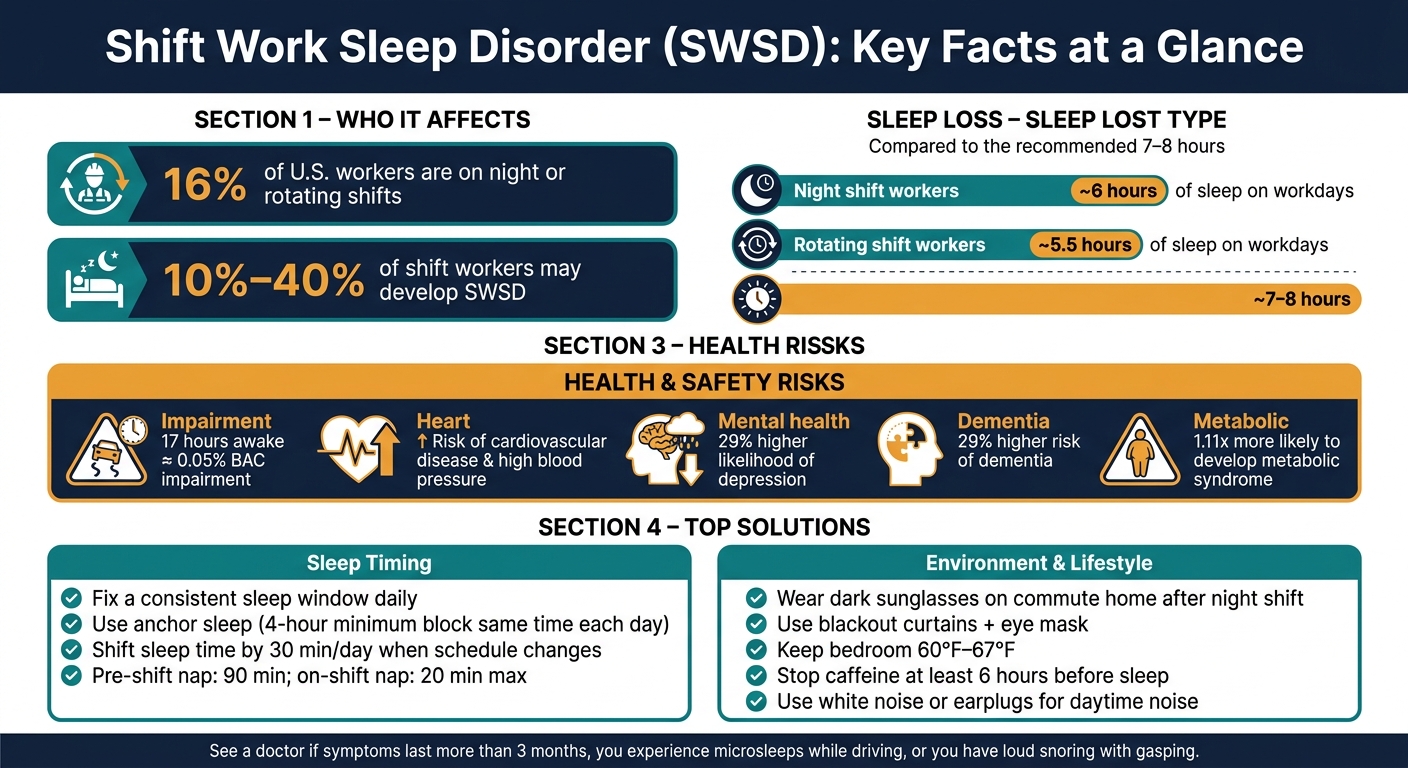
Shift Work Sleep Disorder: Key Stats, Risks & Solutions
How to Survive Night Shifts from a Sleep Expert | Management of Shift Work Sleep Disorder
If you struggle to rest once the sun comes up, explore these solutions for sleeping after night shifts to improve your recovery.
sbb-itb-5106bd1
What Causes Shift Work Sleep Disorder
At the core of SWSD is circadian misalignment. In plain English, that means your work hours, sleep hours, and light exposure are all pulling your body in different directions. The brain wants one schedule. Your job demands another. And light often tips the whole thing the wrong way.
Light is the main reason many shift workers never fully adjust. Your body uses light as its strongest time cue, so shift work sets up a constant tug-of-war between sleep and alertness.
Circadian Misalignment and Light Exposure
Morning light after a night shift can be a big problem. On the commute home, that light tells the brain to stay awake, even when you're about to go to bed. So instead of winding down, your system gets a signal to stay switched on. That makes falling asleep much harder.
Night shifts also force people to work at the exact time their biology is pushing toward sleep. Melatonin is at its highest, yet the worker has to stay active and focused. Then, later, they try to sleep when the body is more geared toward being awake.
Alertness usually dips around 4:00 a.m.. That's often the point when night shift workers feel the heaviest sleepiness and the biggest drop in focus. Doing battle with that body-clock slump night after night is a big part of why SWSD can stick around.
Shift Patterns That Raise the Risk
Some schedules are harder on the body than others. The biggest troublemakers tend to be:
- Rotating shifts
- Very early start times
- Long stretches of night shifts
- Quick turnarounds between shifts
These patterns make it hard for the body to lock into any steady rhythm. Quick turnarounds are rough because they leave little room for solid recovery sleep. And most night shift workers don't fully adjust anyway, even after repeated exposure to that schedule.
Lifestyle and Environment Factors
The schedule isn't the only issue. Daytime sleep can also get chipped away by plain old life. Light coming through the window, noise from traffic or family, phone notifications, caffeine too late in the shift, alcohol, and home responsibilities can all cut sleep short.
And this isn't just about feeling tired. When sleep gets shorter and lighter, safety, mood, and job performance can all take a hit. That same mix of pressure helps explain why SWSD is tied to more errors, more crashes, and more long-term health problems.
How SWSD Affects Health, Safety, and Job Performance
SWSD hits more than sleep. It can affect alertness, safety, mood, and health over time.
Work Errors, Mood Changes, and Driving Risk
When you don't get enough sleep, your brain pays for it. Attention slips, memory gets worse, and reaction time slows down. That makes work mistakes more likely. Fatigue also increases the chance of serious accidents on the job.
Mood can shift fast too. After irregular shifts, people may feel more irritable and less able to handle stress. That’s often an early sign that the issue goes beyond feeling tired.
The drive home can be just as risky. Drowsiness slows reaction time and increases crash risk, and drowsy driving contributes to many crashes each year.
Long-Term Health Effects of Chronic Sleep Disruption
Sleep disruption that keeps happening can take a toll on long-term health. Shift work can throw the body’s internal clock out of sync, and that mismatch is linked to a higher risk of cardiovascular disease, high blood pressure, type 2 diabetes, and metabolic syndrome. Night shift workers are 1.11 times more likely to develop metabolic syndrome than day workers.
Mental health can be affected as well. Night shift workers have a 29% higher likelihood of developing depression and a 29% higher risk of dementia than people on standard schedules. IARC classifies night shift work as a probable human carcinogen because circadian disruption may affect cell-growth control.
That’s why sleep strategy matters so much. The next step is building sleep habits that fit your shift pattern.
Solutions That Help Shift Workers Sleep Better
These fixes focus on the three biggest causes of SWSD: timing, light, and your sleep setup.
Build a More Consistent Sleep Routine
Start with a fixed sleep block your body can get used to.
Use anchor sleep, which means keeping at least a 4-hour sleep block at the same time every day. If your work hours change, move your sleep time little by little - about 30 minutes per day. When possible, use forward-rotating schedules, since they’re easier on the body clock.
Naps can help too, but timing matters. A 90-minute nap before a night shift may help you feel more alert, while naps during a shift should stay at 20 minutes or less.
Once that sleep block is set, protect it. Keep the room dark, quiet, and cool so your body gets the same signal every time: it’s time to sleep.
Manage Light, Noise, Temperature, and Stimulants
Light can throw off sleep fast, especially after a night shift. On the way home, wear dark sunglasses. Then use blackout curtains and an eye mask to block daytime light before sleep.
Your bedroom should stay cool, quiet, and dark. A temperature between 60°F and 67°F helps support the body’s natural drop in temperature during sleep. To deal with daytime noise, try a white noise machine or earplugs. It also helps to ask people at home to leave loud chores for when you’re awake.
Caffeine can help early in a shift, but it can also hang around longer than people expect. Use it early, then stop at least six hours before you plan to sleep.
Natural Sleep Support for Irregular Schedules
If sleep hygiene by itself isn’t enough, add support only after your routine is in place.
Start with routine changes first. If that still doesn’t do the trick, melatonin, glycine, and apigenin may help support sleep. In some cases, a non-habit-forming supplement with melatonin, glycine, phosphatidylserine, magnolia bark, and apigenin may help with sleep timing and sleep quality. RST Sleep uses this mix in an allergen-conscious, GMP-certified formula made for irregular schedules.
A Simple Action Plan and Key Takeaways
A Step-by-Step Plan Based on Your Shift Pattern
Start with one fixed sleep window. Then layer in light control, caffeine timing, and a better sleep setup. That order matters because each step chips away at circadian mismatch, which sits at the center of the problem covered throughout this article.
Use the same sleep, light, and timing fixes already discussed, but line them up with the kind of shift you work. Find your schedule in the table below and begin there.
| Shift Type | Primary Challenge | Key Strategy |
|---|---|---|
| Night Shift | Sleeping in daylight; alertness dips at 3–5 a.m. | Protect a pre-shift nap and block morning light on the commute home |
| Rotating Shift | Circadian jet lag | Move sleep in small steps and avoid switching back to a daytime schedule on days off |
| Early-Morning | Falling asleep early enough | Reduce evening light exposure to trigger earlier melatonin production |
| 12-Hour Shifts | Sleep debt | Limit consecutive shifts to reduce sleep debt |
Aiming for perfect alignment usually sets people up for frustration. The goal is to function better, not to force full adaptation when that rarely happens.
When to See a Doctor and What to Remember
A lot of workers can improve things on their own, but there are times when self-management isn't enough. If these changes don't help, it's time to get checked.
See a doctor if sleep problems have lasted more than 3 months, if you're having microsleeps while driving, or if you have loud snoring with gasping, which may point to sleep apnea. Nodding off behind the wheel isn't just annoying. It's a safety problem.
Other warning signs include blood pressure that's hard to control, frequent morning headaches, and mood changes that stick around, like depression or anxiety. Those signs go beyond typical shift fatigue and call for a proper medical evaluation.
FAQs
How is SWSD diagnosed?
SWSD is diagnosed mainly with a sleep journal kept for at least two weeks. This helps track your sleep and wake times and gives a clear picture of how your schedule lines up with your symptoms.
Doctors also look at whether symptoms have lasted for at least three months. In some cases, they may use tests such as sleep studies to rule out other conditions.
Can SWSD go away if my schedule changes?
Yes. SWSD may get better or even go away after switching to a more regular work schedule.
That said, some people still have symptoms even after going back to regular hours.
What kind of doctor should I see for SWSD?
You should see a healthcare provider for SWSD diagnosis and treatment, such as a sleep specialist or a doctor with experience treating sleep disorders.