

Rotating Shifts vs. Fixed Shifts: Sleep Challenges Compared
If your work hours keep changing, your sleep usually gets hit harder. Rotating shifts tend to cause more broken sleep, more body-clock disruption, and more sharp drops in alertness. Fixed night shifts are more stable, but they still often leave people with only 5–6 hours of sleep a day.
Here’s the short version:
- Rotating shifts make sleep timing unstable
- Fixed night shifts make sleep time short, even with a set routine
- Both can lead to fatigue, slower reaction time, and lower work performance
- Light, temperature, naps, and a set sleep window can help
- If sleepiness affects driving, work, or daily function, it may be time to talk to a doctor about Shift Work Sleep Disorder (SWSD)
This comes down to one core difference: rotating shifts disrupt sleep by changing the clock, while fixed night shifts disrupt sleep by cutting sleep short day after day.
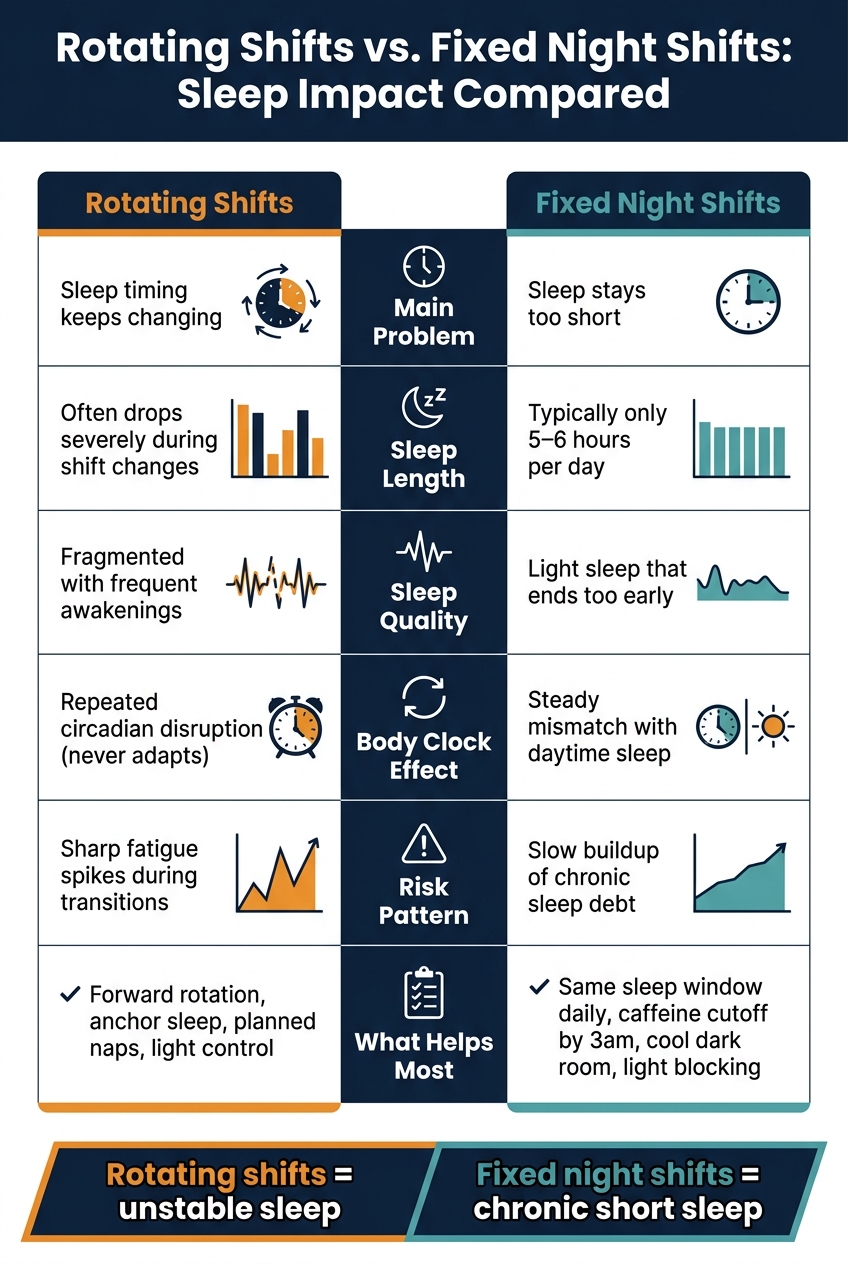
Rotating Shifts vs. Fixed Night Shifts: Sleep Impact Compared
How to Defeat Jet Lag, Shift Work & Sleeplessness | Huberman Lab Essentials
sbb-itb-5106bd1
Quick Comparison
| Sleep factor | Rotating shifts | Fixed night shifts |
|---|---|---|
| Main problem | Sleep timing keeps changing | Sleep stays too short |
| Sleep length | Often drops during shift changes | Often stays around 5–6 hours |
| Sleep quality | More fragmented and uneven | Lighter sleep, often ends early |
| Body clock effect | Repeated circadian disruption | Steady mismatch with daytime sleep |
| Main risk pattern | Sharp fatigue during transitions | Slow build of sleep debt |
| What helps most | Forward rotation, anchor sleep, naps, light control | Same sleep window daily, light control, caffeine cutoff, cool dark room |
If I had to sum it up in one line: rotating shifts are usually harder on sleep overall, but fixed night shifts can wear you down through chronic sleep loss.
Rotating shifts vs. fixed shifts: Sleep challenges side by side
Rotating shifts keep moving the target. Fixed night shifts are more stable, but they still push sleep into the wrong part of the day.
| Feature | Rotating Shifts | Fixed Night Shifts |
|---|---|---|
| Sleep Duration | Highly variable; often severely shortened during transitions | Chronically short - typically 5–6 hours |
| Sleep Quality | Fragmented, with frequent awakenings and broken rest | Light and easily disrupted, with sleep that ends too early |
| Timing Consistency | Poor; sleep window shifts constantly, preventing adaptation | High; allows for a repeatable daytime routine |
Rotating shifts: Unpredictable sleep, slower circadian adjustment, more fragmented sleep
Rotating shifts make steady sleep hard to hold onto. The body clock never gets enough time to settle before the schedule changes again. Each switch can feel like hitting reset, especially with backward rotations or fast turnarounds.
That leads to a few common problems: more awakenings during sleep, longer time to drift off, and stronger waves of sleepiness during shift changes. In plain terms, the body is always trying to catch up and rarely gets there.
Fixed night shifts: Steadier routines, but chronic short sleep
Fixed night shifts do offer one clear edge: the sleep window stays more predictable. That makes it easier to build a routine around work, meals, and rest. But stability doesn't mean enough sleep.
For many night workers, daytime sleep still gets cut short. As core body temperature rises, the body keeps pushing toward wakefulness. Add light coming through the window, household noise, and family or home demands, and sleep often ends earlier than planned. The pattern is steady, but it's often stuck at too little sleep.
Health and well-being differences between the two schedules
The two schedules wear people down in different ways. Rotating shifts tend to trigger sharp sleep loss during transitions. Fixed night shifts tend to create a slower, steady buildup of sleep debt. One hits like a jolt; the other creeps up over time.
That distinction matters because the risks don't show up the same way. Rotating workers may deal with abrupt drops in alertness, while fixed night workers may face a more constant drag from fatigue. Those differences shape how each schedule should be managed.
How to manage sleep on rotating shifts
Rotating shifts usually go better when you keep reset time short and guard your sleep after working nights. Since these schedules keep pushing your sleep timing around, the job is simple in theory and hard in practice: hold onto one steady sleep block and make each switch less disruptive.
| Strategy | When to Use | Problem Addressed |
|---|---|---|
| Forward Rotation | When designing or choosing shift patterns | Difficulty adjusting to backward rotation |
| Anchor Sleep | Daily, regardless of shift | Circadian misalignment and inconsistent sleep windows |
| Planned Naps | Before night shifts or during approved breaks | Chronic sleep debt and nighttime sleepiness |
| Light Management | Bright light during shift; darkness before sleep | Morning light exposure triggering premature awakening |
| Cool Bedroom | During daytime sleep periods; aim for 60–67°F | Circadian rise in body temperature triggering early waking |
Forward rotation, anchor sleep, and planned naps to cut down on disruption
If you have any say in your schedule, forward rotation - day to evening to night - tends to be easier on the body than going in reverse.
Another useful tool is anchor sleep. The idea is to keep one block of sleep at the same time every day, even when your shifts change. That gives your body one steady point to hang onto during the week.
Short naps can also help before a night shift. Just be careful with timing. If you wake up from deep sleep right before work, you may get hit with sleep inertia - that heavy, foggy feeling after waking. It tends to be worst when your body is least ready to be awake.
Managing light and bedroom conditions after overnight work
Light plays a big part in setting your internal clock. During the shift, use bright light to help stay alert. After work, do the opposite and cut down morning light on the way home. Wearing sunglasses while driving or walking home after an overnight shift is a simple move that can help block that signal.
Once you get home, your bedroom setup matters too. Keep the room cool - around 60–67°F - to help daytime sleep last longer.
Fixed schedules call for a different approach: protect a repeatable sleep window and make sure total sleep time doesn’t keep slipping.
How to manage sleep on fixed night and evening shifts
Fixed night shifts are usually easier to handle because the schedule doesn’t keep moving. That consistency gives your body a better shot at settling into a pattern. Even then, daytime sleep often tops out at 5–6 hours because your body is still wired to wake during the day. The point isn’t just to “adjust.” It’s to protect enough sleep, every single day.
Building a repeatable daytime sleep routine that protects total sleep time
If you work a fixed night schedule, the biggest win is keeping the same sleep window every day - including days off. Flipping back on weekends can wipe out the adjustment you built during the week.
Be direct with the people you live with about when you’ll be asleep. Treat that window like any other non-negotiable part of your day. A few basics make a big difference:
- Block morning light on the way home
- Go to sleep at the same time each day
- Keep your room dark and quiet
- Wake up to bright light
Simple? Yes. But this is the stuff that keeps the whole routine from falling apart.
Timing caffeine, meals, and light to support sleep after work
Once your sleep window is locked in, timing matters. A lot. Cut off caffeine by about 3:00 a.m. so it has time to wear off before your sleep block starts. Before bed, go with a light meal that’s high in protein instead of something heavy.
Light exposure matters too. On the commute home, wear sunglasses or blue-light blocking glasses. That can help keep morning light from shutting down melatonin right before you’re trying to sleep.
Where natural sleep support fits into a fixed or irregular schedule
RST Sleep can fit into either a fixed or irregular night schedule as part of your wind-down routine. It includes glycine, phosphatidylserine, magnolia bark, extended-release melatonin, and apigenin. Paired with a steady routine, it supports the same goal: protecting daytime sleep after night work.
Conclusion: Which schedule is harder on sleep and what to do about it
The answer mostly comes down to one thing: does the schedule keep changing, or does it stay the same?
In general, rotating shifts are harder on sleep. When work hours keep moving around, your body clock has to reset again and again. That leads to broken sleep and a higher risk of SWSD. Fixed shifts are more stable, but fixed night work still cuts sleep short. As body temperature starts to rise in the morning, sleep gets harder to hold onto, which often leaves people with only 5–6 hours of rest.
Studies note that daytime sleep after night work is often light and limited to 5–6 hours.
Put simply, rotating shifts tend to create unstable sleep, while fixed night shifts often lead to chronic sleep loss. Either way, the strain can build over time and affect health.
The main fixes are simple:
- Protect your sleep window
- Manage light and consider natural ingredients supporting sleep
- Keep the bedroom dark and cool
If those basics don't help, it's no longer just a routine issue. Persistent insomnia, severe sleepiness, or fatigue that affects work or driving needs medical evaluation. It may point to SWSD or another sleep disorder.
FAQs
Why are rotating shifts harder on sleep?
Rotating shifts are tough on sleep because they keep throwing off the link between your circadian rhythm and your work hours. Put simply, your schedule keeps changing, but your body clock doesn’t switch on command.
That usually means trying to sleep when your body is set up to be awake, and pushing yourself to stay awake when your body expects sleep.
The result? It can be harder to fall asleep and harder to stay asleep, which cuts into restorative sleep. Over time, workers may deal with daytime sleepiness, insomnia, and lower alertness.
Can fixed night shifts feel sustainable?
They’re tough for a simple reason: night shifts flip your body’s built-in clock upside down. You’re trying to sleep when your brain wants to be awake, then work when your body is set to rest. That mismatch can lead to excessive sleepiness on the job and insomnia when it’s time to sleep.
What tends to help most is a steady routine, solid sleep habits, and support for a healthier sleep cycle with natural, non-habit-forming supplements like RST Sleep.
When should I ask a doctor about SWSD?
Ask a doctor if you have persistent SWSD symptoms - like trouble falling asleep, staying asleep, or feeling very sleepy while you're awake - because your work schedule conflicts with your natural circadian rhythm.
If these problems are affecting your health or day-to-day performance, a physician may use sleep diaries, questionnaires, or sleep studies to check whether a sleep disorder is present.