

Q&A: Common Sleep Issues for Shift Workers
If you work nights or rotating shifts, your sleep problem is often a body-clock problem. About 50% to 62% of shift workers deal with sleep trouble, compared with 5% to 11% of day workers.
Here’s the short answer: if you can’t sleep after work, wake too soon, or feel half-asleep on shift, the main issue is often light at the wrong time and a sleep schedule your body doesn’t like. What helps most is simple: block morning light, keep your room dark/quiet/cool, protect your sleep window, and time caffeine, naps, and bright light with care.
If I had to boil the article down, it would be this:
- Can’t fall asleep after a shift? Cut light on the way home, keep the first hour calm, and use the same wind-down steps each day.
- Wake up after only a few hours? Your daytime sleep is easier to break up because of light, noise, and your body’s natural drive to be awake.
- Struggling to stay awake at work? The hardest hours are often 2:00 a.m. to 6:00 a.m. Use bright light, early-shift caffeine, short naps, water, and brief movement breaks.
- Still not sleeping well after a few weeks? Loud snoring, gasping, or dozing off while driving or talking are warning signs that need a doctor, not just sleep tips.
- Where does a supplement fit? If your routine is solid and sleep is still off, a non-habit-forming option like RST Sleep may fit as part of your pre-bed routine.
Quick comparison:
| Problem | What it often feels like | What to focus on |
|---|---|---|
| Trouble falling asleep | Tired, but awake in bed after work | Block light, dim the room, keep a set wind-down routine |
| Waking too early | Sleep starts, then breaks after a few hours | Dark, quiet, cool room; protect time in bed; add a pre-shift nap if needed |
| Sleepiness during shift | Heavy slump, often overnight | Bright light, well-timed caffeine, short naps, movement, hydration |
| Red-flag sleep trouble | Unsafe sleepiness, snoring, gasping | Get medical help |
The big idea is simple: shift-work sleep gets better when you treat sleep like a scheduled job, not something you “fit in” later.
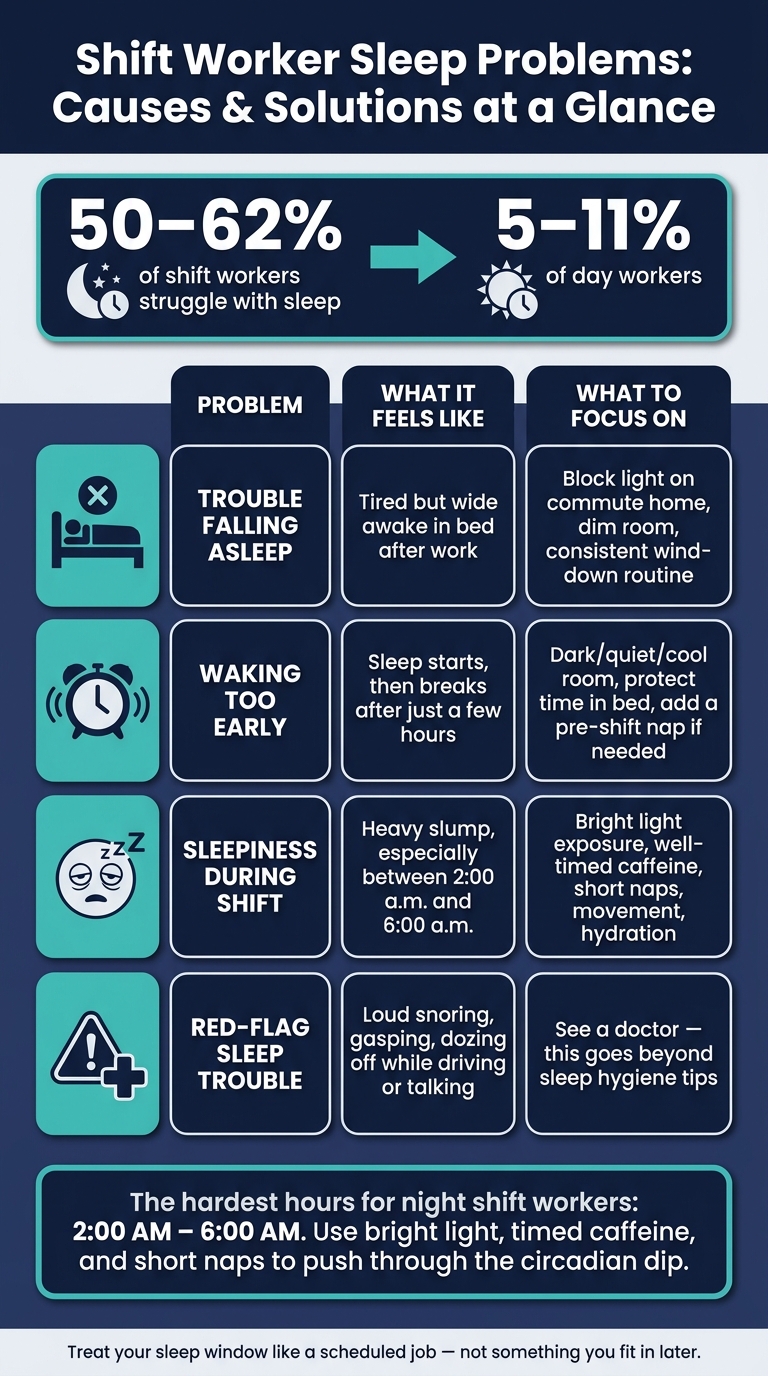
Shift Worker Sleep Problems: Causes & Solutions at a Glance
How to Survive Night Shifts from a Sleep Expert | Management of Shift Work Sleep Disorder
sbb-itb-5106bd1
How to Fall Asleep Faster After a Night or Rotating Shift
### Why Falling Asleep After Work Is So Hard
The first challenge is getting your body to shift into sleep mode when you walk through the door. After a night shift, that’s often easier said than done. Even if you feel wiped out, morning light and a body clock that’s still out of sync can keep you awake. Morning light can suppress melatonin, and sleep timing may move only slowly after back-to-back night shifts.
What to Do in the First Hour After Getting Home
That’s why the first hour after work matters so much. Treat it like a signal to your brain: it’s time to sleep now.
Block light on the way home and keep your bedroom dark. Sunglasses, dim lights at home, blackout curtains, and a sleep mask can all help cut down the light that tells your body to stay alert.
Keep the hour before bed calm and predictable. A short wind-down routine, done the same way each day, can help your brain connect that pattern with sleep.
When a Natural Sleep Supplement May Fit Into Your Routine
If your routine is in place and sleep still falls apart, a supplement may make sense as the final piece. RST Sleep can fit into your wind-down routine if light control and a steady schedule still leave you lying awake. It combines glycine, phosphatidylserine, magnolia bark, extended-release melatonin, and apigenin to support relaxation and sleep timing - and is non-habit forming. Take it 30 to 60 minutes before bed as part of your regular routine.
How to Stay Asleep Longer During Daytime Sleep
Why Daytime Sleep Is Often Light and Broken
Falling asleep after a night shift is only half the battle. Staying asleep is usually the tougher part.
As the morning moves on, your body temperature starts to go up on its own. Sleep, though, works best when your core temperature is lower. When that temperature rises, your brain gets a cue to wake up. Add in morning light and daytime noise, and it’s easy to see why daytime sleep can feel thin and easy to interrupt.
That’s why the goal is simple: make daytime sleep feel as much like nighttime as you can.
How to Set Up Your Bedroom for Uninterrupted Sleep
Start with the basics. Keep the room dark, quiet, and cool.
- Use blackout curtains or a sleep mask to block light.
- Use earplugs or white noise to cut down sound.
- Keep the room cool to help support sleep.
Also, silence your phone and turn off notifications. A single call, text, or app alert can pull you out of sleep when your body is already fighting to stay there.
Once your room is set, the next step is giving yourself enough time in bed.
How Much Sleep to Aim For and When to Split It
If you can’t get one full block of sleep, sleep as long as possible after work. Then add a short nap before your next shift.
If you’re still not getting enough sleep, the next issue becomes staying alert on the job.
How to Stay Alert During a Shift
Why Alertness Drops at Certain Hours
The same body-clock mismatch that makes daytime sleep tough also fuels that overnight slump. Alertness tends to drop at set times. If you work nights, the hardest stretch is usually between 2:00 a.m. and 6:00 a.m., when your circadian system is pushing for sleep the hardest.
There can also be a second dip in the early afternoon. That helps explain why people on rotating shifts may feel tired at odd hours, even when the timing seems random.
What Helps You Stay Alert at Work
The best tools are the ones that work with your body clock: bright light, well-timed caffeine, naps, movement, and hydration.
Bright light is one of the best options. Getting bright light in the workplace during your shift helps keep your brain more awake, especially overnight.
Caffeine timing matters too. If you use caffeine earlier in the shift, it can help you stay awake without making post-shift sleep harder.
A short nap before work or a brief nap during a break can also take the edge off the worst part of the circadian dip. Add water and short movement breaks during the overnight danger zone, and you give yourself a better shot at staying awake when your body most wants to power down.
It also helps to skip antihistamine-based sleep aids or natural ingredients supporting sleep. They can leave you groggy on your next shift.
Quick Comparison of Common Shift-Work Sleep Problems
These problems show up in different ways, but they often come from the same basic pattern.
| Problem | Likely Cause | Practical Focus |
|---|---|---|
| Excessive sleepiness during shift | Strong circadian dip overnight, usually between 2:00 a.m. and 6:00 a.m. | Timed bright light, planned naps, caffeine used at the right time |
When Sleep Problems Need More Than a Schedule Fix
Warning Signs Your Sleep Problem May Be More Serious
If better light control, sleep timing, and bedroom setup still don't help, the issue may be medical. At that point, you're likely dealing with more than circadian misalignment.
Loud snoring or gasping during sleep can point to sleep apnea. Falling asleep by accident during a commute, a conversation, or a break at work is another red flag. That's not just being tired. The same goes for exhaustion that affects driving, reaction time, or job safety.
Sleep trouble can also be tied to depression, especially if your mood has changed too. Those signs call for a medical evaluation, not just the usual sleep fixes.
Key Takeaways for Better Sleep With Shift Work
Most shift-work sleep problems get better with light control, a steady routine, and a protected sleep window. Stick with the basics:
- Treat your sleep window as nonnegotiable
- Cut light after work
- Keep your bedroom dark, quiet, and cool
- Use alertness tools early enough that they don't push sleep later
A natural sleep supplement like RST Sleep can fit into a wind-down routine when schedule changes alone aren't enough.
If you've made steady changes for several weeks and still can't fall asleep, stay asleep, or wake up rested, it's time to talk to a doctor. Bring notes on your sleep timing, how long it takes you to fall asleep, and any symptoms that show up during sleep. The more specific you are, the easier it is to figure out what's actually going on.