

How Progressive Muscle Relaxation Supports Circadian Rhythm
Progressive Muscle Relaxation (PMR) is a simple yet effective technique to improve sleep quality and duration by reducing stress and aligning your body with its natural rhythms. This is a key part of learning how to fix your sleep cycle effectively. It works by tensing and relaxing muscle groups, shifting your body from a "fight-or-flight" state to a calm "rest-and-digest" mode. This not only helps you fall asleep faster but also supports better sleep continuity, even for those with irregular schedules like shift workers.
Key Takeaways:
- PMR Basics: Involves tensing each muscle group for 5 seconds, then releasing for 10 seconds.
- Sleep Benefits: Reduces stress, lowers heart rate, and improves sleep latency and duration.
- Circadian Rhythm: While PMR doesn’t directly reset your internal clock, it helps your body relax, making sleep easier at unconventional hours.
- Research Insights: Studies show PMR improves sleep quality across diverse groups, from healthy adults to those with chronic sleep issues.
For irregular schedules, combining PMR with tools like extended-release melatonin (e.g., RST Sleep) can further enhance sleep by addressing both physical and biochemical barriers. PMR is easy to learn, non-invasive, and can be practiced in just 10–20 minutes daily.
PMR (Progressive Muscle Relaxation) to Help Release Tension, Relieve Anxiety or Insomnia
sbb-itb-5106bd1
How Progressive Muscle Relaxation Affects Sleep Biology
Progressive Muscle Relaxation (PMR) triggers physical changes in the body that help promote better sleep. These changes work together to ease the transition into rest and support your natural sleep-wake cycle.
Reducing Sympathetic Nervous System Activation
Think of the sympathetic nervous system (SNS) as your body’s accelerator. It keeps your heart racing, muscles tense, and mind alert - great for handling daytime demands, but not so helpful when bedtime rolls around. Stress from work, late-night exercise, or even excessive screen time can keep your SNS in overdrive, making it tough to wind down.
PMR steps in by systematically relaxing your muscles, which signals your body to shift gears from the SNS to the parasympathetic nervous system (PNS) - your body’s “brake pedal.” Dr. Matthew Kampert, a Sports Medicine Physician at Cleveland Clinic, explains:
"With progressive muscle relaxation, you're trying to calm down that sympathetic output and let your parasympathetic system take over. When that switch happens, you can see a change in your heart rate and blood pressure."
This shift not only reduces physical tension but also fosters a sense of mental calm.
Lowering Muscle Tension and Pre-Sleep Arousal
Physical tension and mental restlessness often go hand in hand. A clenched jaw or stiff shoulders can keep your mind racing, while an anxious mind leaves your muscles braced. PMR helps break this cycle by starting with the body.
By cycling through tension and release in different muscle groups, PMR encourages your muscles to let go of built-up stress - something that doesn’t always happen just by lying down. This release has a ripple effect, calming the mind and reducing the mental overactivity that can make it hard to drift off. In fact, studies have shown PMR to be as effective as acupuncture in lowering anxiety levels, highlighting its ability to address both physical and mental pre-sleep challenges.
Effects on Sleep Onset and Continuity
When your nervous system slows down and your muscles relax, your body is set up for sleep. A PMR session typically takes just 10–20 minutes, making it a practical addition to your bedtime routine. By actively countering the stress and tension of the day, PMR helps you fall asleep faster and stay asleep longer, promoting the deep, uninterrupted rest that keeps your sleep cycle balanced.
Research on Progressive Muscle Relaxation and Sleep Outcomes
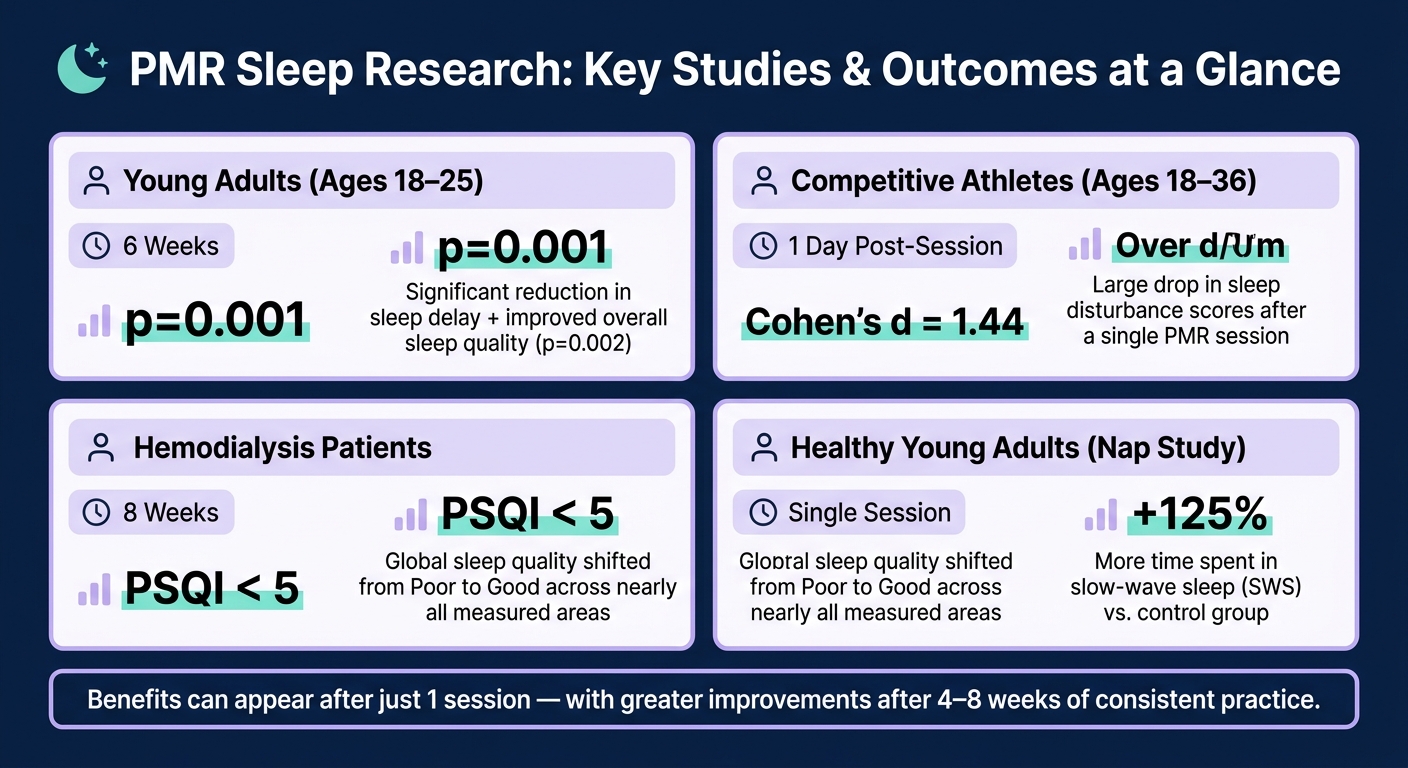
PMR Sleep Research: Key Studies & Outcomes at a Glance
Recent studies highlight how progressive muscle relaxation (PMR) can positively impact sleep quality across various groups, from healthy individuals to those with chronic sleep issues.
Evidence from Healthy Adult Populations
A 2019 study from Marmara University, published in the Archives of Health Science and Research, examined 84 young adults aged 18 to 25. Participants practiced PMR combined with diaphragmatic breathing for six weeks, seven days a week. Results showed a notable reduction in sleep delay (p=0.001), less daytime drowsiness (p=0.002), and better overall sleep quality (p=0.002) compared to the control group.
In another study from 2024, researchers focused on 24 competitive athletes aged 18 to 36, a group often under sleep-related stress due to high-pressure environments. Within just one day of a single PMR session, the experimental group experienced a significant drop in sleep disturbance scores (p=0.006), with a large effect size (Cohen's d=1.44). The control group showed no measurable changes.
Findings from Populations with Sleep Disruptions
The benefits of PMR are even more apparent in individuals with pre-existing sleep problems. A 2022 trial conducted at a Konya dialysis center involved 76 hemodialysis patients, a population where sleep problems affect 40%–83%. Participants in the intervention group practiced PMR twice daily for eight weeks using guided video instructions.
By the end of the trial, the intervention group's global Pittsburgh Sleep Quality Index (PSQI) scores fell below 5, marking the shift from poor to good sleep quality. Improvements were observed in nearly all measured areas, including sleep latency, total sleep duration, habitual sleep efficiency, and daytime functionality.
Another 2022 study, led by Katharine C. Simon at UC Irvine, explored PMR's effects on daytime naps. Healthy young adults who practiced PMR before a 90-minute nap spent 125% more time in slow-wave sleep (SWS) - the most restorative sleep stage - compared to a control group that listened to Mozart. This is particularly relevant for those managing fatigue due to irregular schedules.
Key Takeaways from PMR Studies
The research consistently highlights PMR's benefits:
| Population | Study Duration | Key Sleep Outcome |
|---|---|---|
| Young adults (18–25) | 6 weeks | Reduced sleep delay (p=0.001) and improved sleep quality (p=0.002) |
| Competitive athletes (18–36) | 1 day post-intervention | Significant drop in sleep disturbance scores (Cohen's d=1.44) |
| Hemodialysis patients | 8 weeks | Global PSQI score moved from "poor" to "good" (below 5) |
| Healthy young adults (nap study) | Acute/single session | 125% more time in slow-wave sleep |
Some benefits, like reduced sleep disturbances, can appear after just one PMR session. However, more substantial improvements, such as better sleep quality and efficiency, tend to emerge after four to eight weeks of consistent practice. PMR's ability to help such diverse groups - from healthy students to those with chronic illnesses - makes it a versatile, non-drug method for improving sleep. Its role in enhancing sleep metrics also suggests potential for aiding circadian rhythm regulation, especially for individuals with irregular schedules. These findings point to PMR as a practical tool for addressing sleep challenges.
Progressive Muscle Relaxation for Circadian Rhythm Disruption
PMR's Role in Supporting Sleep Regularity
For those seeking natural ways to manage their circadian rhythm - whether they're night shift workers, rotating shift employees, or frequent travelers - the main challenge often isn't just falling asleep. It's about training the body to sleep at unusual hours. While Progressive Muscle Relaxation (PMR) can't single-handedly reset your internal clock, it helps remove physical barriers to sleep by consistently triggering the parasympathetic response, no matter the time of day. Dr. Matthew Kampert, a Sports Medicine Physician at Cleveland Clinic, explains that this response leads to measurable changes in heart rate and blood pressure, making it easier to fall asleep even outside a traditional schedule.
This calming effect not only makes it easier to transition into sleep but also sets the stage for better stress management during waking hours.
Reducing Daytime Stress and Fatigue
Circadian disruptions don’t just interfere with nighttime rest - they can also cause brain fog, irritability, and low energy during the day. Practicing PMR can be a game-changer here. Whether you're at your desk, on a break, or commuting, PMR offers a way to stop stress in its tracks before it drains your energy. By easing muscle tension, PMR helps conserve energy that might otherwise be lost to chronic stress, promoting alertness and aiding in recovery throughout the day.
While these benefits help you feel more awake and refreshed, it’s important to note that they don’t directly alter your body’s circadian rhythm.
Can PMR Directly Shift Circadian Phase?
The evidence so far suggests that PMR doesn’t directly shift your circadian phase. Unlike light exposure or timed melatonin, PMR won't reset your internal clock. Instead, it works by breaking the cycle of stress and muscle tension, which signals the brain to stay alert and makes falling asleep more difficult.
How to Use Progressive Muscle Relaxation in Your Sleep Routine
Progressive Muscle Relaxation (PMR) can be a helpful addition to your nightly routine, especially for improving sleep and maintaining a healthy circadian rhythm. Here's how to make it a part of your evening wind-down.
How to Practice PMR Step by Step
To get started, find a quiet, comfortable spot where you won’t be disturbed. You can lie down or sit in a relaxed position, wearing loose, comfortable clothing. Close your eyes and take a few slow, deep breaths to settle your mind and relax your body.
The process involves tensing and relaxing each major muscle group in a specific order, starting at your feet and moving upward. For each group, inhale deeply, contract the muscles firmly for about 5 seconds, then exhale and release, letting the tension melt away. Focus on the difference between the sensation of tension and relaxation before moving to the next group.
Here’s a suggested sequence to follow:
| Muscle Group | How to Tense It |
|---|---|
| Feet/Toes | Curl your toes downward or fan them out, arching your foot |
| Calves | Pull your toes upward toward your knees |
| Buttocks | Squeeze your glutes tightly |
| Abdomen | Tighten your stomach muscles as if bracing for impact |
| Hands | Clench your hands into fists |
| Shoulders | Shrug your shoulders up toward your ears |
| Face | Scrunch your eyes, nose, and mouth tightly |
A full session typically lasts 10–20 minutes. If you’re new to PMR, consider using a guided app to help you through the process.
"PMR is a relaxation method that allows you to focus on something, which is great for people who get frustrated at the challenge of quieting their mind." - Claudia Zurlini, Certified Meditation Instructor
Best Times to Practice PMR
Once you’re comfortable with the technique, timing your sessions can enhance its benefits. Ideally, practice PMR right before your planned sleep time. For those working night shifts, this might mean using PMR to unwind at unconventional hours, like 8:00 AM or 2:00 PM, depending on your schedule.
A 2024 study in the journal Burns revealed that practicing PMR for 20–30 minutes daily over three consecutive days significantly improved sleep quality.
Combining PMR with Other Sleep Habits
PMR works best when paired with other healthy sleep practices. Here are some tips to create an environment that promotes relaxation and rest:
- Keep your bedroom cool, between 60–67°F.
- Use blackout curtains to block out light.
- Consider a white noise machine to drown out disruptive sounds.
- Try the 4-7-8 breathing technique before starting PMR: inhale for 4 counts, hold for 7, and exhale for 8. This can stimulate the vagus nerve and help your brain prepare for sleep.
Additionally, avoid caffeine for at least 10 hours before bedtime and limit screen exposure an hour before you plan to sleep. If you’re on blood pressure medication, remember to stand up slowly after a PMR session, as the deep relaxation can temporarily lower your blood pressure.
Limitations of Current Research on PMR and Circadian Rhythm
PMR has a strong foundation as a relaxation technique, but its role in regulating circadian rhythms is still not fully understood. Recognizing the gaps in current research is crucial for applying PMR effectively in this area.
Small Sample Sizes in PMR Studies
One of the biggest challenges in PMR research is the limited number of participants in most studies. For instance, a 2024 study involving athletes had only 24 participants - 12 in the intervention group and 12 in the control group. As Medical News Today points out:
"Many of these studies involved a low number of participants, so more research on the specific applications of PMR is necessary."
Additionally, these studies often focus on niche groups, such as hemodialysis patients or competitive athletes, rather than broader populations. This narrow focus makes it harder to apply findings universally. The small sample sizes also raise questions about how long and how deeply PMR’s benefits might last.
Short Study Durations
Another limitation is the brief duration of many studies. Some measure results as soon as one day after a single PMR session. While this can demonstrate immediate benefits, it doesn’t provide insight into whether those effects are sustainable. Even longer studies, like an 8-week trial with 76 hemodialysis patients, didn’t explore whether the improvements continued after the intervention ended. Without extended follow-up periods, the long-term impact of PMR remains unclear.
Relaxation Effects vs. Circadian Phase Shifts
A critical issue in PMR research is distinguishing between relaxation and actual shifts in circadian rhythms. Feeling relaxed before bed doesn’t necessarily mean your biological clock has shifted.
Most studies rely on subjective assessments, like the Pittsburgh Sleep Quality Index (PSQI), instead of objective markers such as Dim Light Melatonin Onset (DLMO) or core body temperature changes. This lack of biological data makes it harder to confirm whether PMR impacts circadian timing. For example, in the hemodialysis trial, one researcher suggested that increased interaction with participants might have influenced their sense of well-being:
"The researcher's increased interaction with the intervention group for teaching and reminders about the exercises might have created a subjective sense of well-being." - Halime Gökhan Hakverir, Hemodialysis Nurse
Ultimately, while PMR can help the body relax and prepare for sleep by reducing nervous system arousal, it doesn’t appear to directly adjust the internal clock. This distinction is especially important for people dealing with irregular sleep schedules.
Natural Sleep Support for Irregular Schedules: RST Sleep
Progressive Muscle Relaxation (PMR) is great for easing physical tension, but for those with irregular schedules, it might not be enough to fully trigger the sleep process. When your body's natural circadian rhythm is out of sync with day-night cycles, the addition of a biochemical sleep signal can make a big difference. This is where extended-release melatonin comes into play - it helps nudge the body toward sleep despite disrupted circadian cues. Enter RST Sleep, a product designed to complement PMR and provide that extra nudge toward restorative sleep.
How RST Sleep Complements PMR
PMR helps calm the body by shifting it from a "fight-or-flight" mode to a more relaxed "rest-and-digest" state, which naturally lowers heart rate and blood pressure. Building on this, RST Sleep introduces extended-release melatonin, which offers a steady sleep signal to help with both falling asleep and staying asleep. It also includes glycine, which enhances the relaxation initiated by PMR, helping the body settle into a deeper state of rest. Together, PMR and RST Sleep create a two-pronged approach: PMR handles physical relaxation, while RST Sleep’s ingredients support biochemical signals for better sleep onset and continuity.
Why RST Sleep Works for Night Shift Workers
Night shift workers often face chronic fatigue and difficulty functioning during the day due to their irregular schedules. RST Sleep’s formula was specifically designed to tackle these challenges. Alongside extended-release melatonin and glycine, it features phosphatidylserine, magnolia bark, and apigenin - ingredients chosen to address hormonal and biochemical imbalances caused by shift work and misaligned circadian rhythms.
What sets RST Sleep apart is its non-habit-forming nature and allergen-conscious formulation. Plus, it’s produced in GMP-certified facilities, ensuring it meets high standards of quality and safety. For those working night shifts who need dependable, science-driven support, RST Sleep pairs perfectly with a PMR routine to promote better sleep night after night.
Conclusion: PMR and Circadian Rhythm Support
Progressive Muscle Relaxation (PMR) is an accessible and effective way to ease your body out of the "fight-or-flight" state and into a calm, sleep-ready mode. With decades of use behind it, this method addresses both the physical and mental tension that can interfere with restful sleep. A short 10–20 minute session can help create a smoother transition to sleep.
For those with irregular schedules, incorporating PMR both during the day and before bedtime can reinforce your body's natural sleep cues, helping to establish a more consistent sleep rhythm. If PMR alone doesn’t fully address sleep challenges, adding biochemical support may further improve sleep quality.
Research supports combining PMR with targeted biochemical aids - like extended-release melatonin and glycine, as found in RST Sleep - to help bridge the gap between relaxation and deep sleep.
FAQs
How fast does PMR help you fall asleep?
Progressive muscle relaxation (PMR) is a technique that can help you drift off to sleep in just 10 to 20 minutes of practice. By focusing on reducing muscle tension and easing stress, PMR encourages both your body and mind to relax. It’s especially helpful for quieting a busy mind and getting your body ready for deep, restorative sleep.
Can PMR help if you sleep during the day?
Progressive muscle relaxation (PMR) can help improve daytime sleep by encouraging relaxation and boosting slow-wave sleep during naps. This method is especially helpful for people with irregular schedules who want to enhance the quality of their rest.
Should I combine PMR with RST Sleep?
Pairing progressive muscle relaxation (PMR) with RST Sleep could boost sleep quality, particularly for people dealing with irregular routines or elevated stress levels.
PMR helps by easing stress and encouraging a state of calm, while RST Sleep is designed to support natural sleep cycles. When combined, these methods can enhance relaxation and may aid in balancing circadian rhythms, making it easier to fall and stay asleep.
For personalized advice, it's always a good idea to consult a healthcare professional who can guide you toward the most effective approach for your situation.