

Science of Post-Shift Sleep Recovery
If I work nights, my sleep after the shift usually gives me less recovery than normal night sleep. The main reason is simple: my body clock is still pushing me to stay awake during the day, so post-shift sleep is often shorter, lighter, and more broken up.
Here’s the short version:
- Daytime sleep is less efficient than night sleep
- In one study, sleep efficiency was about 39% in a daytime sleep window vs. 71% at night
- One sleep period may not be enough to get me back to baseline after a night shift
- Time in bed is not the same as time asleep
- After a shift, I need to focus on:
- sleeping as soon as it fits my schedule
- keeping my room dark, cool, and quiet
- limiting bright light on the way home
- using a short, repeatable wind-down routine
- tracking recovery with objective data when I can
What this means for me is straightforward: post-shift recovery depends less on how long I lie down and more on how much sleep I actually get. That’s the core idea behind the research, and it shapes how I should think about timing, sleep quality, and recovery after night work.
Night Shift Recovery: Fix Your Sleep and Energy
sbb-itb-5106bd1
What Studies Show About Recovery After Night Shifts
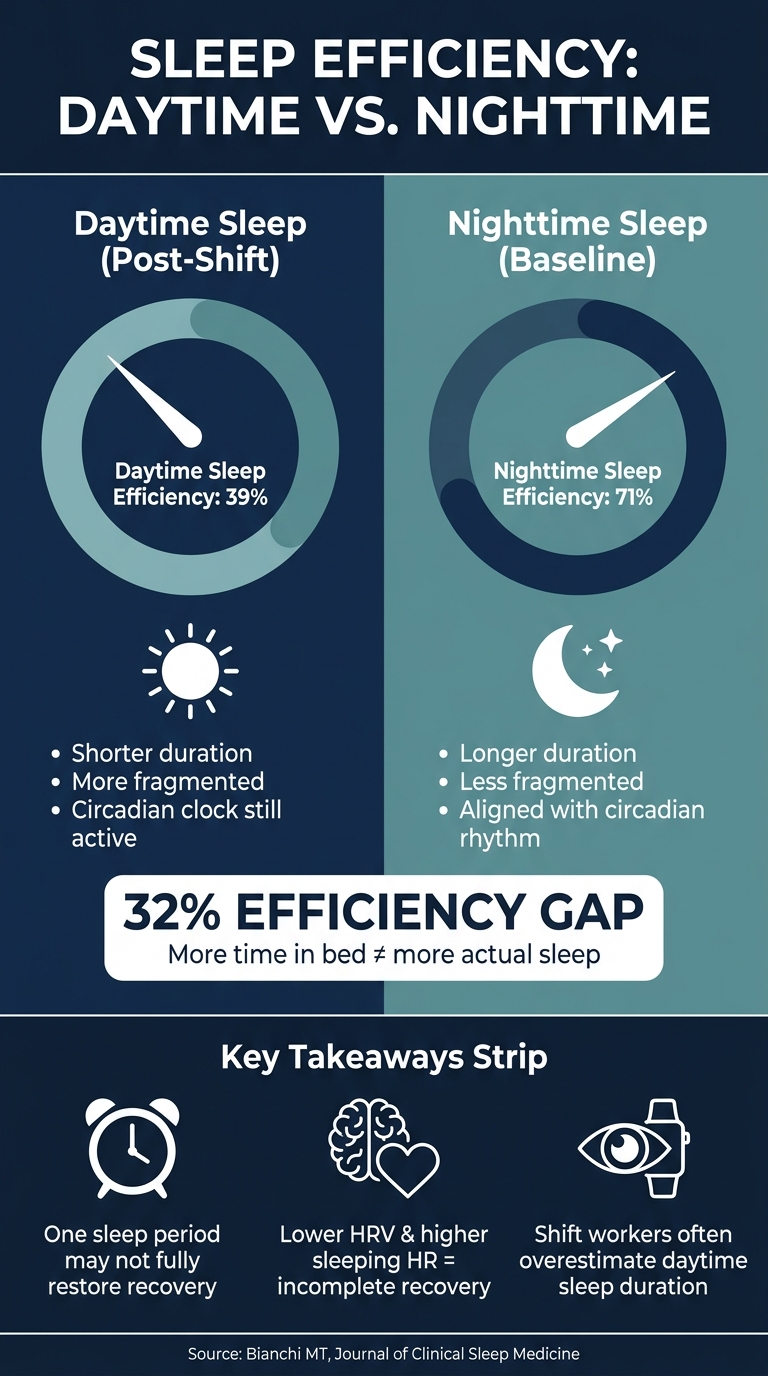
Daytime vs. Nighttime Sleep Efficiency After Night Shifts
Daytime Sleep Is Usually Shorter and More Fragmented
Studies show that sleep after a night shift is shorter and more fragmented than nighttime sleep. In one study, daytime sleep efficiency was about 39%, versus 71% at night.
That leads to the next point: is it better to sleep better after working nights by resting right after the shift, or waiting until later?
Recovery Often Takes More Than One Sleep Period
One post-shift sleep block often does not fully reverse the sympathetic–parasympathetic imbalance caused by night work. In plain terms, one stretch of sleep usually isn't enough to reset what the body went through overnight.
That imbalance can build when sleep is repeatedly interrupted, so cumulative sleep loss adds to the physical cost of shift work.
Results Vary by Schedule and Circadian Adaptation
Results also vary because not all shift workers adjust in the same way. Permanent night shift workers still show a more alert sleep physiology. So even when someone works nights on a regular schedule, the body may not fully move into restorative parasympathetic dominance.
That’s why sleep timing matters just as much as sleep duration.
Because adaptation differs by schedule, timing and sleep length matter next. Using a sleep schedule checklist for irregular workers can help manage these variables.
Sleep Timing and Duration After Shift Work
Sleeping Soon After the Shift vs. Delaying Sleep
One sleep period may not be enough to bring you back to baseline. So the next issue is timing. If you sleep soon after a night shift, that usually means sleeping during the day. And daytime sleep is less efficient than nighttime sleep. That’s why the choice matters: go to bed right away, or stay awake and sleep later.
There’s another wrinkle here. People who sleep during the day often get their sleep estimate wrong. As Bianchi MT noted:
"The subjective reports following nighttime 12-h sleep opportunities significantly underestimated objective sleep duration, while those following daytime 4-h sleep opportunities significantly overestimated objective sleep duration." - Bianchi MT, Journal of Clinical Sleep Medicine
That mismatch between what people think they slept and what they actually slept helps explain why sleep strategy matters just as much as sleep length.
How Much Sleep Supports Recovery Without Disrupting the Next Sleep Window
After a night shift, the aim is simple: get enough actual sleep to recover alertness before the next shift. The catch is that daytime sleep is less efficient, so more time in bed doesn’t always mean more sleep.
The evidence points to one clear takeaway: because daytime sleep is less efficient, post-shift recovery depends more on the amount of sleep you actually get than on the amount of time you spend in bed.
Evidence-Based Steps to Improve Post-Shift Recovery
Control Your Sleep Environment and Light Exposure
Once you've got your sleep timing set, the next step is to clean up the room itself. Keep it cool, dark, and quiet, and block bright light on the commute home. A cooler room can help cut down on awakenings and support deeper sleep.
Then stick with the same pre-sleep pattern each time. That consistency helps your body shift into sleep mode with less friction.
Use Wind-Down Routines
Keep the last 30 minutes before sleep low-light and low-stimulation. Use the same short routine after each shift so your brain starts to link those cues with sleep.
Where a Natural Sleep Supplement May Fit In
If daytime sleep still doesn't come easily, melatonin may help with sleep onset after night work. For workers who want a natural sleep aid for daytime rest after night work, RST Sleep combines extended-release melatonin, glycine, phosphatidylserine, magnolia bark, and apigenin to support relaxation and sleep quality.
Conclusion: What the Research Means for Shift Workers
Put the studies side by side, and one thing stands out: daytime sleep after a night shift is lighter and less efficient than nighttime sleep. In the research, sleep efficiency was about 39% in a 4-hour daytime window, compared with about 71% in a 12-hour nighttime window.
That gap is exactly why objective data matters. After a short daytime sleep, shift workers often think they slept more than they did. A wearable or other form of objective tracking gives a clearer picture of recovery than going by feeling alone.
Recovery also tends to take more than one sleep period. Night work keeps the body in a more activated state during sleep, and lower HRV along with a higher sleeping heart rate can point to incomplete recovery. Protect your sleep window, track recovery with objective data, and, when your schedule allows, make room for more than one sleep chance.
FAQs
How can I tell if I’m recovering after a night shift?
Look at both your mood and your physical state. When recovery is going well, people often notice better energy and a more positive mood. When sleep quality slips, tension, fatigue, and a lower mood tend to show up.
It also helps to pay attention to how you feel during the day, not just how many hours you slept. Sleep data can tell part of the story. But your own sense of sleep quality matters too, and the two don't always line up.
Is it better to split my sleep after a night shift?
Usually, no. Research suggests consistent, consolidated sleep is best for recovery after night shifts.
Split or broken-up sleep can get in the way of the restorative processes that support cardiovascular and immune health. If your schedule is irregular, it makes more sense to focus on sleep quality and consistency than on total sleep time alone. RST Sleep is designed to support relaxation and sleep quality for people with irregular schedules.
Can melatonin help me fall asleep during the day?
Yes. Melatonin can help shift workers fall asleep during the day by supporting healthy sleep cycles when work hours are all over the place.
RST Sleep is a natural supplement made for night shift workers and people with irregular sleep patterns. It combines extended-release melatonin with ingredients like glycine, phosphatidylserine, magnolia bark, and apigenin to support relaxation and sleep quality.