

Mindfulness Practices Backed by Science for Better Sleep
If your mind stays on after your shift ends, mindfulness can help you sleep better - but mostly by cutting stress and pre-sleep arousal, not by acting like a sleep button.
From the research I reviewed, the strongest options are MBTI, body scan meditation, mindful breathing, and yoga nidra. Across studies, people often report better sleep quality, less insomnia distress, and ISI drops of about 4 to 8 points. Measured sleep changes, like time to fall asleep or time awake at night, are often smaller.
Here’s the short version:
- Mindfulness helps most with sleep-related stress and racing thoughts
- MBTI has some of the best results for insomnia over time
- Body scans and breath practice work well before sleep, especially after night or rotating shifts
- Yoga nidra may help with sleep onset, total sleep time, and stress
- A 10–20 minute pre-sleep routine is often the best place to start
- For shift workers, timing matters: use upright, eyes-open practice before or during work, and lying-down practice only before bed
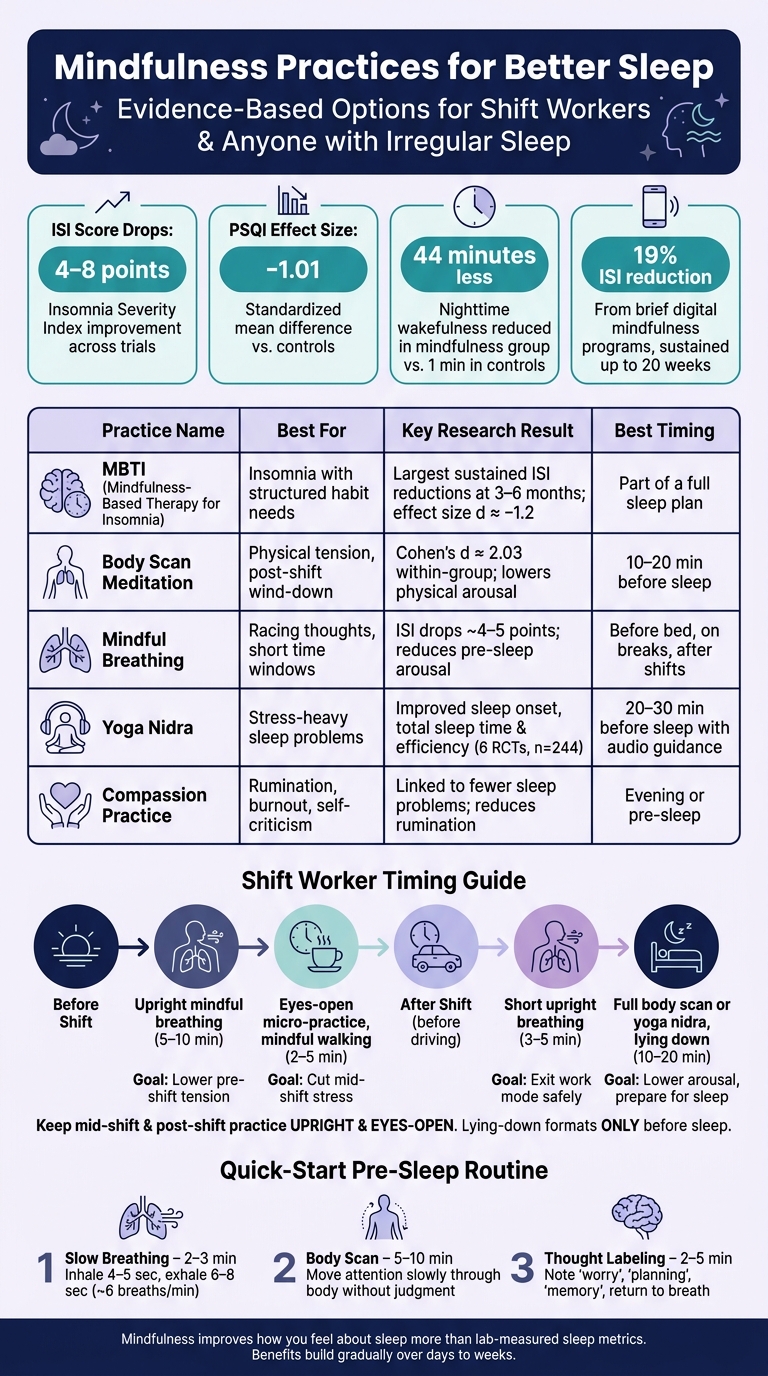
Mindfulness Practices for Better Sleep: Science-Backed Comparison Guide
Quick comparison
| Practice | Best use | What the research tends to show | Best timing |
|---|---|---|---|
| MBTI | Insomnia with sleep habits that need structure | ISI often drops more and lasts longer than general mindfulness programs | Part of a full sleep plan |
| Body scan | Physical tension and post-shift wind-down | Lower arousal; strong results in insomnia-focused programs | 10–20 min before sleep |
| Mindful breathing | Racing thoughts and short time windows | Lower pre-sleep arousal; flexible and easy to repeat | Before bed, on breaks, after shifts |
| Yoga nidra | Stress-heavy sleep problems | Better sleep onset, total sleep time, and stress in early trials | Before sleep with audio guidance |
| Compassion practice | Rumination, burnout, self-criticism | May help sleep quality by easing mental strain | Evening or pre-sleep |
My main takeaway: if your sleep schedule moves around, don’t chase a perfect bedtime. Use the same short wind-down routine before every sleep period. That gives you the best shot at steady improvement over days to weeks.
sbb-itb-5106bd1
What Research Shows About Mindfulness and Sleep
Clinical research paints a pretty clear picture: mindfulness tends to improve how people feel about their sleep more than it changes sleep metrics on a device or in a lab.
Across randomized controlled trials and meta-analyses, structured mindfulness programs keep showing the same pattern. People report better sleep and less distress about sleep. But shifts in time to fall asleep, time awake after falling asleep, and sleep efficiency are often smaller and less consistent. The best data comes from structured programs, especially MBSR, MBTI, and short digital practice. Since only a small number of trials include shift workers, the evidence is indirect for that group, but still useful for people with irregular schedules.
Key Findings From Clinical Trials and Meta-Analyses
The clearest pattern in the research shows up on two common sleep scales: the Pittsburgh Sleep Quality Index (PSQI) and the Insomnia Severity Index (ISI).
A meta-analysis of mindfulness-based interventions for insomnia found a standardized mean difference of about −1.01 (95% CI −1.28 to −0.75) on the PSQI compared with controls, which points to a meaningful change. In individual trials, ISI scores fell by about 4 to 8 points. That is often enough to move someone from moderate insomnia into the subthreshold or remission range.
One chronic insomnia trial gives a good sense of what that can look like in practice. People in mindfulness conditions cut their time awake during the night by about 44 minutes, compared with about 1 minute in the control group. Pre-sleep arousal also fell by about 7 points on the Pre-Sleep Arousal Scale, while controls showed almost no change. For shift workers, that matters because one of the biggest problems is often hyperarousal before sleep. You finally get the chance to rest, but your mind is still running at full speed.
When researchers look at wearables and lab-based measures, the picture gets more muted. These studies usually find smaller and less steady changes in time to fall asleep, time awake after falling asleep, and sleep efficiency. Put simply, mindfulness may ease the stress and mental activation around insomnia even when measured sleep changes only a little.
The Main Programs Studied: MBSR, MBTI, and Brief Digital Practice
Three formats show up again and again in the research.
Mindfulness-Based Stress Reduction (MBSR) is an 8-week group program. It was not built just for insomnia, but it has been tested a lot in people dealing with sleep problems. Mindfulness-Based Therapy for Insomnia (MBTI) is more sleep-focused. It blends mindfulness with behavior-based methods like stimulus control and sleep restriction, and it tends to show longer-lasting gains for insomnia. Brief app- or web-based programs are newer, but the data on them is growing. They also make sense for people who can't make time for a weekly class.
The main formats differ in how intense they are, how sleep-specific they are, and how easy they are to fit into daily life.
| Intervention | Sleep outcomes reported | Key limitations |
|---|---|---|
| MBSR (8 weeks) | Large within-group improvements in PSQI and ISI; objective changes are usually smaller | Some benefits lessen at longer follow-up |
| MBTI | Greater sustained ISI reductions at 3 to 6 months than MBSR; objective SOL and WASO improvements | Fewer large trials; little shift-worker data |
| Brief digital programs | About a 19% ISI reduction (roughly 14.8 to 12.0); benefits sustained up to 20 weeks in some internet-delivered programs | Smaller effect sizes than in-person programs; limited long-term comparative data |
There are a few limits worth keeping in mind. Most trials are small. Many rely on self-report. A lot of them use waitlist controls instead of stronger comparison groups. And very few include night-shift or rotating-shift workers.
That evidence points most clearly to a few specific practices.
Mindfulness Practices With the Strongest Sleep Evidence
For shift workers, the best options are the ones that calm the nervous system fast and work even when your sleep window is short.
Mindfulness-Based Therapy for Insomnia and Body Scan Meditation
MBTI combines mindfulness with stimulus control, sleep restriction, and cognitive techniques. In randomized trials, it has been linked to large drops in insomnia severity and less time awake during the night. In studies with older adults, effect sizes for insomnia severity have reached about d ≈ −1.2, which is considered large.
Body scan meditation moves your attention slowly through the body while you notice sensations without judging them. Research suggests this can lower physical arousal and help the body shift into a rest-ready state. A 10–20 minute body scan can make the jump from high alert to relaxation a lot easier, which matters after a rotating or overnight shift. In trials where body scan is a main part of the program, researchers found large within-group drops in insomnia severity, with Cohen's d around 2.03.
If you need something even shorter, breath-based practice is easier to use on the fly.
Mindful Breathing and Simple Mindfulness Meditation
Breath-focused practice is simple: you bring your attention back to the breath each time the mind drifts. That can help interrupt rumination and the tense effort to make sleep happen. Meta-analyses of mindfulness programs that use these practices show meaningful drops in pre-sleep arousal, with ISI scores falling by about 4–5 points. Because it's flexible, mindful breathing can fit into a short session after a shift, during a break, or in bed before sleep.
When stress and emotional strain are doing more of the damage, compassion-based practices may be a better fit.
Compassion Practices and Yoga Nidra for Stress-Heavy Sleep Problems
When stress, burnout, or self-criticism are behind sleep loss, loving-kindness meditation and self-compassion practices can help. These methods focus on building warmth toward yourself and other people, often with short phrases repeated silently. Research also suggests that higher compassion levels are linked with fewer sleep problems over time, and that brief self-compassion exercises can reduce rumination and improve sleep quality.
Yoga Nidra is a guided rest practice that blends body scanning, breath awareness, and deep rest. Early evidence links loving-kindness meditation with better sleep quality, and yoga nidra with gains in sleep onset, total sleep time, and sleep efficiency. A 2026 review of six randomized controlled trials (n = 244) found gains in sleep onset latency, total sleep time, and sleep efficiency, along with drops in stress and anxiety. Sessions usually last 20–30 minutes and are easy to follow with audio guidance, which makes them a good option after a hard shift.
The next step is fitting these practices into a shift schedule.
How to Use These Practices on a Shift Work Schedule
Mindfulness and a natural night shift sleep supplement help most when they line up with your sleep window, even if that window moves all over the place. For shift workers, timing matters just as much as the practice. If bedtime changes from one day to the next, the routine becomes the anchor.
A Simple 10 to 20 Minute Routine Before Sleep
The goal is consistency, not perfection. When your sleep schedule shifts, a fixed sequence matters more than a fixed clock time. Doing the same steps before each sleep period teaches your brain that rest is next.
Use the same sequence every time so your brain links it with sleep:
- 2–3 minutes of slow breathing - Inhale for 4–5 seconds, exhale for 6–8 seconds, aiming for about 6 breaths per minute.
- 5–10 minutes of body scan - Move your attention slowly through the body. Notice what’s there; don’t try to change it.
- 2–5 minutes of brief thought labeling - Note “planning,” “worry,” or “memory,” then return to the breath.
If your pre-sleep window is tight, don’t skip the body scan altogether. Just shorten it and focus on a few key areas: feet, torso, shoulders, and face.
When to Practice Before, During, and After a Shift
Mindfulness works best as a wind-down tool. It’s not an on-demand sleep switch. Its job is to lower stress and pre-sleep arousal during the period leading into rest. A simple way to place each practice around a shift is below.
| Timing | Practice | Duration | Goal |
|---|---|---|---|
| Before the shift | Upright mindful breathing, open awareness | 5–10 min | Lower pre-shift tension |
| During a break | Eyes-open micro-practice: slow breaths, mindful walking | 2–5 min | Cut mid-shift stress |
| Right after the shift, before driving | Short breathing or body-based practice, upright, lights on | 3–5 min | Shift out of work mode without getting sleepy |
| Before bed (main session) | Full body scan or yoga nidra, lying down in a dark, quiet room | 10–20 min | Lower arousal, prepare for sleep |
Occupational health guidance, including CDC/NIOSH recommendations, advises reducing light exposure and avoiding stimulating activities for at least 2 hours before intended sleep. It also lists relaxation and stress-reduction practices as part of that wind-down window. That makes mindfulness a natural fit for this part of the day.
One key rule: keep mid-shift and post-shift practices upright and eyes-open if you need to stay alert or drive home. Save lying-down, eyes-closed formats ONLY for the pre-sleep session.
Conclusion: A Science-Based Sleep Support Plan
The evidence points to mindfulness as a practical wind-down tool for people with irregular sleep schedules. It’s not a stand-alone answer for sleep problems. But research does link it to better sleep quality, less insomnia severity, and lower pre-sleep stress and rumination.
A 2015 meta-analysis of 575 participants found that mindfulness practice was tied to higher sleep efficiency, less wake time after sleep onset, and more total sleep time. Some of those gains were still present 2 to 6 months after treatment began. This isn’t the kind of change that shows up overnight. Benefits tend to build little by little with steady practice.
For shift workers, that matters. The main upside is flexibility. If you work rotating or overnight shifts, mindfulness can fit almost any sleep window: before daytime sleep, after a night shift, or ahead of a nap between shifts. What it asks for is simple: a pre-sleep routine you can repeat.
Key Takeaways for Readers With Irregular Sleep Schedules
Start with one practice and use it before every sleep period. Mindful breathing, a body scan, or a short guided meditation can all work. Pick the one that feels easiest to do again and again.
Expect gradual improvement over days to weeks. The changes may seem small at first. Falling asleep a bit faster or waking up a little more rested can build over time.
FAQs
How long does mindfulness take to improve sleep?
It depends on the approach. Some body changes tied to stress recovery have shown up after one day of practice.
For more noticeable improvements in sleep and stress, studies often look at eight-week programs with daily practice. Some also show clear sleep benefits after 30 days of steady practice.
Which mindfulness practice is best for racing thoughts at bedtime?
Practices that keep your attention on the present moment often work well when your thoughts start racing at bedtime. Breath awareness can help by moving your focus out of your head and back into your body. A simple way to do this is to count your inhales and exhales.
Progressive relaxation can help too. It moves your attention through the body, one area at a time, so you can let go of tension and quiet intrusive thoughts.
Can shift workers use mindfulness without getting too sleepy?
Yes. Shift workers can use mindfulness to support relaxation and sleep recovery without causing unwanted daytime sleepiness.
Mindfulness helps calm cognitive arousal - things like racing thoughts or intrusive thoughts - instead of forcing drowsiness. For people with irregular schedules, it can be a simple way to wind down and improve sleep quality.