

Melatonin and Daytime Sleep: What Studies Show
Melatonin supplements can help people who need to sleep during the day, such as night shift workers, by improving sleep quality and regulating circadian rhythms. Research highlights the following key points:
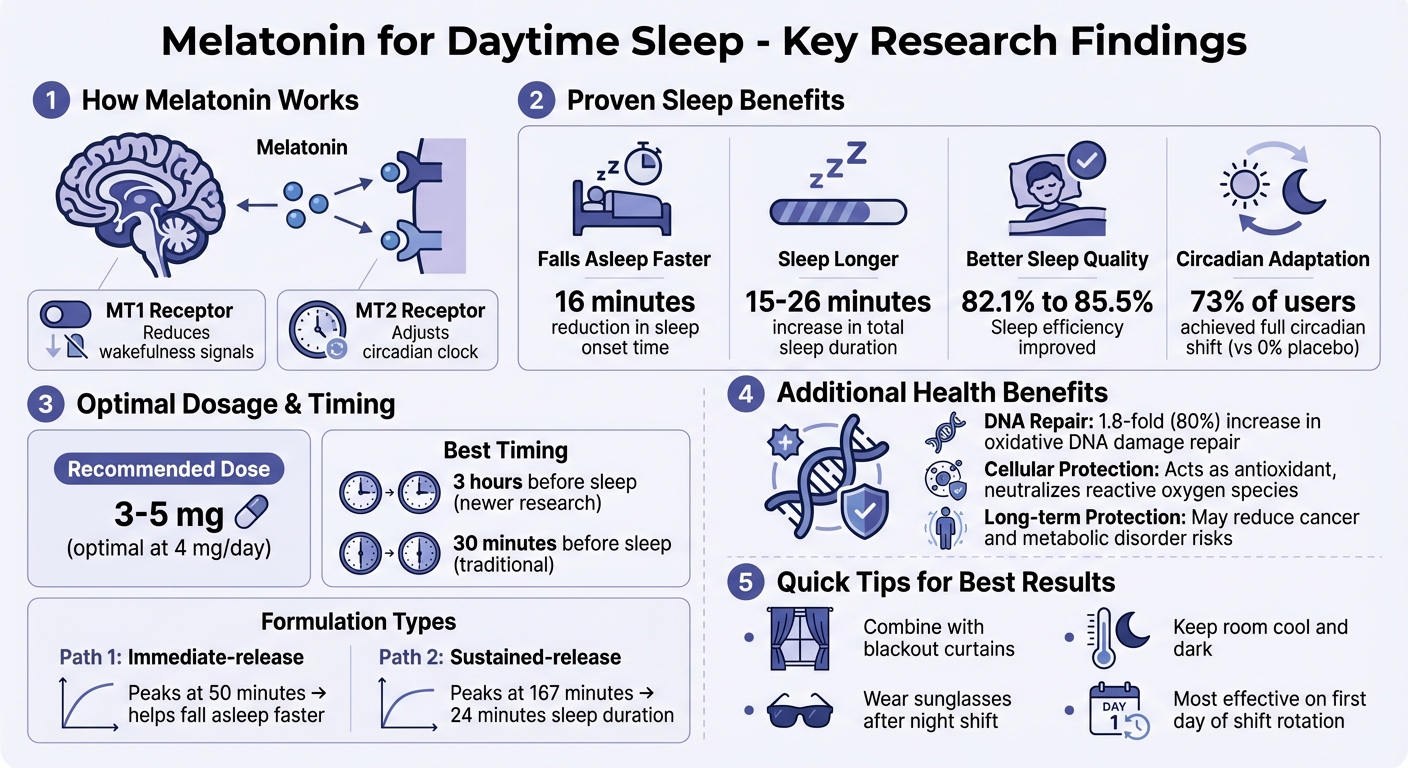
- How It Works: Melatonin interacts with MT1 and MT2 receptors in the brain to promote sleep and adjust the body's internal clock.
- Benefits: Studies show melatonin can reduce the time it takes to fall asleep (by about 16 minutes), increase total sleep duration (by 15–26 minutes), and improve sleep efficiency.
- Dosage and Timing: Optimal doses range from 3–5 mg, and taking it 30 minutes to 3 hours before sleep is most effective.
- Types of Melatonin: Immediate-release aids in falling asleep faster, while sustained-release helps maintain sleep.
- Health Insights: Melatonin may support DNA repair and reduce risks associated with circadian disruption, such as cancer and metabolic disorders.
For best results, combine melatonin with sleep-friendly habits like using blackout curtains and avoiding bright light exposure before sleep.
Melatonin Benefits for Shift Workers: Dosage, Timing, and Sleep Improvements
How Melatonin Works for Daytime Sleep
Melatonin Receptors and Sleep Promotion
Melatonin promotes sleep by interacting with two receptors in the brain: MT1 and MT2. The MT1 receptor reduces neuronal activity in the suprachiasmatic nucleus (SCN) - the brain's internal clock. By quieting the SCN's signals that promote wakefulness, MT1 helps initiate sleep and regulate REM cycles. Meanwhile, the MT2 receptor adjusts the circadian clock itself, focusing on non-REM sleep.
For individuals like shift workers, taking melatonin supplements activates these receptors to counteract daytime wakefulness. As Bárbara Carriedo-Diez from the Occupational Health Service explains, "Melatonin is the main hormone involved in the regulation of oscillation between sleep and wakefulness". During the day, when natural melatonin levels are low, supplemental melatonin binds to these receptors, overriding the body's natural tendency to stay awake. This process helps reset the internal clock, making melatonin a key tool for managing disrupted sleep schedules.
Correcting Circadian Disruption
Shift workers often experience misaligned circadian rhythms because their internal clocks remain set for nighttime sleep, even when their jobs require them to stay awake. Melatonin acts as a "chronobiotic", meaning it can shift the body's internal clock to better match a new sleep schedule. For example, it helps realign the body's core temperature minimum (Tmin) - a key marker of the circadian rhythm - so it occurs during the intended daytime sleep window instead of at night.
The timing of melatonin intake is guided by what's known as the Phase Response Curve. Taking melatonin in the late afternoon or evening advances the circadian clock, while morning doses delay it. A study conducted at Rush-Presbyterian-St. Luke's Medical Center between 1997 and 1999 showed that 73% of participants taking 3.0 mg of melatonin achieved full circadian adaptation, shifting their Tmin into the daytime sleep period. In contrast, none of the placebo group achieved this shift.
Measured Benefits from Studies
Research highlights the benefits of melatonin for improving daytime sleep quality. Katherine M. Sharkey from the Biological Rhythms Research Laboratory found that 3.0 mg of melatonin advanced the dim light melatonin onset (DLMO) by an average of 3.9 ± 0.5 hours, compared to just 1.7 ± 1.2 hours with a placebo. This demonstrates a significant adjustment of the internal clock.
In a study involving 86 shift-work nurses, taking 5 mg of melatonin 30 minutes before sleep reduced sleep onset latency by 16 minutes compared to baseline. Another trial showed that melatonin increased sleep efficiency from 82.1% to 85.5%. Additionally, a study using 1.8 mg of sustained-release melatonin found it extended total sleep time by about 24 minutes, primarily by preventing early awakenings during the latter half of the sleep period.
| Study Parameter | Melatonin Result (3.0 mg) | Placebo Result |
|---|---|---|
| Circadian Adaptation (Tmin shift) | 73% of subjects | 0% of subjects |
| DLMO Phase Advance | 3.9 ± 0.5 hours | 1.7 ± 1.2 hours |
| Sleep Onset Latency (Nurses) | Significant reduction | No significant change |
sbb-itb-5106bd1
Dosing and Timing: What Research Shows
Research-Supported Dosages
Studies suggest that melatonin doses between 3 mg and 4 mg are the most effective. A 2024 meta-analysis highlighted that sleep benefits peak at 4 mg per day. Dr. Francy Cruz-Sanabria from the Department of Developmental Neuroscience at IRCCS Fondazione Stella Maris explained:
"Our results suggest that advancing the timing of administration (3 h before the desired bedtime) and increasing the administered dose (4 mg/day)... might optimize the efficacy of exogenous melatonin in promoting sleep."
In a randomized trial, 72 resident physicians were given 5 mg of immediate-release melatonin 30 minutes before daytime sleep. By week four, they experienced fewer sleep disturbances and showed improved cognitive performance.
The type of melatonin formulation also plays a role. Immediate-release melatonin (3–5 mg) reaches peak levels in about 50 minutes, helping you fall asleep faster. On the other hand, sustained-release melatonin peaks later (around 167 minutes) and adds roughly 24 minutes to sleep duration.
These findings highlight how both dose and formulation influence melatonin's effectiveness.
When to Take Melatonin
Timing is key when it comes to melatonin's ability to reset the circadian clock. While the common advice has been to take it 30 minutes before bedtime, newer research suggests that taking melatonin 3 hours before sleep delivers better results. A meta-analysis covering 26 randomized controlled trials with 1,689 participants found that 3–4 mg taken 3 hours before bedtime significantly reduced the time it took to fall asleep.
For shift workers, timing is especially important. Calculating 3 hours before your target sleep time may enhance melatonin's effectiveness. However, the traditional 30-minute pre-sleep dose can still help reduce how long it takes to fall asleep.
To maximize benefits, consider using fast-release melatonin to help you fall asleep quickly and sustained-release formulations to maintain sleep. Since over-the-counter melatonin products can vary widely, choosing pharmaceutical-grade options ensures better quality and consistency.
Melatonin Effectiveness Across Different Shift Schedules
Fixed Night Shifts vs. Rotating Shifts
When it comes to melatonin's effects, the type of shift schedule plays a big role. Fixed night-shift workers generally have lower natural melatonin levels compared to those working daytime hours. For these workers, taking melatonin supplements can help offset the shorter sleep durations they often experience during the day. However, studies suggest this benefit may only last briefly. For instance, one study showed that a single 1.8 mg dose of melatonin increased daytime sleep by just 24 minutes on the first day of use. As Katherine M. Sharkey from the Biological Rhythms Research Laboratory explained:
"Melatonin prevented the decrease in sleep time during daytime sleep relative to baseline, but only on the first day of melatonin administration."
Rotating shift workers, on the other hand, experience different effects from melatonin. For these workers, melatonin helps shorten the time it takes to fall asleep. A study involving 86 shift-working nurses found that a 5 mg dose reduced sleep onset time by 16 minutes compared to their usual baseline. Similarly, research on oil-rig workers with rotating schedules reported that a 3 mg dose of melatonin increased total sleep by about 15–20 minutes per day. While these findings highlight melatonin's potential to improve sleep duration, it’s important to note that it doesn’t fully address issues like alertness or performance during night shifts. Persistent circadian misalignment remains a challenge, as evidenced by the fact that 32% of night-shift workers report insomnia or excessive daytime sleepiness, compared to 18% of day workers.
Gaps in Current Research
Although melatonin shows promise for shift workers, existing research has significant limitations. Many studies involve small sample sizes, making it hard to apply the findings to broader populations. Bárbara Carriedo-Diez from Manacor Hospital pointed out:
"A great disparity was evidenced in terms of dose, follow-up periods and type of melatonin, small participant population, same age ranges and young age."
The studies also vary widely in terms of dosage - ranging from 1 to 10 mg - follow-up durations, and the type of melatonin used. Most research has focused on younger adults, leaving a gap in understanding how melatonin affects older shift workers. Furthermore, many studies rely on self-reported data rather than objective tools like polysomnography or actigraphy to measure sleep. Perhaps the most pressing issue is the lack of evidence regarding the long-term safety and effectiveness of melatonin for chronic shift work. Addressing these gaps in future research will be crucial for optimizing melatonin use in this population.
Sleep Quality Improvements: What Clinical Trials Show
Falling Asleep Faster and Sleeping Longer
Melatonin has been shown to significantly reduce the time it takes to fall asleep, especially among shift workers. For example, a trial involving nurses on rotating shifts found that those who took 5 mg of melatonin fell asleep in just 21.5 minutes, compared to 49.7 minutes for those on a placebo. As Khosro Sadeghniiat-Haghighi from Tehran University of Medical Sciences stated, “sleep onset latency was significantly reduced while subjects were taking melatonin as compared with both placebo and baseline”.
This effect isn’t limited to one dosage. In another study, a 3 mg dose of melatonin reduced sleep onset latency from 16.2 minutes to just 12 minutes. In cases involving insomnia and sleep apnea, a higher dose of 10 mg helped 93.3% of participants fall asleep within 15 minutes, compared to only 33.3% before treatment. While the increase in total sleep time was less dramatic, even a 1.8 mg dose added an extra 24 minutes of sleep on the first day of use.
Melatonin doesn’t just help people fall asleep faster - it also supports longer, uninterrupted sleep, particularly during extended daytime rest periods.
Fewer Sleep Interruptions
Melatonin also reduces how often people wake up during sleep, which is especially beneficial for those trying to rest during the day. This is measured by Wake After Sleep Onset (WASO), or the time spent awake after initially falling asleep. Studies show that melatonin is particularly effective in reducing WASO during the second half of a sleep cycle, a time when the body’s natural circadian rhythm tends to promote wakefulness.
For instance, a month-long study reported a 0.5-fold reduction in WASO with melatonin use, meaning participants spent significantly less time awake during their sleep period. Reviews focusing on healthcare workers confirm that melatonin reduces nighttime awakenings and increases uninterrupted sleep time. This is a game-changer for shift workers, who often face additional challenges like daytime noise and light that disrupt their ability to maintain sleep.
Improvement with Continued Use
The benefits of melatonin don’t stop at short-term improvements. Regular use can further enhance sleep quality. A 4-week trial using 3 mg of melatonin showed notable progress in sleep maintenance, or the ability to stay asleep, with participants reporting improved sleep efficiency - rising from 82.1% to 85.5%.
However, not all effects follow a steady upward trend. While some studies suggest consistent benefits over time, others indicate that certain improvements, like extended sleep duration, may peak on the first day and taper off with continued use. Despite these variations, melatonin’s broader health benefits seem to build over time. For example, after one month of taking 3 mg daily, shift workers experienced a 1.8-fold increase in oxidative DNA repair, a process linked to higher melatonin levels in the body.
Other Health Benefits for Shift Workers
Cellular Protection and DNA Repair
Melatonin does more than just improve sleep for shift workers - it also plays a critical role in protecting cells and aiding DNA repair. Night shift workers often experience reduced melatonin levels, which impacts their ability to repair DNA damage caused by oxidative stress. Acting as both a direct and indirect antioxidant, melatonin helps neutralize reactive oxygen species (ROS) while also boosting the body's own protective enzymes.
Research shows that melatonin supports the repair of 8-OH-dG lesions, a marker of oxidative DNA damage, thereby enhancing the body's DNA repair capacity. A study conducted by the BC Cancer Research Institute and the University of British Columbia tested the effects of melatonin on 40 night shift workers. Participants took 3 mg of oral melatonin an hour before their daytime sleep over four weeks. The results were striking: a 1.8-fold (80%) increase in urinary 8-OH-dG excretion during daytime sleep, indicating improved DNA repair.
"Our results suggest that melatonin supplementation improves oxidative DNA damage repair capacity among night shift workers." - Umaimah Zanif, Researcher, BC Cancer Research Institute
The same study revealed that melatonin supplementation led to a median circulating level of 90.8 ng/mg, compared to just 1.5 ng/mg in the placebo group. Additionally, melatonin appears to activate genes in the nucleotide excision repair (NER) pathway, which is essential for detecting and removing DNA lesions. This mechanism offers a layer of protection against cellular damage, which is particularly important for those working irregular hours.
These cellular benefits may contribute to broader health advantages over time.
Long-Term Health Effects
Beyond its immediate role in DNA repair, melatonin may help reduce long-term health risks linked to disrupted circadian rhythms. Night shift workers with reduced melatonin production face higher risks of conditions like breast and prostate cancer, as well as metabolic disorders such as type 2 diabetes and obesity. Researchers suggest that decreased DNA repair capacity could be a key factor in the increased cancer risk seen in long-term night shift workers.
"Increased oxidative DNA damage due to diminished DNA repair capacity is a compelling mechanism that may contribute to the carcinogenicity of night shift work." - Occupational & Environmental Medicine
However, the benefits of improved DNA repair during daytime sleep don't carry over into night shifts, as melatonin levels drop significantly during work hours. This highlights the importance of consistency in supplementation. Dr. Parveen Bhatti emphasized the need for long-term use, stating, "Assessing long-term efficacy is critical since those who work night shifts for many years would need to consistently consume melatonin supplements over that time frame to maximize the potential cancer prevention benefits".
Taking 3 mg of melatonin before daytime sleep can support cellular health. For a more comprehensive approach, products like RST Sleep combine extended-release melatonin with additional ingredients designed to promote relaxation and improve sleep quality.
How to Defeat Jet Lag, Shift Work & Sleeplessness | Huberman Lab Essentials
Conclusion: Research-Based Recommendations
Melatonin has been shown to reduce the time it takes for shift workers to fall asleep during the day by about 16 minutes. While the overall increase in total sleep time is modest - typically between 15 and 26 minutes - melatonin provides other advantages. These include a 20% reduction in circadian misalignment and improved cognitive performance during work shifts.
To get the most out of melatonin, both dosage and timing are critical. Research suggests that doses between 1.8 mg and 6 mg are effective for shift workers. Smaller doses may help extend sleep duration without causing grogginess, while higher doses (around 5–6 mg) can improve sleep quality and focus at work. For best results, take melatonin 30 minutes before trying to sleep during the day.
Choosing the right formulation can also make a difference. Sustained-release melatonin is ideal for workers who wake up frequently, while immediate-release formulations work better for those who need help falling asleep quickly.
Incorporating sleep-friendly habits alongside melatonin can further enhance its benefits. For example, wearing sunglasses on the way home from a night shift reduces morning light exposure, which can interfere with daytime sleep. Creating a dark, cool sleeping environment with blackout curtains also promotes better rest. Interestingly, studies indicate that melatonin may be most effective on the first day of a shift rotation, as tolerance could develop with continued use.
For those looking for a more comprehensive solution, products like RST Sleep offer extended-release melatonin combined with ingredients like glycine, phosphatidylserine, and magnolia bark to support better sleep. When used properly, melatonin is a safe, non-addictive option for addressing the sleep challenges faced by night shift workers.
FAQs
Will melatonin make me groggy during my night shift?
Melatonin can help night shift workers get better daytime sleep and lessen sleep disruptions. However, some people might feel groggy after taking it, especially if they use it at the wrong time or take an incorrect dose. To avoid this, it’s important to stick to the recommended timing and dosage instructions.
How do I choose immediate-release vs. sustained-release melatonin for daytime sleep?
When deciding between immediate-release and sustained-release melatonin, it all comes down to your specific sleep needs.
- Immediate-release melatonin kicks in quickly, making it a good choice if you need help falling asleep soon after going to bed.
- Sustained-release melatonin, on the other hand, releases the hormone gradually, which can help maintain longer and more stable sleep periods - perfect for shift workers or anyone needing extended rest.
If you're unsure which type suits you best, it's always a good idea to consult a healthcare professional for guidance.
How long can I take melatonin for shift work, and is it safe long term?
Research suggests that melatonin can be effective in helping shift workers improve their daytime sleep, especially when taken before going to bed after a night shift. It is generally regarded as safe for short-term use, with no major short-term side effects reported. However, there isn't much data available on its long-term safety, and prolonged use might come with potential risks. It's always a good idea to consult a healthcare professional for tailored advice, especially if you're thinking about using it for an extended period.