

How Glycine Helps Manage Stress for Better Sleep
My take: Glycine may help you sleep better, but it is not a proven treatment for stress, anxiety, or insomnia. Small studies used 3 grams shortly before bed and suggest better sleep quality and next-day alertness - not a dose recommendation for everyone.
Here’s what I’d keep in mind before trying it:
- The research is limited. Results don’t establish that glycine lowers cortisol or corrects body-clock disruption from night shifts.
- Your routine still matters. Plan around your sleep period, keep your room dark and quiet, and track sleep and next-day grogginess.
- Check the whole supplement. RST Sleep combines glycine with other ingredients; studies of those ingredients don’t prove the blend works. Ask a clinician or pharmacist about dosing, timing, and interactions.
- Know when to get help. Persistent sleep trouble, snoring with gasping, or sleepiness that affects driving needs medical attention.
I’d treat glycine as possible sleep support, <u>not a replacement for enough sleep or medical care</u>.
What Studies Show About Glycine and Sleep
Body Temperature and Falling Asleep
Your core body temperature drops as you fall asleep. Glycine may help support that natural drop, but research hasn’t established the same effect for daytime sleep after a night shift.
Animal studies suggest glycine may act on NMDA receptors in the suprachiasmatic nucleus (SCN), the brain’s body clock. Researchers have also observed shorter non-REM (NREM) sleep latency in animals - meaning less time before NREM sleep begins. These findings suggest how glycine might work, not proven results in shift workers.
Falling asleep more easily could make stress-related bedtime restlessness less disruptive. But does that lead to better sleep quality and next-day function?
Sleep Quality and Next-Day Alertness
Human evidence comes from small studies in people with sleep complaints. Yamadera et al.’s 2007 study found improvements in participants’ reported sleep quality, along with measured changes in sleep.
Bannai et al.’s 2012 study looked at next-day function after reduced sleep - not long-term night-shift work. It suggested improvements in fatigue, alertness, and performance, but those findings may not apply to shift workers.
Sleep Research at a Glance
| What glycine may do | Evidence type | Meaning for sleep | Key limitation |
|---|---|---|---|
| Support a drop in core body temperature | Human and animal research | May help with sleep onset; animal findings suggest an NMDA-receptor pathway in the SCN. | Not established for daytime sleep after night shifts. |
| Improve subjective sleep quality | Small human studies | Some participants report better sleep and feeling more rested. | Findings may not apply to everyone. |
| Support next-day function | Human studies after reduced sleep | May reduce fatigue and improve alertness. | Not studied as a long-term approach to shift work. |
Current research does not show that glycine directly lowers cortisol. With the evidence still preliminary, the next step is to consider glycine as part of a consistent wind-down routine, not a stand-alone fix.
sbb-itb-5106bd1
Glycine: The Sleep Hack Doctors Forget to Mention
Building a Sleep Routine With Glycine
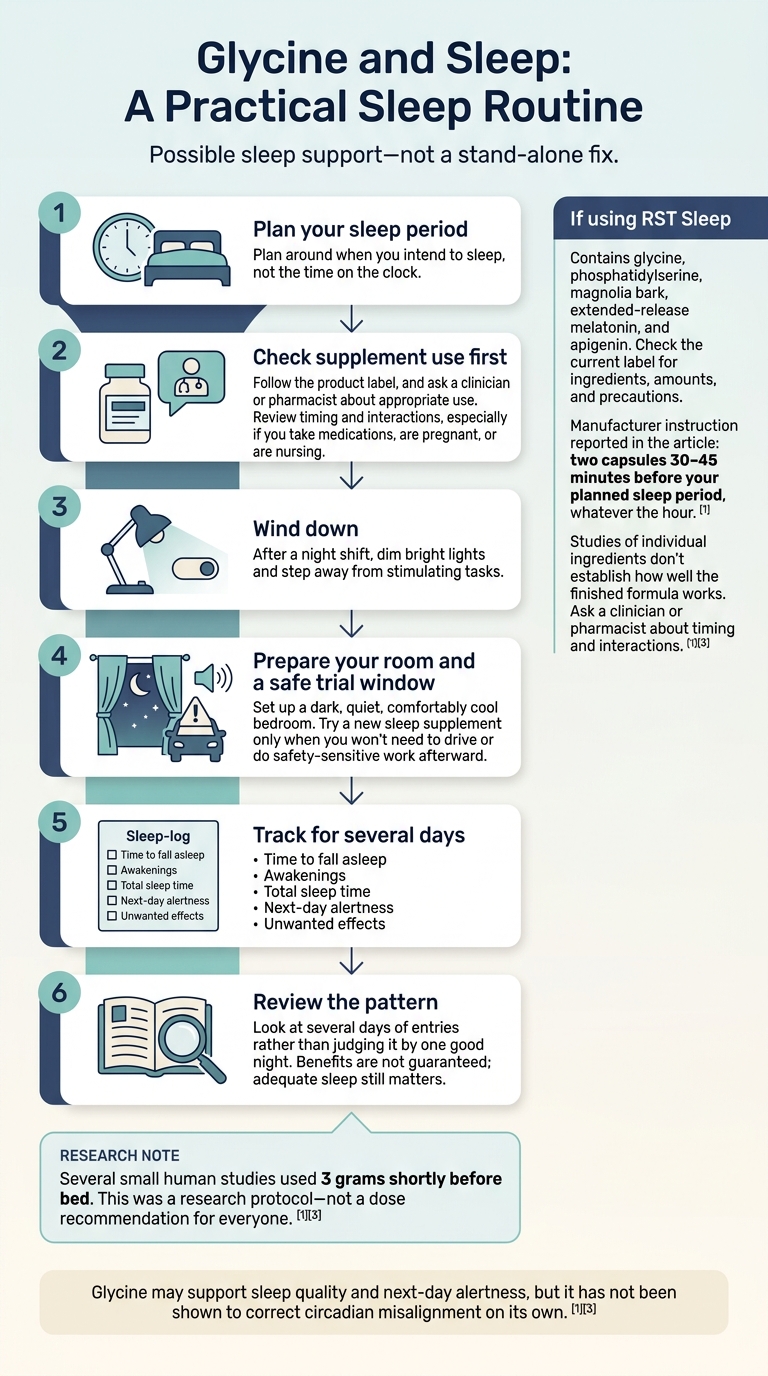
Glycine and Sleep: A Practical Sleep Routine
Timing, Wind-Down, and Sleep Tracking
Plan around when you intend to sleep, not the time on the clock. Several small human studies used 3 grams of glycine shortly before bed. That was a research protocol - not a dose recommendation for everyone. Follow the product label, and ask a clinician or pharmacist about appropriate use.
After a night shift, dim bright lights and step away from stimulating tasks as you wind down. Set up a dark, quiet, comfortably cool bedroom. Try a new sleep supplement only when you won’t need to drive or do safety-sensitive work afterward. For several days, track how long it takes to fall asleep, awakenings, total sleep time, next-day alertness, and unwanted effects.
Using RST Sleep
For readers who prefer one pre-sleep formula, RST Sleep combines glycine with other sleep-support ingredients for irregular schedules. It includes phosphatidylserine, magnolia bark, extended-release melatonin, and apigenin. Check the current label for ingredients, amounts, and precautions. The manufacturer recommends two capsules 30–45 minutes before your planned sleep period, whatever the hour.
Studies of individual ingredients don’t establish how well the finished formula works. Melatonin timing can matter, so ask a clinician or pharmacist about timing and interactions before use - especially if you take medications, are pregnant, or are nursing.
What to Expect From Glycine
Use your sleep log to check whether glycine helps your routine. Look at several days of entries rather than judging it by one good night. Glycine may support sleep quality and next-day alertness, but it has not been shown to correct circadian misalignment on its own.
| Possible benefit | Supporting evidence | Practical limitation |
|---|---|---|
| Better subjective sleep quality | Small human studies | Responses vary; benefits aren’t guaranteed. |
| Better next-day functioning | Small studies after partial sleep restriction | Doesn’t replace adequate sleep; long-term outcomes remain uncertain. |
| Support for sleep onset through temperature changes | Physiological research | Doesn’t establish that glycine can realign the body clock. |
Safety and When to Seek Care
Before adding glycine to your sleep routine, check its safety, possible interactions, and warning signs.
Risks and effects depend on dose, timing, ingredients, medications, and health history. Long-term safety data are limited. Even natural products can cause adverse reactions.
Medications and Possible Side Effects
Ask a clinician or pharmacist to review the full label alongside your prescriptions and health conditions. This is especially important if you’re pregnant, nursing, or taking medications that may interact with melatonin or magnolia bark. For RST Sleep, review the entire blend - not just glycine.
Mild digestive upset can occur. Stop use and seek care if stomach upset persists, your sleep gets worse, or you feel groggy the next day.
Sleep Symptoms That Need Medical Attention
Side effects aren’t the only reason to seek care. Get a medical evaluation for persistent sleep disruption, sleepiness that affects driving or work, loud snoring, gasping, or pauses in breathing. Seek care for depression or major mood changes, too.
Do not drive or operate heavy machinery when sleepy.
Research limitations: Animal and mechanistic findings do not always apply to shift-working adults. Glycine is not an established treatment for insomnia, sleep apnea, anxiety, depression, or shift work disorder, and it should not replace medical evaluation.
Conclusion: Key Points on Glycine and Sleep
Research on glycine is promising, but limited. Studies suggest it may improve sleep quality and next-day alertness. Better sleep may help you feel less stressed, but glycine has not been proven to reduce stress or anxiety. The evidence supports using glycine as a sleep aid, not a cure.
Make it part of your sleep routine rather than a stand-alone fix. Pair any supplement with a consistent wind-down routine and enough time for uninterrupted sleep.
Track your sleep quality in a journal. If sleep problems continue or worsen, share your notes with your healthcare provider.
FAQs
How long should I try glycine before reassessing?
Results vary from person to person. RST Sleep’s 30-day return window gives you time to see whether its formula, which includes glycine and other sleep-supporting ingredients, works for you. If you’re not satisfied, you can return it within that window.
Before starting any new supplement, talk with your physician or a qualified healthcare provider to check whether it’s right for your health.
Can I take glycine every day?
Yes, glycine can be part of your daily sleep routine. RST Sleep’s non-habit-forming supplement contains glycine to help you relax and support healthy sleep cycles if you work night shifts or have an irregular sleep schedule.
Take two capsules 30 to 45 minutes before you plan to sleep.
Before starting, talk with your physician or a qualified healthcare provider, especially if you have any medical conditions or take medication.
How can I tell if glycine helps my sleep?
Look for better sleep quality, improved daytime performance, feeling more rested in the morning, and fewer nighttime interruptions. Glycine may help your core body temperature drop naturally as you fall asleep. It may also help quiet a racing mind and support deeper, more restorative rest.
Keep a sleep diary to track changes in your sleep patterns and overall quality of rest over time.