

Fixing Sleep Timing for Shift Workers
If you do shift work, the main fix is usually not “sleep more.” It’s sleep at the same time more often.
I’d boil the article down to this:
- Build one repeatable sleep window
- Keep a 3–4 hour anchor sleep block if your shifts rotate
- Use bright light early in the shift and block light after work
- Be careful with naps, caffeine, meals, and your wind-down
- Track your sleep for 14 days before changing the plan
That matters because shift work often throws off sleep timing, not just sleep length. The article notes that 50% to 62% of shift workers deal with sleep disorders, versus 5% to 11% of day workers. It also points out that night workers average only 5.7 hours of sleep per day.
The big idea is simple: if you keep changing your sleep hours on workdays and days off, your body clock never settles. But if you hold one core sleep block steady, control light, and keep a short log, you give yourself a better shot at falling asleep faster, sleeping longer, and staying more alert on shift.
A few key signs stood out to me:
- You’re exhausted but can’t fall asleep
- You wake too early and can’t get back to sleep
- You feel awake at bedtime but sleepy at work
- Your reaction time gets worse across shifts
For me, the most useful part is how practical the plan is. It’s not about chasing perfect sleep. It’s about using a schedule your body can learn and sticking with it long enough to see if it works.
That’s the core message of the article in plain English.
‘Sleep washes the brain’: How shift workers can improve sleep | Better Every Shift
sbb-itb-5106bd1
Sleep Timing Problems Shift Workers Face
The main issue is timing. Many shift workers try to sleep when their circadian clock is still pushing them to stay awake. Add morning light during the drive home and a different sleep schedule on days off, and the body clock can stay out of sync. That mismatch often leads to shaky sleep windows and a hard time adjusting from one shift pattern to another.
There’s also a second timing issue: many people flip back and forth between workdays and days off.
Circadian Misalignment and Unstable Sleep Windows
A fast switch from day shifts to night shifts can throw sleep and alertness out of phase. In plain English, your body can feel sleepy when you need to work and wide awake when you finally get into bed.
One seven-day night-shift rotation study found that melatonin shifted by only 26 minutes, while reaction time got worse by the end of the cycle.
Light exposure is a big part of the problem. Most shift workers can’t fully control when they get light and when they avoid it, so full adjustment often never happens. In fact, more than 30% of shift workers can’t achieve meaningful circadian shifts even under controlled experimental conditions. That’s not a motivation issue. It’s biology.
These patterns tend to show up in a few common ways.
Signs That Sleep Timing Is the Real Problem
Total sleep time matters. But when timing is off, the pattern usually leaves its own clues. The table below shows the most common signs:
| Sign | What It Looks Like |
|---|---|
| Taking a long time to fall asleep | Lying awake for a long time after a shift, even when exhausted |
| Early waking | Falling asleep but waking after a few hours and being unable to get back to sleep |
| Wired at bedtime, sleepy on shift | Feeling alert at bedtime, dragging through the actual work shift |
| Reaction time gets worse across shifts | Reaction times that worsen across consecutive shifts rather than improving |
If this sounds like your routine, the fix usually starts with a more stable sleep window.
Once timing is the issue, the next move is to stabilize that sleep window.
Sleep Timing Strategies That Work for Shift Workers
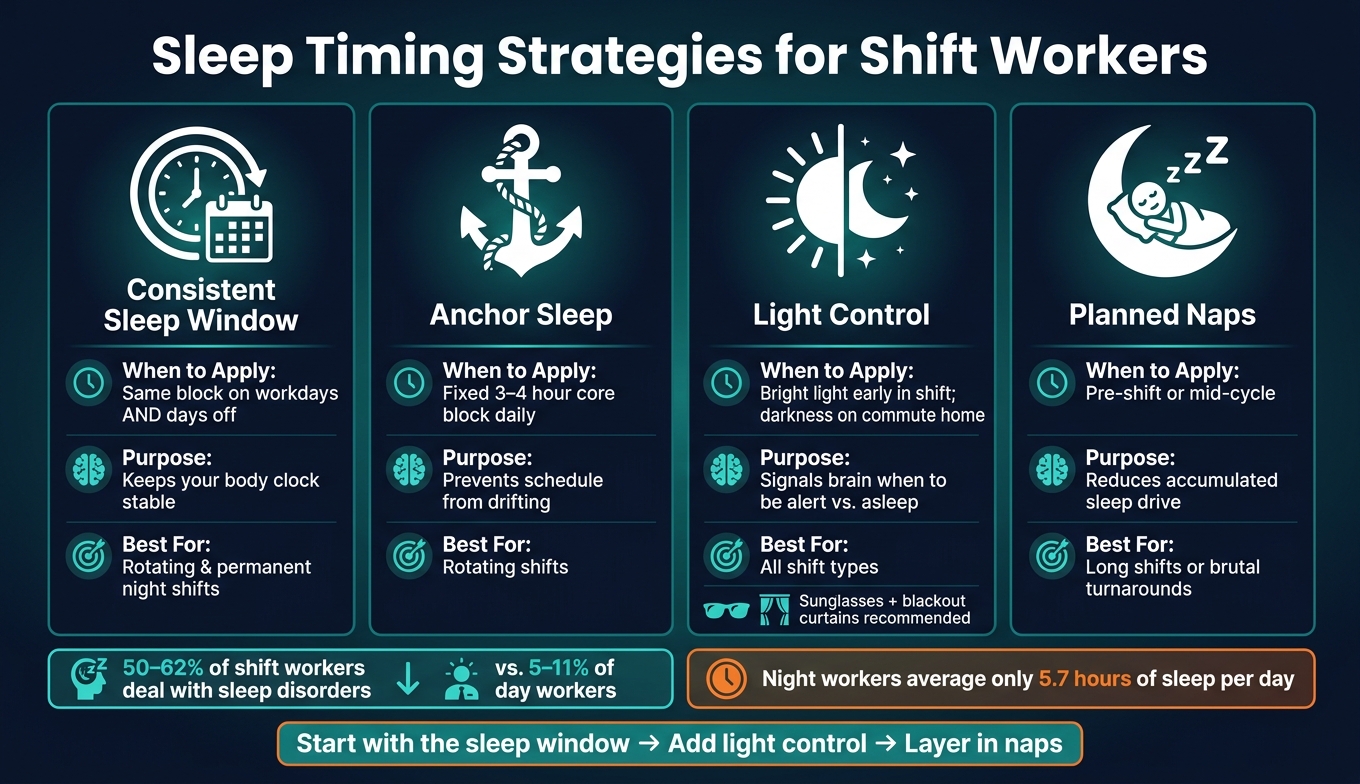
Shift Worker Sleep Strategies: 4 Tools to Fix Sleep Timing
Shift work can throw sleep timing all over the place. The best way to steady it is to lean on four tools: a fixed sleep window, anchor sleep, light control, and planned naps.
Start with the sleep window first. Then use light and naps to make that schedule easier to stick to.
| Method | When to Apply | Purpose | Best For |
|---|---|---|---|
| Consistent Sleep Window | Same block on workdays and days off | Keeps your body clock stable | Rotating and permanent night shifts |
| Anchor Sleep | Fixed 3–4 hour core block daily | Keeps your schedule from drifting apart | Rotating shifts |
| Light Control | Bright light early in shift; darkness on commute home | Signals the brain when to be alert vs. asleep | All shift types |
| Planned Naps | Pre-shift or mid-cycle | Reduces accumulated sleep drive | Long shifts or brutal turnarounds |
Set a Consistent Sleep Window and Use Anchor Sleep
If you work permanent night shifts, try to keep the same sleep and wake times every day, not just on workdays. That steady block helps your body clock stay on track.
If your shifts rotate, use a 3–4 hour anchor sleep at the same time each day. Think of it as your sleep schedule’s home base. Even if the rest of your sleep moves around, that fixed core block gives your body clock something steady to lock onto. Once that piece is in place, light timing can help push the rest of the schedule in the right direction.
Control Light and Darkness at the Right Times
Light is the strongest signal your body clock gets. During a night shift, bright light in the first half of the shift helps delay your circadian rhythm and can keep you more alert when you need it most. On the flip side, once your shift ends, morning light can make daytime sleep much harder.
That’s why a simple move like wearing sunglasses on the commute home can help. At home, blackout curtains and a sleep mask can keep your room dark through your sleep window.
Time Naps, Caffeine, Meals, and Wind-Down Habits Carefully
A short nap before a night shift can take the edge off accumulated sleep drive. For rotating shift workers, a nap on the transition day between day and night shifts can also help cut down sleep debt.
After a nap, the next job is protecting your sleep window. Try not to use stimulants too late in the shift. If caffeine runs too close to bedtime, it can spill into the sleep period that follows. It also helps to keep heavy meals earlier in the shift and follow the same short wind-down routine before bed.
A Sample Night Shift Sleep Schedule
Here’s what those timing rules can look like in an actual night-shift routine.
Example Sleep Timing for Workdays and Days Off
Use this as a starting point, then move the hours to fit your shift.
| Activity | Workday (Night Shift) | Day Off (Partial-Shift Schedule) |
|---|---|---|
| Shift Ends | 7:00 AM | N/A |
| Main Sleep Window | 8:00 AM – 3:00 PM | 3:00 AM – 10:00 AM |
| Wake / Light Exposure | 3:00 PM | 10:00 AM |
| Anchor Sleep | 8:00 AM – 10:00 AM | 8:00 AM – 10:00 AM |
That anchor overlap matters. It helps keep your body clock from sliding back and forth between workdays and days off.
On workdays, get in bed within 60 to 90 minutes after your shift ends. Keep your room dark and quiet so your brain gets a clear signal that it’s time to sleep.
On days off, stick with the anchor overlap and avoid flipping your whole schedule. Think of it like keeping one foot in the same spot, even when the rest of the day shifts around.
The aim isn’t perfect alignment. It’s a sleep pattern your body can stick with day after day.
RST Sleep in a Night-Shift Routine

Some night-shift workers find that a supplement helps them fall asleep and stay asleep once they’re in bed. RST Sleep is a natural, non-habit-forming supplement made to support sleep timing and sleep quality, including extended-release melatonin to help last through a daytime sleep block.
If you use it, take it about 30–45 minutes before your planned bedtime - around 8:00 AM on workdays or 2:30 AM on days off based on the schedule above.
Pay attention to a few simple signals:
- How fast you fall asleep
- How often you wake up
- How alert you feel during your shift
Next, use a sleep log to check whether the schedule is holding up.
How to Keep the Schedule Going and Track Progress
Once the schedule is set, the next job is simple: see if it keeps working in daily life.
The goal isn't perfection. It's consistency. Try to hold the same anchor hours across rotating shifts, weekends, and recovery days.
Keep those anchor hours steady, and block bright morning light after night shifts so your body clock doesn't drift earlier. Track whether light exposure is pushing sleep onset later or pulling your wake time earlier. Those patterns tell you if your anchor hours and light timing are doing their job.
Also log whether days off are pulling your sleep window earlier or later.
Use a Simple Sleep Log to See What Is Working
Track for 14 days. That gives you data you can use instead of relying on guesswork.
Write down:
- bedtime and wake time
- nap duration
- caffeine timing
- alertness levels during shifts
- whether you used blackout curtains, a sleep mask, earplugs, or white noise to protect your sleep space
Use the log to spot which habit is moving your sleep window.
| Metric | What to Record | Target |
|---|---|---|
| Bedtime & Wake Time | Actual times each day | A consistent 3- to 4-hour anchor block |
| Sleep Onset | Minutes to fall asleep | Under 20–30 minutes consistently |
| Total Sleep Time | Hours of actual sleep | A steady sleep window across workdays and days off |
| Caffeine Timing | Time of last cup | Avoid caffeine too close to bedtime |
| On-Shift Alertness | 1–10 scale, mid-shift | Steady mid-shift alertness |
If sleep onset is taking more than 30 minutes on several nights, check your caffeine log first. That's often the easiest place to spot a problem.
If your mid-shift alertness scores stay low even after a full sleep block, your anchor hours may need a small change.
Pay attention to sleep inertia too - the stretch of time between waking up and feeling fully alert. Tracking how long it takes to shake off can help you see whether the sleep period before it was restorative.
"Fatigue is an alarm system that warns us that a recovery rest should be taken." - EUROCONTROL
After 14 days, make one change at a time. Then keep logging so you can tell what helped and what didn't.
Key Takeaways
The fix is simple: one sleep window, timed light, and steady tracking. Shift work creates a body-clock mismatch when work and sleep schedules run against the body's internal rhythms.
Keep one consistent sleep window, use bright light at the start of the shift, and block light before bed.
Once the sleep window is set, protect it with the timing of caffeine, meals, and your wind-down routine so they don't push sleep later.
Pick one schedule and test it for 1 to 2 weeks before changing anything. Track sleep onset, total sleep time, and alertness during work hours. Then keep tracking for 1 to 2 weeks and change one variable at a time.
FAQs
How long does it take to reset sleep timing?
Resetting sleep timing means lining your sleep schedule back up with your internal circadian rhythm. For shift workers, that’s easier said than done. Even after several shifts in a row, the body may still not fully adjust.
A couple of things can help:
- Manage light exposure. Bright light at the right time can nudge your body clock in the direction you want it to go.
- Stick to a consistent pre-sleep routine. Doing the same wind-down steps each day helps signal that it’s time to sleep.
RST Sleep is made to support healthy sleep cycles with ingredients like glycine, phosphatidylserine, magnolia bark, extended-release melatonin, and apigenin.
What if I can’t keep the same sleep schedule on days off?
Sticking to the same sleep schedule on your days off isn't always easy. Still, going to bed and waking up at about the same time each day helps keep your body clock on track.
When your circadian rhythm keeps changing, your body can struggle to tell when it's time to sleep and when it's time to be awake. RST Sleep may help support healthy sleep cycles and better sleep quality.
When should I get medical help for shift work sleep problems?
See a healthcare provider if sleep problems last longer than three months. That includes trouble falling asleep or staying asleep even when you’ve had enough time and chance to rest.
It’s also smart to get medical advice if daytime sleepiness or irregular sleep-wake patterns start to affect daily life. Shift work symptoms can look a lot like other sleep disorders, so a screening can help rule out issues like insomnia or obstructive sleep apnea.