

How Night Shift Workers Can Fix Sleep Fragmentation
If you work nights and keep waking up after 2 to 4 hours, the problem often isn’t just short sleep. It’s broken sleep.
I’d sum it up like this: night shift sleep tends to fall apart because your body wants to sleep at night, daytime noise and light keep cutting in, and stress can keep you tired but still alert. That matters because daytime sleep efficiency can drop to about 39%, versus about 71% at night.
Here’s the short version of what I’d focus on:
- Keep one fixed core sleep window as close to the same time each day as you can
- Protect that block from calls, errands, light, noise, and heat
- Cut caffeine early enough so it doesn’t spill into sleep time
- Use naps carefully so they don’t eat into your main sleep block
- Think about extended-release melatonin if you keep waking too early
- Add calming support like glycine, phosphatidylserine, magnolia bark, or apigenin if stress seems to be part of the problem
What I like about this approach is that it stays simple: <u>protect sleep first, then add support if you still keep waking up.</u>
What Causes Sleep Fragmentation in Night Shift Workers
Once you know what fragmented sleep feels like, the next step is figuring out what keeps pulling your sleep apart. For night shift workers, it usually comes down to three things: circadian mismatch, daytime disruptions, and a nervous system that just won't settle all the way.
Circadian Mismatch and Daytime Sleep
Your body clock is set up for sleeping at night. So when you're trying to sleep during the day, you're working against that built-in timing. Morning light and rotating schedules make it even harder by nudging your rhythm in the wrong direction. The result? Daytime sleep tends to be lighter and easier to interrupt.
Circadian mismatch can lower daytime sleep efficiency and make it harder for the brain to hold steady transitions between wakefulness and deeper sleep stages.
Studies of permanent night shift nurses also show higher stress-response activity during sleep. That's the exact opposite of what you want if you're trying to get solid, restorative sleep.
Even if your body clock is already off, outside disruptions can still be the thing that decides whether your sleep holds together or falls apart.
Noise, Heat, and Daytime Interruptions
Daytime sleep is easier to disturb. Noise, movement, phones, traffic, bright light, or someone shutting a door can all jolt you awake. And each wake-up isn't just annoying. When it happens, your heart rate can jump and then settle back down, which shows your stress response has kicked in. If this keeps happening, that stress response can stay elevated long after you fall back asleep.
A warm room makes things worse. Higher room temperature can further disrupt daytime sleep.
The Tired but Wired Problem
A lot of night shift workers know this feeling well: you're dead tired after a shift, but once you finally get into bed, your sleep still doesn't stick.
So you may fall asleep only to wake up easily, sleep lightly, or get up earlier than you meant to. It's like your body is worn out, but part of your system is still on alert. That leads to shallow sleep, early awakenings, and the same pattern repeating after each shift.
sbb-itb-5106bd1
How to Consolidate Sleep Naturally
Once you know what's breaking your sleep, the goal is pretty simple: cut wake-ups and protect one solid sleep window. This isn't just about what you take before bed. It starts with your routine and your space. If your body never gets a fair shot at staying asleep, sleep will keep slipping through your fingers.
Build and Protect a Consistent Core Sleep Block
Try to keep your longest sleep period in the same time window every day, even on days off. That kind of consistency can help steady the autonomic nervous system and lower that high-alert state. If your schedule rotates, holding your main sleep block as steady as possible still gives your body a rhythm it can learn.
Just as important, protect that window. Errands, phone calls, and social plans right after a shift can eat into the sleep time your body needs most. A shorter uninterrupted core sleep block is often better than a longer one that gets broken again and again.
Once that block is in place, it gets easier to time light, food, caffeine, and naps around it.
Use Light, Food, Caffeine, and Naps Strategically
Block morning light on the way home with sunglasses. Keep caffeine several hours away from sleep. Use a pre-shift nap only if it doesn't cut into your core sleep block.
Small timing changes can make a big difference here. Think of them as guardrails that help your body stay on track instead of getting mixed signals.
Set Up Your Bedroom for Daytime Sleep
Your bedroom matters even more when you're sleeping during the day. Use blackout curtains and an eye mask to block light after your shift. Add a white noise machine or earplugs to reduce sudden noise spikes that can pull you out of sleep. Keep the room cool so daytime sleep is easier to maintain.
If you live with other people, a direct conversation about quiet hours during your sleep window can help cut random wake-ups. Sometimes that one talk does more than any sleep gadget.
If these habits still leave your sleep broken, the next step is targeted sleep support.
Natural Sleep Support That Targets Fragmentation
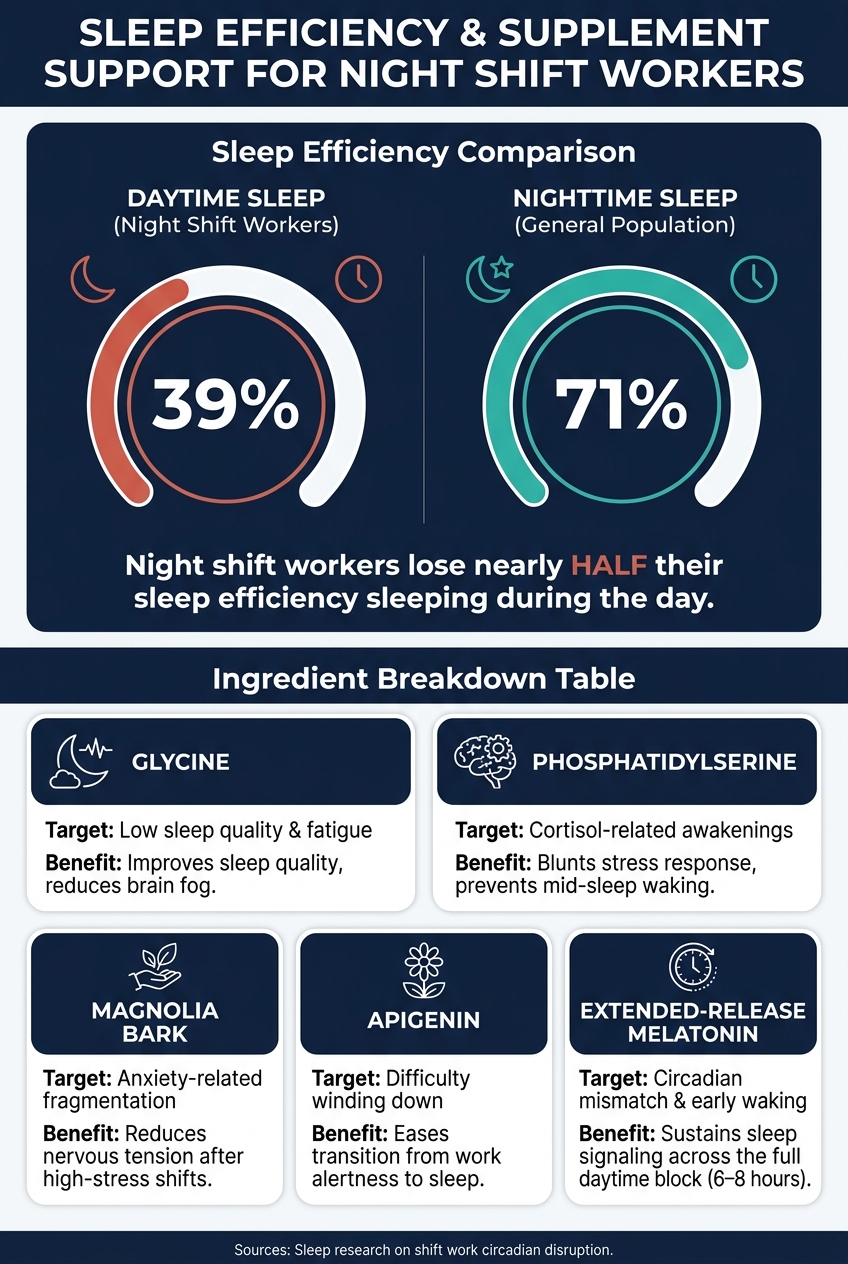
Daytime vs. Nighttime Sleep Efficiency for Night Shift Workers
If you’ve already fixed the basics and your sleep still splits up, the next move is support that helps you stay asleep.
A dark room, less noise, and a steady routine can help a lot. But for some night shift workers, sleep still falls apart after 3 to 4 hours. When that happens, it’s not just about falling asleep. It’s about keeping sleep in one solid block.
Extended-Release Melatonin for Sleep Timing and Sleep Maintenance
Extended-release melatonin releases over 6 to 8 hours. That makes it a better fit for daytime sleep maintenance than immediate-release melatonin.
And that matters. Studies show daytime sleep efficiency can drop to roughly 39%, compared to about 71% for nighttime sleep. For night workers, that gap is a big deal. If you wake up too early and can’t get back to sleep, even a decent bedtime setup may not be enough.
If melatonin by itself doesn’t do the job, the next step is adding ingredients that help with stress and that “still wired after work” feeling.
Glycine, Phosphatidylserine, Magnolia Bark, and Apigenin
These ingredients each tackle a different piece of broken sleep.
- Glycine supports sleep quality.
- Phosphatidylserine helps blunt stress-related wake-ups.
- Magnolia bark eases tension.
- Apigenin helps you wind down.
Think of it like this: melatonin helps cue sleep timing, while these ingredients can help smooth out the bumps that wake you up in the middle of your sleep block.
How RST Sleep Fits a Night Shift Routine

For a single-formula option, RST Sleep combines these ingredients into one bedtime routine. Take it 30 to 60 minutes before your core sleep block.
| Ingredient | Target Problem | Benefit for Night Workers |
|---|---|---|
| Glycine | Low sleep quality & next-day fatigue | Improves sleep quality and reduces morning brain fog |
| Phosphatidylserine | Cortisol-related awakenings | Blunts stress response to prevent mid-sleep waking |
| Magnolia Bark | Anxiety-related fragmentation | Reduces nervous tension after a high-stress shift |
| Apigenin | Difficulty winding down | Eases the transition from work alertness to sleep |
| ER Melatonin | Circadian mismatch & early waking | Sustains sleep signaling throughout the daytime block |
Conclusion: A Simple Plan for Longer, More Restorative Sleep
Fixing fragmented sleep as a night shift worker doesn't mean changing everything at once. The goal is simple: protect your sleep window and cut the biggest daytime disruptions. That matters because daytime sleep is easier to interrupt.
Research shows daytime sleep efficiency averages about 39%, compared with 71% for nighttime sleep. That gap is hard to ignore. A protected sleep window can help improve deep sleep, which means a shorter uninterrupted block can beat a longer broken one.
Your room setup matters too. Blackout curtains, a cooler room, and a firm caffeine cutoff can lower arousal and make it easier to stay asleep. And if those steps still don't do the job, more focused support may help.
If sleep still breaks apart, RST Sleep combines extended-release melatonin, glycine, phosphatidylserine, magnolia bark, and apigenin to support longer, less broken daytime sleep.
Pick one change today:
- blackout
- a caffeine cutoff
- a fixed sleep window
Then do it again tomorrow.
FAQs
How long should my core sleep block be?
For most healthy adults, a typical sleep duration is about 8 hours, though sleep needs change with age. Adults ages 70 to 80 may need closer to 6 hours.
Your core sleep block should balance your physical and mental needs. It should also give you a consistent sleep opportunity so your body can move through healthy sleep cycles on a steady schedule.
When should I stop caffeine after a night shift?
Avoid caffeine for at least six hours before your planned bedtime. That buffer gives your body more time to wind down and can help limit caffeine’s effect on sleep quality.
If you want extra help, RST Sleep offers a natural supplement for irregular sleep schedules. It’s made to support relaxation and better sleep without habit formation.
Is fragmented sleep hurting my health?
Yes. Fragmented sleep is linked to poor health outcomes, including depression, anxiety, obesity, diabetes, and high blood pressure.
It can also lead to daytime fatigue, which may point to other health risks. RST Sleep offers a natural supplement made to support healthy sleep cycles and better sleep quality for people with irregular schedules.