

5 Common Digestive Issues Night Workers Face
Night work can mess with your gut fast. If you work overnight, the most common problems are IBS, acid reflux, bloating and gas, constipation, and upper stomach pain or indigestion.
I’d sum it up like this: when you eat, sleep, and work at the wrong times for your body clock, digestion often slows down or gets thrown off. That can mean more pain, more bloating, more heartburn, and less regular bowel movements. The data in this article points to the same pattern: 21.27% of night workers meet the criteria for IBS, 30.36% for functional dyspepsia, and 47% of rotating shift workers report at least one severe GI symptom.
If you want the short version, here it is:
- IBS: pain, bloating, diarrhea, or constipation tied to shift changes and poor sleep
- Acid reflux: heartburn and regurgitation, often after late meals or lying down too soon
- Bloating and gas: fullness, pressure, and swelling, often worse from 12:00 a.m. to 6:00 a.m.
- Constipation: hard stools, straining, and fewer bowel movements from low fiber and off-schedule digestion
- Abdominal pain and indigestion: upper stomach pain, nausea, and early fullness that often track with night shifts
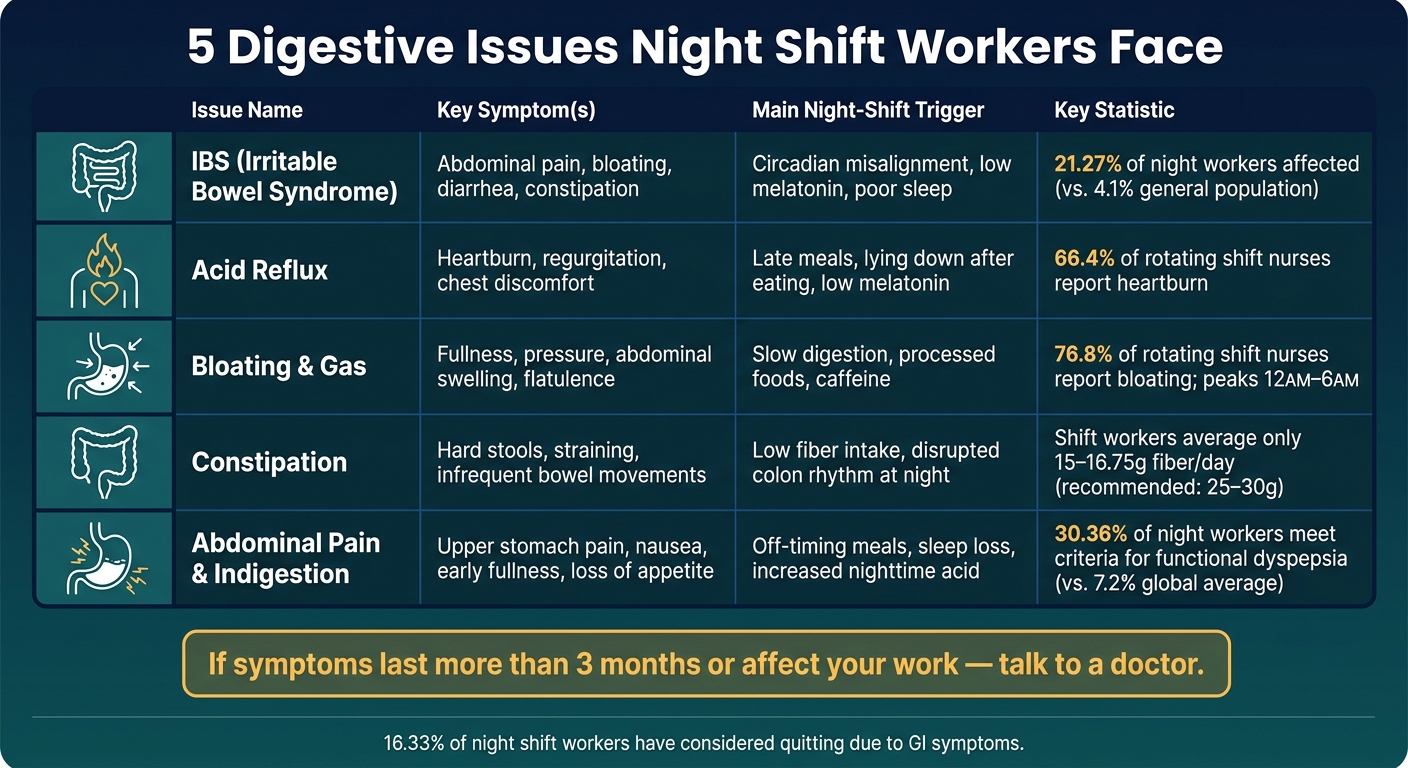
5 Digestive Issues Night Workers Face: Stats & Triggers
Working Night Shifts? Fix Your Gut Health Now
sbb-itb-5106bd1
Quick Comparison
| Issue | Common Symptoms | Main Night-Shift Cause | Key Stat |
|---|---|---|---|
| IBS | Pain, bloating, diarrhea, constipation | Body clock disruption, low melatonin, poor sleep | 21.27% of night workers |
| Acid Reflux | Heartburn, regurgitation | Late meals, lying down after eating | 66.4% of rotating shift nurses reported heartburn |
| Bloating & Gas | Fullness, pressure, swelling | Slow digestion, processed foods, carbonated drinks | 76.8% of rotating shift nurses reported bloating |
| Constipation | Hard stools, straining, fewer bowel movements | Low fiber, slower colon rhythm at night | Shift workers average 15.07 to 16.75 g fiber a day |
| Indigestion | Upper stomach pain, nausea, early fullness | Nighttime acid, sleep loss, off-timing | 30.36% of night workers |
Bottom line: if your gut problems keep coming back, last more than 3 months, or start affecting your work, it’s a good idea to talk with a doctor.
Quick Look: Common Digestive Issues in Night Workers
Here’s a quick snapshot of the five digestive problems night workers deal with most often, what they tend to feel like, and the usual night-shift causes behind them.
| Issue | Typical Symptoms | Common Night-Shift Trigger | Why It Matters |
|---|---|---|---|
| Irritable Bowel Syndrome (IBS) | Abdominal pain, bloating, diarrhea, constipation | Circadian misalignment and lower melatonin | Affects about 21.27% of night workers, compared with 4.1% of the general population |
| Acid Reflux | Heartburn, regurgitation, chest discomfort | Late eating and lying down soon after | Can worsen reflux and is linked to a higher risk of ulcers |
| Bloating & Gas | Abdominal distension, heaviness, flatulence | Slower digestion, heavy convenience foods, and extra caffeine | Causes discomfort and can reduce productivity |
| Constipation | Hard stools, infrequent bowel movements, straining | Low fiber intake and disrupted bowel rhythms | Shift workers average 15.07 g of fiber daily, below the recommended 25–30 g |
| Abdominal Pain & Indigestion | Upper stomach pain, nausea, loss of appetite, fullness | Late eating, sleep loss, and work stress | Functional dyspepsia affects 30.36% of night workers, compared with a 7.2% global average |
These problems aren’t random. They usually show up when eating, sleep, and digestion get pushed out of sync. And for many night workers, that mismatch becomes part of daily life.
First up: IBS, the most common shift-work gut complaint.
1. Irritable Bowel Syndrome (IBS)
IBS is one of the most common gut problems night workers deal with. For many people, it’s the first digestive issue that shows up when shift changes start throwing the body off. That makes sense: when your schedule changes, your bowel rhythm often changes with it.
What it feels like
IBS usually causes recurring abdominal pain linked to bowel movements, along with diarrhea, constipation, and bloating. This isn’t a one-off stomach bug or a bad meal. IBS tends to stick around and come back over time.
Why night work can trigger it
Night work can disrupt the brain-gut timing that helps digestion run on schedule. That shift can affect intestinal motility and nighttime acid secretion. It also lowers melatonin, which helps protect the gut and regulate movement.
On top of that, poor sleep and stress can make symptoms worse by increasing gut sensitivity. So it’s not just what someone eats during a night shift. It’s also the timing, the sleep loss, and the strain that comes with working against the body clock.
The numbers back this up:
- Rotating shift workers have a 74% higher risk of IBS than day workers (OR = 1.74).
- People who always work nights have a 36% to 53% higher risk than those who rarely or never work nights.
- When chronic insomnia is part of the picture, the risk goes up by 65%.
When it tends to show up during a shift schedule
Symptoms often flare during night-shift blocks, especially after late meals or when the schedule changes.
Why it matters
IBS is more than an uncomfortable nuisance. It can affect day-to-day work, concentration, and quality of life. About 16.33% of night shift workers said their digestive symptoms were bad enough to make them think about quitting.
Next up: acid reflux, another problem often linked to late eating and lying down too soon.
2. Acid Reflux
Acid reflux is another common issue when late meals clash with a body clock that’s already off.
What it feels like
Acid reflux happens when stomach acid flows back into the esophagus. That can cause heartburn and regurgitation.
Why night work can trigger it
Night shifts often line up with the body’s late-evening acid peak, which can make reflux more likely during meals. Night work can also lower melatonin, and melatonin normally helps protect the esophageal lining. On top of that, less sleep can make the esophagus more sensitive to acid.
Food choices don’t help either. Many shift workers lean on caffeine and high-fat grab-and-go foods, and both can set off reflux.
When it tends to show up during a shift schedule
Symptoms often flare after meals, especially when someone stays still or lies down soon after a shift. Rotating shifts are linked to a higher GERD risk than fixed night schedules, with an odds ratio of 1.83 for developing GERD symptoms.
Why it matters
If it isn’t dealt with, acid reflux can lead to erosive esophagitis. That means repeated acid exposure starts to damage the lining of the esophagus. In rotating shift nurses, 66.4% reported heartburn.
It also tends to overlap with bloating and gas, which is the next common digestive problem tied to shift work.
3. Bloating and Gas
What it feels like
Bloating and gas often feel like stomach fullness, pressure, and swelling after eating. It’s that uncomfortable, stuffed feeling when your stomach seems to sit there and not move much. In a study of rotating shift nurses, 76.8% dealt with bloating. Many workers also describe worry about gut symptoms. That pattern tends to show up when a meal eaten at night hits a digestive system that’s already moving more slowly.
Why night work can trigger it
Meals eaten overnight can slow digestion and leave gas stuck in the gut, especially when a shift depends on heavy, processed, or carbonated foods. Night work can also lower melatonin, which plays a part in gut movement. When that slowdown keeps going, constipation can start to show up too, especially if fiber intake is low.
When it tends to show up during a shift schedule
Symptoms often peak between 12 a.m. and 6 a.m., when gastric motility is at its lowest. They may flare soon after a heavy or processed meal during a break. Rotating shift workers also report worse symptoms during night rotation than workers on fixed night schedules.
Why it matters
Persistent bloating and gas can make it harder to work, think clearly, and stay comfortable through a shift. In one report, 16.33% of night shift workers had considered quitting their jobs specifically because of GI symptoms. Ongoing gut problems are also linked to systemic inflammation and metabolic syndrome. If bloating starts to come with fewer bowel movements or straining, constipation may be part of the same pattern. When bloating starts pairing with harder stools, constipation is often the next issue to watch.
4. Constipation
What it feels like
For night workers, constipation often shows up as hard stools, fewer bowel movements, and that annoying feeling that you’re not fully done after going. A lot of people also notice that everything feels slowed down. Stools are harder to pass, and the whole process can feel like work.
It may also come with indigestion or a change in appetite. On a shift, that kind of discomfort isn’t just unpleasant. It can make it harder to stay focused and get through the night.
Why night work can trigger it
Night work throws off the colon’s normal timing, not just digestion as a whole. During night shifts, the colon’s usual rhythm slows down, which means stool moves more slowly. If you’re eating and working during those low-motility hours, your digestive system may have a harder time moving food along the way it usually would.
Melatonin also plays a part here. Night shifts can suppress melatonin, and that hormone helps regulate gastrointestinal motility. When melatonin drops, bowel movements can become irregular.
Diet adds another layer. Low fiber intake is common among shift workers, and that doesn’t help. One study of U.S. shift workers found that both day and night workers averaged only 15.07 to 16.75 grams of fiber per day, which is well below the recommended daily intake.
When it tends to show up during a shift schedule
Constipation tends to show up during the night shift itself or soon after someone switches from day shifts to night shifts. That change in schedule can hit the gut hard.
Workers on rotating shifts often report worse symptoms than people who stay on a fixed night schedule.
Why it matters
Constipation is more than a bathroom issue. It can affect concentration, mood, and how well someone works during a shift. Severe GI symptoms are linked to lower concentration, more irritability, worse work efficiency, and more absenteeism.
If symptoms last longer than 3 months, talk with a doctor. And when constipation comes with upper-abdominal discomfort, indigestion often follows.
5. Abdominal Pain and Indigestion
What it feels like
When the discomfort moves from the bowel to the upper stomach, it often feels like indigestion. For many night workers, that means upper-stomach pain, feeling full too early, heaviness, and nausea. This usually doesn’t look like a one-time stomach issue after a bad meal. The big clue is the pattern: the symptoms keep coming back and tend to follow shift timing and irregular eating.
About 30.36% of night shift workers meet the criteria for chronic indigestion, also called functional dyspepsia. Many also spend a lot of time worrying about their stomach symptoms.
Why night work can trigger it
Night work throws off the body clock that helps control digestion. It can also lower melatonin and increase acid production at night, which may increase ulcer risk. Put those pieces together - off-timing, lower melatonin, and more acid - and recurring indigestion starts to make a lot more sense.
When it tends to show up during a shift schedule
Symptoms often hit hardest during the night shift itself. That lines up with the time when gastric motility is at its lowest. Workers on rotating shifts also report worse symptoms during night rotations than people on fixed night schedules.
Why it matters
When indigestion keeps returning, it may point to a larger digestive issue. It can also make night work much harder to get through. And the toll isn’t just physical: 16.33% of night shift workers have considered quitting their jobs because of how much their GI symptoms affect them.
Conclusion
Night shift work can throw both sleep and digestion off track. When eating and sleeping happen at times that clash with the body clock, the gut often pays the price. That helps explain why IBS, acid reflux, bloating, constipation, and indigestion show up so often.
The numbers are hard to ignore. In one study, 21.27% of night shift workers met the criteria for IBS, and 30.36% met the criteria for functional dyspepsia. Both rates were far above those seen in the general population.
Persistent symptoms shouldn't be brushed off as something you just have to live with. NIOSH advises workers to seek medical attention for persistent abdominal pain, gas, diarrhea, constipation, nausea, vomiting, appetite changes, indigestion, or heartburn. If symptoms last more than three months, interfere with work, or cause ongoing worry, talk with a doctor.
FAQs
Why does night shift work affect digestion?
Night shift work can throw digestion off because it disrupts your circadian rhythm - your body’s internal clock. That clock helps control gut movement, hormone release, and the digestive enzymes your body uses to break food down.
When you’re awake, working, and eating at night, your digestive system is being asked to do its job at the “wrong” time. Add poor sleep, stress, and uneven meal times to the mix, and digestion can slow down. That’s when issues like bloating, acid reflux, and nausea tend to show up.
When should I see a doctor for gut symptoms?
See a doctor if you have symptoms like abdominal pain, gas, diarrhea, constipation, nausea, vomiting, indigestion, heartburn, or changes in appetite.
Night shift work is linked to a higher risk of digestive disorders, so it’s smart to pay close attention to these signs. If discomfort is persistent or severe, a medical evaluation can help protect your health and your ability to function well at work.
How can night workers reduce digestive problems?
Night workers can ease digestive issues by keeping meals in step with their body clock. Big, heavy meals in the middle of the night can be hard on the stomach, so it’s smarter to eat your largest meal before your shift starts.
During the shift, stick with lighter foods that are easier to handle, like oats, fruit, or yogurt. That gives you some energy without leaving you feeling weighed down.
It also helps to stay upright after eating. Try not to lie down within 3 to 4 hours of a substantial meal, since that can make discomfort worse.
Stress and poor sleep can also take a toll on gut health. Getting solid rest and finding ways to relax can make a big difference. RST Sleep may help support that by promoting relaxation and better sleep for people with irregular schedules.