

Circadian Rhythm Disruption and Gut Health
If your sleep and meal schedule keeps shifting, your gut often pays for it first.
I’d sum up the article like this: night shifts, late-night light, and off-hour meals can throw off your body clock, disrupt gut bacteria, weaken the gut lining, and make digestion less predictable. The main ways to lower that strain are simple: keep one meal at the same time each day, eat your largest meal before work, keep overnight food light, and protect sleep with less bright light after your shift and a dark, cool, quiet room.
Here’s the short version:
- Your body runs on a 24-hour clock. Your gut follows that clock too.
- Light at night lowers melatonin fast, which can shift sleep and digestion.
- Irregular meals and sleep can flatten the gut’s daily rhythm.
- That can lead to lower short-chain fatty acid output, including butyrate, and a weaker gut barrier.
- Common next steps:
- Set one anchor meal daily
- Eat more fiber from oats, beans, lentils, fruit, vegetables, and brown rice
- Limit high-sugar, ultra-processed night snacks
- Add foods like yogurt with live cultures or kefir
- Keep your sleep window steady, even on days off when possible
One point stood out to me: this article isn’t about chasing perfection. It’s about giving your gut more predictable signals from food, light, and sleep so digestion has a better shot at staying on track.
The interplay between gut microbiota, diet, and circadian rhythms, with Dr. Vanessa Leone PhD
sbb-itb-5106bd1
The Problem: What Circadian Disruption Does to the Gut Microbiome
When sleep and eating schedules shift, the gut microbiome can lose its normal daily rhythm. Under normal conditions, the microbiome rises and falls over the course of the day. But when circadian disruption flattens that pattern, microbes stop changing on schedule, and digestion gets harder to predict.
Microbiome Changes Linked to Night Shift Work
Night shift work is linked to measurable changes in gut bacteria. When the body's clock gets out of sync, microbial balance can shift and the production of short-chain fatty acids (SCFAs), including butyrate, can drop. That matters because butyrate helps fuel the cells that line the colon and supports an anti-inflammatory environment. When levels fall, the gut may become less resilient.
Circadian disruption can also weaken the gut barrier. The intestinal lining depends on tight junctions to stay sealed. If those junctions are impaired, the gut becomes more permeable, which can let endotoxins pass into the bloodstream.
The main effects tend to show up in two areas:
| Microbiome Change | Potential Health Effect |
|---|---|
| Lower butyrate (SCFA) production | Impaired colon cell function, less support for an anti-inflammatory environment |
| Weakened tight junctions | Increased gut permeability, endotoxin leakage |
How Irregular Sleep and Meal Timing Can Cause Digestive Symptoms
When these microbial changes start piling up, digestion can become less predictable.
The next step is to steady meal timing, light exposure, and sleep timing so the gut gets a more predictable daily rhythm.
Natural Solutions: Daily Habits That Support Gut Health on an Irregular Schedule
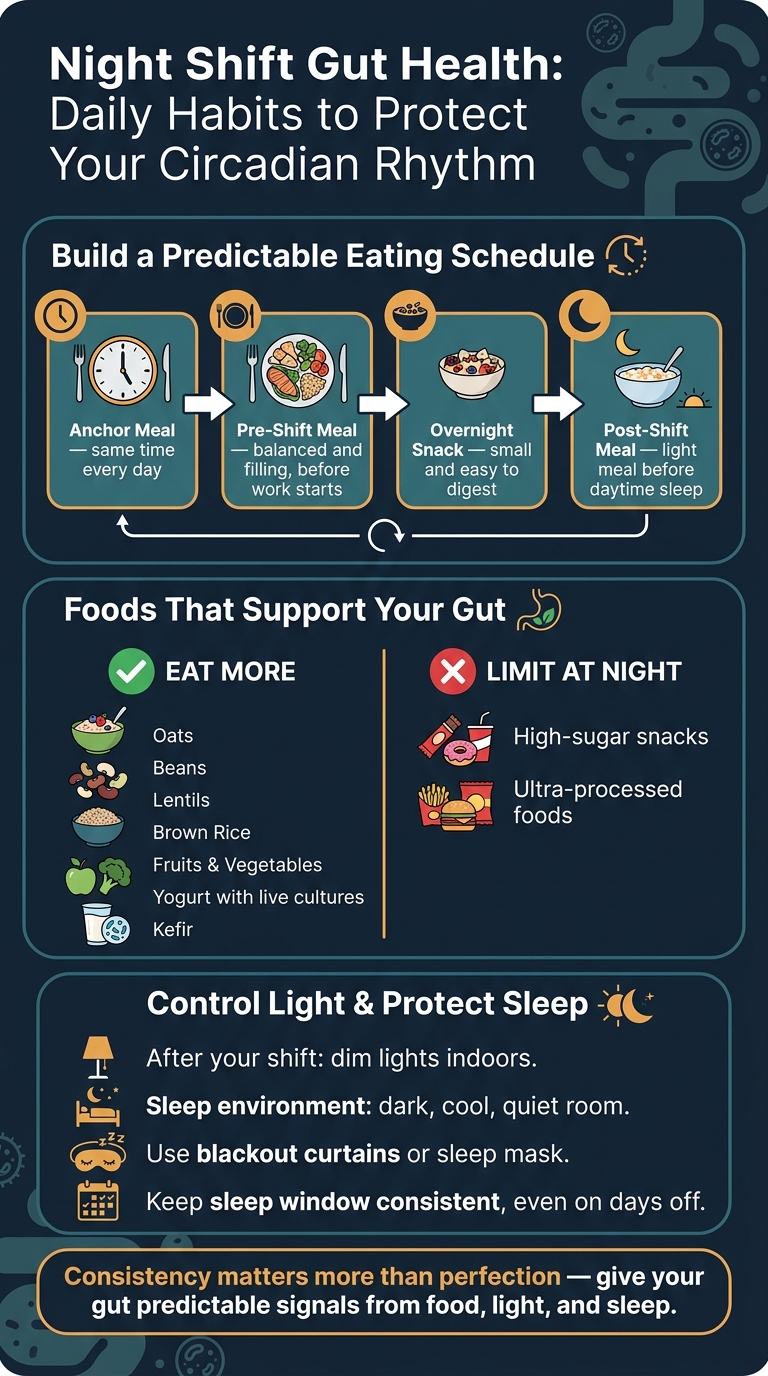
Night Shift Gut Health: Daily Habits to Protect Your Circadian Rhythm
When circadian disruption starts messing with digestion, the goal is simple: make your routine more steady. On a night shift schedule, three things matter most: when you eat, what you eat, and how you handle light and sleep.
Use Meal Timing to Reduce Digestive Strain
Meal timing matters because your gut runs on a daily rhythm too. When eating times stay more steady, the microbiome tends to stay more stable.
A simple way to do that is to set one anchor meal at the same time every day. That gives your body one predictable point it can count on. From there, try to eat your biggest meal before your shift starts, then keep overnight eating light, especially in the early morning hours when digestion can feel a bit sluggish.
A simple rhythm looks like this:
- Anchor meal: same time every day
- Pre-shift meal: balanced and filling
- Overnight snack: small and easy to digest
- Post-shift meal: light before daytime sleep
That timing can take some pressure off your digestive system. But timing alone isn’t enough. The food itself also plays a big part in how well your gut holds up.
Eat More Fiber and Cut Back on Ultra-Processed Snacks at Night
Fiber helps feed helpful microbes in the gut. It also helps them make short-chain fatty acids, which support gut function. If your sleep-wake cycle is all over the place, foods like oats, beans, lentils, brown rice, fruits, and vegetables can help offset some of the microbiome shifts that come with it.
Fermented foods can help too. Yogurt with live active cultures and kefir are two easy options that may support helpful gut bacteria.
At the same time, it helps to cut back on high-sugar, ultra-processed snacks during the night. Those foods can push gut bacteria in the wrong direction, which is the last thing you want when your schedule is already hard on digestion.
Control Light Exposure and Build a Consistent Sleep Routine
Food matters, but light is what tells your body what time it is. Bright light at night suppresses melatonin. That can make it harder for your body to settle down after a shift.
After work, dim the lights and let your brain start shifting into sleep mode. Think of it as giving your body a clear signal that the day is done, even if the sun is up. A dark, cool, quiet room gives you the best shot at recovery. Blackout curtains or a sleep mask can block daylight, and earplugs can help with daytime noise.
Try to keep your sleep window as steady as possible, even on days off. That kind of consistency can make a rough schedule feel a little less chaotic.
Sleep Support: Where RST Sleep Fits Into a Gut-Health Plan

Better sleep helps support digestive rhythm too. When sleep timing is all over the place, the gut-brain axis tends to get less stable. Sleep support can help back up the same rhythms that meal timing and light control are trying to restore. For workers with schedules that still change from week to week, that extra support can matter. Following a sleep schedule checklist can further stabilize these routines.
Ingredients That May Support Sleep, Stress Response, and Circadian Regulation
RST Sleep includes extended-release melatonin to support circadian regulation when night light exposure has already pushed the body off schedule. The formula is built to support a few different parts of that process:
| Ingredient | Primary Effect |
|---|---|
| Extended-Release Melatonin | Circadian regulation |
| Glycine | Supports relaxation |
| Phosphatidylserine | Supports stress response linked to digestion |
| Magnolia Bark | Promotes relaxation |
| Apigenin | Supports sleep quality |
That mix makes the formula a strong fit for workers who struggle to sleep after night shifts.
How RST Sleep Is Built for Night Shift Workers
RST Sleep is a natural sleep supplement made for night shift workers and people with irregular schedules. Its formula is non-habit-forming, allergen-conscious, and made in GMP-certified facilities. When used alongside meal timing and light control, it can help support routines that protect digestion.
Conclusion: Small Routine Changes Can Help Protect Both Sleep and Digestion
When your gut and body clock get out of step, digestion often gets harder to predict. Circadian disruption can throw off both digestive function and the gut microbiome.
The good news is that many of these circadian-related shifts can ease when your daily routine gets more steady.
The big levers are consistent meal timing, controlled light exposure, and a protected sleep window. When those three stay in sync, the gut tends to follow a steadier rhythm too.
If symptoms keep showing up, your schedule can offer useful clues. Track when digestive issues flare and compare that with your sleep, meals, and light exposure. If symptoms are persistent or severe, see a healthcare provider.
Consistency matters more than perfection.
FAQs
Can circadian disruption cause bloating or irregular bowel movements?
Yes. When your circadian rhythm gets thrown off, digestion can get thrown off too.
Research links circadian rhythm disruption to bloating, irregular bowel movements, and other gastrointestinal issues. That makes sense when you think about it: your digestive system runs on timing, not just food.
If your internal body clock is out of sync - because of shift work, late nights, or an uneven sleep schedule - digestive function may suffer. Sticking to a steady sleep-wake routine may help support healthy digestion and metabolic stability.
How long does it take my gut to adjust to a steadier routine?
Usually a few days.
Research suggests the body’s internal clock may take about 1 to 2 days to adjust to later schedules and about 5 to 6 days to adapt to earlier ones.
If you're trying to stick to a steadier routine, RST Sleep may help support relaxation and healthy, consistent sleep cycles.
What should I eat during a night shift to be easier on my gut?
To go easier on your gut during a night shift, plan your meals on purpose. Research suggests that timed food access may help support metabolic function and restore molecular rhythms, even when shift work disrupts sleep.
Try to eat as little as possible during the night shift itself. A steady, time-limited eating pattern may help reduce metabolic misalignment and support your internal clock.