

How Circadian Rhythm Affects Night Shift Sleep
Night shifts disrupt your body's natural sleep-wake cycle, or circadian rhythm, which is designed to align with daylight. This misalignment makes it harder to sleep during the day and stay alert at night, leading to fragmented sleep, shorter rest periods, and long-term health risks. Key takeaways:
- Light exposure: Sunlight and artificial light suppress melatonin, making it harder to fall asleep after a night shift.
- Hormonal disruption: Melatonin and cortisol levels stay out of sync, impacting sleep quality and alertness.
- Health risks: Chronic misalignment can increase the risk of diabetes, heart disease, and mental health issues.
- Solutions: Wear sunglasses during morning commutes, use blackout curtains, limit screen time before bed, and consider melatonin supplements to improve daytime sleep.
Managing light exposure and creating a dark, quiet sleep environment are critical to minimizing the effects of night shift work on your health and sleep quality.
How to Survive Night Shifts from a Sleep Expert | Management of Shift Work Sleep Disorder
sbb-itb-5106bd1
How Circadian Rhythms Control Sleep
Sleep is regulated by two interconnected systems that work together to manage when you feel alert and when you need rest. These systems, along with the influence of work schedules, help explain why night shift workers face such intense sleep challenges, largely due to disrupted hormone patterns.
The Two-Process Model of Sleep Regulation
Sleep is controlled by two key processes. The first is the homeostatic process (Process S), which builds up your need for sleep the longer you're awake. Think of it as sleep pressure that grows over time.
The second is the circadian process (Process C), which is governed by your suprachiasmatic nucleus (SCN) - a part of your brain that acts as your internal clock. These two processes work together to determine when you actually fall asleep. Your circadian rhythm ensures that sleep pressure leads to rest at the right time by managing hormones like melatonin and cortisol.
Melatonin, often called the "sleep hormone", starts being produced about two hours before your natural bedtime and peaks in the middle of the night, signaling your body to wind down. On the flip side, cortisol levels rise in the morning to help you wake up and stay alert during the day. For night shift workers, this hormonal rhythm is completely out of sync with their work hours, making it harder to get quality sleep.
Next, let’s look at how light plays a central role in keeping this system on track.
How Light Synchronizes Your Internal Clock
Light is the most powerful external signal - or zeitgeber (German for "time-giver") - that helps align your internal clock with the 24-hour day. When light enters your eyes, specialized cells in your retina detect it and send signals to the SCN via the retinohypothalamic tract. This process helps your brain figure out whether it’s day or night.
In response to light, the SCN suppresses melatonin production. Even moderate room lighting, around 200–300 lux, can inhibit melatonin. Dimmer light, between 100–200 lux, can still make you feel more alert if you’ve been sitting in darkness. This sensitivity explains why sunlight exposure during a morning commute after a night shift can make it nearly impossible to fall asleep once you’re home.
Timing is everything when it comes to light exposure. Light in the early evening causes a phase delay, pushing your sleep schedule later. In contrast, light in the early morning creates a phase advance, shifting your sleep schedule earlier. For night shift workers, this creates a frustrating cycle: exposure to artificial light during work hours and natural sunlight on the way home both disrupt efforts to establish a consistent daytime sleep routine.
The SCN doesn’t just regulate sleep hormones - it also coordinates "peripheral clocks" in nearly every organ and tissue, including your liver, lungs, and digestive system. Amazingly, about 10% of all expressed genes in the human body are influenced by circadian rhythms. Dr. Phyllis C. Zee, a leading expert from Northwestern University, explains:
"The SCN is the central pacemaker that links the 24-hour changes in the external environment with the 24-hour changes in the internal environment."
This extensive influence means that disrupting your circadian rhythm doesn’t just affect your sleep - it impacts nearly every system in your body. For night shift workers, the combination of artificial and natural light exposure throws these processes into disarray, leading to ongoing sleep struggles and broader health challenges.
How Night Shifts Disrupt Circadian Rhythm
Night shift work creates a tug-of-war between your natural biological clock and the artificial schedule imposed by working through the night. While it might seem logical that the body could adjust over time, the process is far from straightforward. The brain's "master clock", known as the suprachiasmatic nucleus (SCN), is hardwired to sync with the 24-hour solar cycle. It resists abrupt changes and adapts more effectively to gradual shifts in light exposure rather than sudden disruptions.
Why the Body Struggles to Adjust to Night Shifts
One of the biggest challenges lies in the stark difference between indoor and outdoor light levels. Indoor lighting, typically ranging from 100 to 300 lux, is too dim to shift your circadian rhythm effectively. Meanwhile, stepping outdoors into bright morning sunlight (10,000–25,000 lux) after a night shift triggers a "phase advance", which shifts your internal clock earlier - making it even harder to sleep during the day.
This phenomenon, often referred to as the "phase-advance trap", is a biological Catch-22. Exposure to morning sunlight after a night shift works against your efforts to adjust to a daytime sleep schedule. Even if you're physically exhausted, your internal clock remains out of sync.
Adding to this challenge, social obligations often prevent full adaptation. Many night shift workers revert to a daytime routine on their days off to spend time with family or attend social events. This constant switching between schedules disrupts the SCN's ability to establish a consistent nocturnal rhythm. Full adaptation would require strict adherence to a nighttime schedule for 2 to 3 weeks, including total avoidance of daytime light - an unrealistic expectation for most people.
As a result, the internal clock ends up oscillating between two states rather than fully committing to one. This misalignment shortens daytime sleep by 1 to 4 hours and reduces the quality of both REM and slow-wave sleep. With around 25% of U.S. adults working night shifts, many face this ongoing struggle between biological and social demands.
How Artificial Light Interferes with Sleep
Artificial light during night shifts further complicates the situation by suppressing melatonin, the hormone that signals your body to prepare for sleep. The circadian system is particularly sensitive to blue light (around 480 nanometers), which is commonly emitted by LED lighting and digital screens found in workplaces.
Even dim light below 3 lux - like that from a nightlight - can suppress melatonin. Standard indoor lighting (100–300 lux) has an even greater impact, delaying the hormonal signals your body needs to wind down after a shift. This suppression not only disrupts sleep but also undermines melatonin's other roles, such as acting as an antioxidant and tumor suppressor.
The World Health Organization has classified night shift work as a "probable carcinogen" due to the long-term effects of melatonin suppression. Research suggests that working as few as three night shifts a month over several years can increase the risk of chronic illnesses.
| Feature | Natural Circadian State (Night) | Night Shift Worker State |
|---|---|---|
| Light Exposure | Darkness (Melatonin rise) | Artificial Light (Melatonin suppression) |
| Body Temperature | Decreases | Remains elevated |
| SCN Signaling | Promotes rest | Conflicts with work demands |
| Sleep Quality | Consolidated | Fragmented and shortened |
The combination of dim indoor lighting during work and bright sunlight during the morning commute creates conflicting signals for the SCN, leaving your body in a constant state of misalignment. This ongoing disruption prevents the formation of a stable circadian rhythm, making it difficult to achieve restorative sleep.
How Circadian Misalignment Affects Sleep Quality
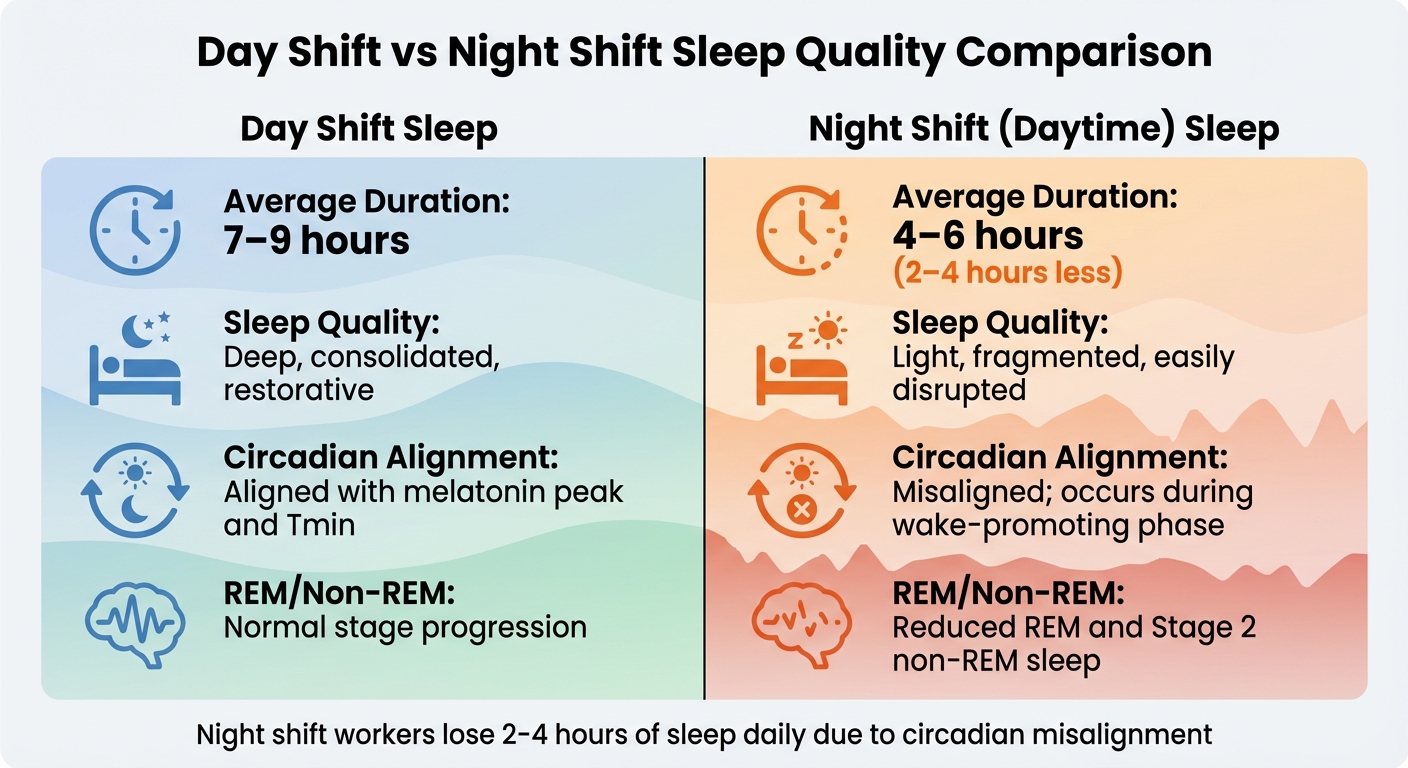
Day Shift vs Night Shift Sleep Quality Comparison
When your sleep schedule is out of sync with your internal biological clock, the effects go far beyond just feeling groggy. Circadian misalignment forces night shift workers to sleep during times when their bodies are naturally signaling wakefulness, leading to shorter and lower-quality sleep.
Night shift workers typically lose 2–4 hours of sleep each day. Compounding the issue, their Tmin - the lowest body temperature point that supports deep sleep - occurs during work hours instead of sleep hours, further eroding restorative rest. These disruptions don’t just affect how long they sleep but also alter the structure of their sleep cycles.
Changes in Sleep Stages for Night Shift Workers
Circadian misalignment distorts the very architecture of sleep. When night shift workers try to sleep during the day, their rest tends to be lighter, more fragmented, and less rejuvenating because it happens during a phase when the body is primed for alertness. Research indicates that this misalignment significantly reduces both REM sleep and Stage 2 non-REM sleep - two stages essential for memory, emotional health, and physical recovery. Unlike day workers who move through normal sleep cycles, night shift workers endure disrupted patterns, leaving them perpetually under-rested.
| Feature | Day Shift Sleep | Night Shift (Daytime) Sleep |
|---|---|---|
| Average Duration | 7–9 hours | 4–6 hours (2–4 hours less) |
| Sleep Quality | Deep, consolidated, restorative | Light, fragmented, easily disrupted |
| Circadian Alignment | Aligned with melatonin peak and Tmin | Misaligned; occurs during wake-promoting phase |
| REM/Non-REM | Normal stage progression | Reduced REM and Stage 2 non-REM sleep |
This misalignment doesn’t just stop at sleep - it disrupts nearly 44% of protein-coding genes across various tissues, causing internal systems to fall out of sync. While the brain’s central clock stays aligned with daytime, peripheral clocks in organs like the liver and heart shift at different rates, creating widespread desynchronization. This lack of coordination undermines the cognitive and physical processes that rely on smooth transitions through sleep stages.
Effects on Mental and Physical Health
The consequences of circadian misalignment extend well beyond disrupted sleep. Cognitive function takes a major hit, with night shift workers often struggling with impaired focus, slower reaction times, and memory issues due to chronic sleep deprivation. Working during the "circadian nadir" - the time when the body is most strongly programmed for sleep - leads to sharp declines in alertness and performance. Even with the use of stimulants like armodafinil, studies show that night shift workers often remain pathologically sleepy, with sleep latencies of just five minutes or less during early morning hours.
"Obtaining adequate sleep during the day does not mean that night-shift alertness, performance, and safety will also be normalized. Millions of years of evolution have made us diurnal animals, programmed to be sleepy at night." - Mark R. Smith and Charmane I. Eastman, Biological Rhythms Research Laboratory
Mental health also suffers under these conditions. Night shift workers face a 25–30% higher risk of developing mental health disorders like depression and anxiety. The constant clash between their biological clock and sleep-wake schedule makes them more vulnerable to mood swings. Beyond these conditions, they also report higher levels of irritability, burnout, and strained social relationships.
Physically, the risks are just as severe. Night shift work is linked to a 37% higher chance of developing type 2 diabetes, along with increased risks for heart disease, high blood pressure, obesity, and digestive issues. Workplace accidents are also nearly 40% more likely to occur during night shifts due to sleep deprivation and the natural dips in alertness. The mismatch between hormonal cycles - working when cortisol is low and melatonin is high, and sleeping during wake-promoting periods - creates chronic stress that damages long-term health.
"Working and sleeping during hours misaligned with natural light for extended periods of time is not likely to be healthy for you." - Eric Zhou, Assistant Professor, Harvard Medical School
Solutions for Better Sleep on Night Shifts
Night shift work can disrupt your natural rhythms, but targeted strategies can help improve your sleep quality. With studies showing that 10% to 38% of shift workers suffer from shift work disorder, it’s clear that addressing these challenges is essential.
Managing Light Exposure
Light plays a crucial role in regulating your internal clock. To stay alert during your shift, expose yourself to bright light - either from overhead fixtures or a 10,000-lux light therapy box - for 20–30 minutes at the start of your shift. This reduces melatonin production, helping you stay awake. Interestingly, medium-intensity light (around 1,230 lux) can be nearly as effective as higher-intensity light in delaying your circadian rhythm to better match night shifts.
However, sunlight during your morning commute can interfere with your ability to wind down. To counter this, wear dark, wraparound sunglasses as soon as you leave work. At home, create a sleep-friendly environment by using blackout curtains, sleep masks, or earplugs to block out light and noise.
Digital screens can also disrupt your wind-down process. Avoiding screens for 60–90 minutes before bed - or using blue-light filtering glasses - can help signal your body that it’s time to sleep. Additionally, dimming lights during the latter part of your shift supports a smoother transition into sleep mode.
If managing light exposure isn’t enough, natural sleep supplements can provide additional support.
Using Natural Sleep Supplements
Even with good light management, sleeping during the day - when your body is naturally wired to be awake - can be challenging. Natural supplements like melatonin can help. Melatonin works as both a chronobiotic, resetting your internal clock, and a soporific, promoting sleep. A dose of 3–5 mg taken 30–60 minutes before your desired sleep time can help counteract your body’s natural resistance to daytime sleep. Research shows melatonin can improve both sleep duration and quality, especially during the latter part of your rest period.
For those needing additional support, RST Sleep offers a supplement specifically designed for night shift workers and people with irregular sleep schedules. Their formula combines extended-release melatonin with ingredients like glycine, phosphatidylserine, magnolia bark, and apigenin. These components are known to promote relaxation, enhance sleep quality, and support healthy sleep cycles. The extended-release design helps maintain sleep throughout the day. Plus, the supplement is non-habit forming, allergen-conscious, and made in GMP-certified facilities.
To maximize the effectiveness of any sleep supplement, avoid caffeine for at least four hours before your shift ends. Consistency is key - take your supplement at the same time relative to your sleep schedule to help stabilize your circadian rhythm. Combining these strategies can help you overcome the biological hurdles of night shift work.
Conclusion
Your circadian rhythm is the natural driver of your sleep-wake cycle, but night shifts disrupt this balance, creating a clash between your biological clock and your work schedule. Even with several days of night shifts, your internal clock - regulated by hormones like melatonin and cortisol - often stays tuned to a daytime rhythm. This circadian misalignment doesn’t just leave you feeling drained; it can also lead to "internal desynchronization", where your body’s systems operate out of sync. Over time, this increases the risk of serious health issues like cardiovascular disease, diabetes, and certain cancers.
To address this, strategic changes can help improve sleep quality and reduce the strain on your body. Light exposure plays a huge role - using bright light during your shift and avoiding sunlight on your way home helps send the right signals to your internal clock. Creating a dark, cool sleep environment (around 60°F–65°F) can further support daytime rest. Pairing these environmental changes with thoughtful supplementation offers a well-rounded approach.
When managing light isn’t enough, natural sleep supplements can be a helpful tool. Melatonin, for instance, can help shift your internal clock and promote sleep during unusual hours. Supplements that include ingredients like glycine, phosphatidylserine, and magnolia bark can also support night shift workers by addressing specific sleep challenges without creating dependency.
"Pursuing restorative sleep is a critical means of caring for yourself." - Robon Vanek, APRN, CNP
Strive for 7–9 hours of sleep to safeguard your health. Globally, between 10% and 30% of workers deal with these challenges at least once a month. Even working just three night shifts per month over several years is linked to an increased risk of illness. By combining light management techniques with natural supplements, you can minimize the effects of circadian misalignment. Aligning your sleep habits with your body’s natural rhythms is key to tackling the unique demands of night shift work.
FAQs
Why can’t I sleep after a night shift even when I’m exhausted?
Struggling to drift off after a night shift, despite feeling completely drained, often boils down to your circadian rhythm being thrown off. This internal clock, which guides your sleep-wake cycle, clashes with the demands of working through the night. Night shifts interfere with the natural light-dark cycle, disrupting hormones, body temperature, and other key processes that help you sleep. As a result, even when your body is begging for rest, actually falling and staying asleep becomes a real challenge.
How can I use light to adjust my sleep schedule for night shifts?
To adapt your sleep schedule for night shifts, focus on managing light exposure. During your shift, expose yourself to bright light to stay awake and help shift your internal clock. After work, wear dark sunglasses on your way home to minimize light exposure and make it easier to fall asleep during the day. Create a dark, quiet room for daytime sleep to improve rest. Later in the afternoon, after waking up, spend time in bright light to help regulate your internal clock and improve your overall adjustment to night work.
What’s the safest way to use melatonin for daytime sleep?
To use melatonin safely for daytime sleep, take a low dose about 30–60 minutes before you plan to sleep. This timing helps adjust your circadian rhythm and reduces the chance of side effects like feeling overly drowsy. Getting the timing right is especially helpful for night shift workers or anyone with an irregular schedule who needs better sleep quality.