

Checklist: Choosing Non-Habit Forming Sleep Aids
The best non-habit forming sleep aid depends on your exact sleep problem - not the label on the bottle. If you can’t fall asleep, a sleep-onset option may fit. If you wake up and can’t stay asleep, you may need something else. And if you work nights or rotating shifts, your body clock may be the main issue.
I’d boil the article down to this:
- Match the product to the problem: falling asleep, staying asleep, or schedule shift
- Check the label: exact doses, clear directions, and no hidden blends
- Review safety: side effects, drug interactions, alcohol use, and next-day drowsiness
- Think about your schedule: many sleep aids are a bad fit if you need to drive or work soon after waking
- Keep it simple: start with the option that fits your sleep pattern and give it time before switching
A few numbers stand out. About 17.8% of U.S. adults report trouble staying asleep most days or every day, while 14.5% report trouble falling asleep. And about 27% of adult shift workers meet the criteria for shift work disorder. That tells me one thing: sleep trouble is common, but it is not all the same.
5 sleep supplements that HURT (and 5 that WORK)
sbb-itb-5106bd1
Quick Comparison
| What I’d check first | Why it matters |
|---|---|
| Your sleep problem | A product for sleep onset may not help much with middle-of-the-night waking |
| Ingredient purpose | Melatonin is more about body-clock timing; glycine is more about sleep quality |
| Full label details | If amounts are hidden, it’s hard to judge what you’re taking |
| Side effects | Even non-habit forming products can cause grogginess, headache, or GI issues |
| Work and drive timing | Some options are a poor fit if you have a short sleep window or early commute |
If I were choosing one, I’d use this checklist first, then pick the simplest option that matches my routine.
Checklist 1: Define your sleep problem before you buy
Before you buy anything, get clear on the problem first. That part sounds obvious, but it's where a lot of people go off track. A product that helps you fall asleep may not do much if your main issue is waking up at 2:00 a.m. Or if your sleep schedule is all over the place, the bigger issue may be your body clock, not sleep itself.
Use this checklist to match the aid to the problem.
Check whether you need help falling asleep, staying asleep, or adjusting your body clock
- Trouble falling asleep - You lie down at your usual time, but sleep does not come.
- Trouble staying asleep - You wake up during the sleep period and cannot fall back asleep.
- Body clock off - You work nights, rotate shifts, or need to reset sleep between work and off days.
Next, match that problem to how often you plan to use the product.
Check how often you plan to use it
How often you use it matters. For schedule-based sleep support, consistency and timing are key.
You should also rule out symptoms that need medical evaluation first. Loud snoring, gasping during sleep, or heavy daytime sleepiness point to a sleep disorder, not a sleep-aid problem.
Checklist 2: Review ingredients, labels, and product quality
Once you know what kind of sleep issue you’re dealing with, slow down and read the label. That step matters more than most people think. Supplements aren’t FDA-approved before they’re sold, so the label is one of the main ways to judge what you’re getting.
A good way to do this is simple: sort ingredients by what they’re supposed to do, not by how flashy the marketing sounds. Match each ingredient to the sleep problem you named earlier. In most cases, a useful formula should do one job well: body-clock support, sleep quality, or relaxation.
Look for ingredients with a clear sleep or relaxation purpose
For shift workers, timing support matters just as much as relaxation. That’s the whole game. If your body thinks it’s daytime, a calming herb alone may not do much.
| Ingredient | Primary role | Use notes |
|---|---|---|
| Melatonin | Body-clock support | Best for schedule shifts, jet lag, or delayed sleep schedules rather than deep sedation; effects are modest, with meta-analyses showing roughly a 7–10 minute reduction in sleep onset latency |
| Glycine | Sleep quality | About 3 g taken 30–60 minutes before bed has improved subjective sleep quality and morning refreshment in human trials |
| Phosphatidylserine | Stress and cortisol modulation | Useful for "tired but wired" nights and may help blunt elevated evening cortisol |
| Apigenin | Relaxation / mild anxiolytic | A flavonoid found in chamomile that may support relaxation; typical sleep-support doses are around 50 mg before bed |
| Magnolia bark | Calming / anxiety reduction | Traditional botanical used for relaxation and stress relief before bed; evidence is mainly from smaller studies and traditional use |
| L-theanine | Calm focus / mental tension | Often used to promote relaxation without causing drowsiness; common range is 100–400 mg |
| Magnesium | Muscle relaxation / nervous system calm | Not a sedative, but may help reduce physical tension; 200–400 mg in the evening is a common range |
Here’s a practical test: if you removed an ingredient and the product would probably work the same way, that ingredient is likely just filler.
Check for full label transparency and quality standards
A U.S. Supplement Facts panel should list each active ingredient, the exact amount per serving, and the serving size. That sounds basic, but it’s a big deal. Without exact amounts, you can’t compare the formula to studied doses, like the roughly 3 g of glycine used in clinical trials or the lower-dose melatonin ranges often used for circadian timing.
This is why proprietary blends can be such a headache. They hide the numbers. And if the numbers are hidden, you’re left guessing.
Beyond the ingredient list, check for a few plain-but-important details:
- Timing directions
- Allergen disclosures
- The manufacturer’s name and contact information
U.S. labels are also expected to include a domestic address or phone number for reporting serious adverse events. On the quality side, look for language stating that the product is made in a GMP-certified facility. That points to compliance with Good Manufacturing Practices under 21 CFR Part 111 for testing, batch records, and raw material verification. Third-party audits from groups like NSF or USP add another layer of verification.
Example of a shift-work-focused formula
Here’s what that can look like in practice.
RST Sleep is a non-habit forming supplement made for night shift workers and people with irregular schedules. Its formula lines up with the checklist: extended-release melatonin for sleep during a nonstandard window and circadian adjustment, glycine for sleep quality and morning refreshment, phosphatidylserine to help manage stress and nighttime cortisol, and magnolia bark plus apigenin for calm and relaxation. It is allergen-conscious, GMP-certified, and fully transparent about ingredient amounts.
Next, check for interactions, next-day grogginess, and whether the product fits your sleep window.
Checklist 3: Compare Safety, Side Effects, and Fit for Your Schedule
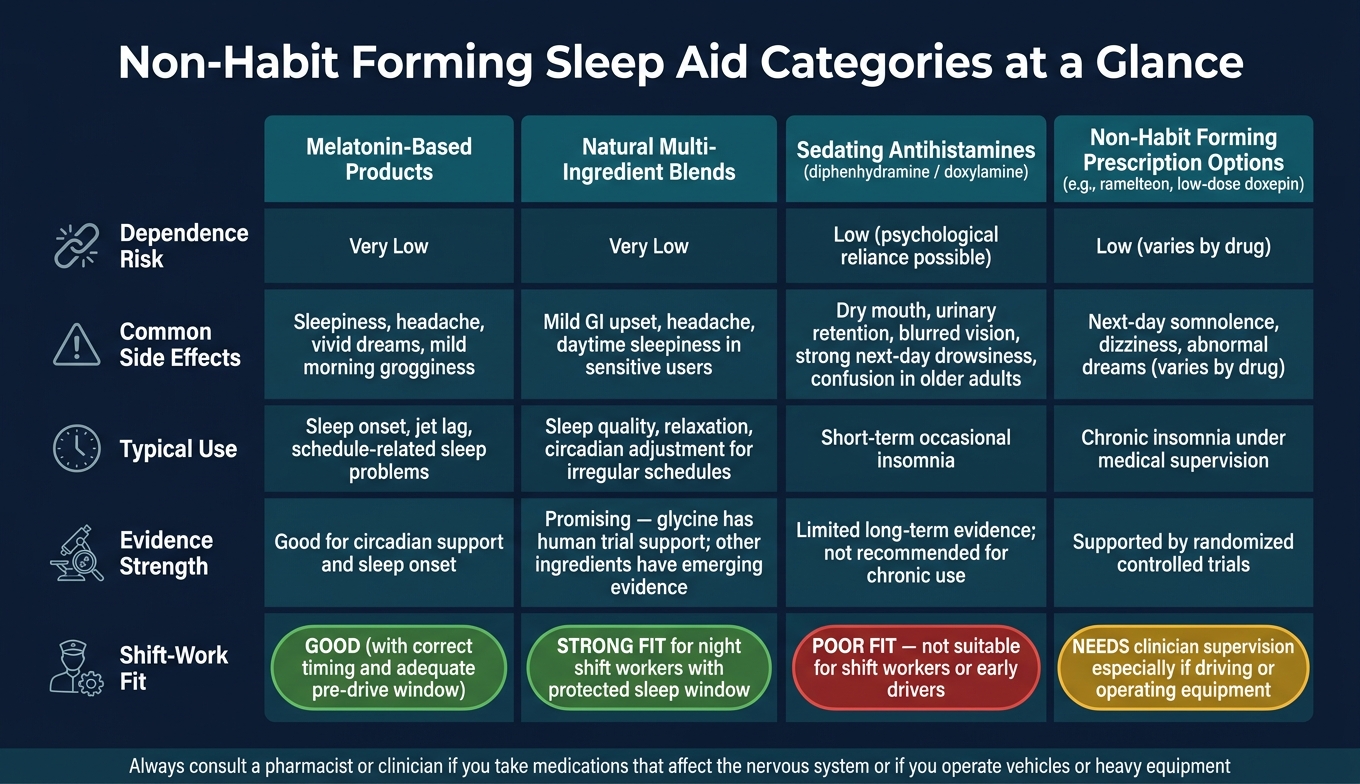
Non-Habit Forming Sleep Aid Categories: Side Effects, Evidence & Shift-Work Fit
After ingredients, the next filter is safety. This is where you catch bad fits before you buy.
Start with your medications. Sedating sleep aids can interact with antidepressants, anti-anxiety drugs, blood pressure medicine, seizure medicine, and other sedatives. Alcohol can make sedation and coordination problems worse. If anything on your med list affects the nervous system, check with a pharmacist before adding a sleep product.
Then look at your sleep window. Many sedating sleep aids are built around a full 7–8 hours of sleep. Next-day grogginess and slower concentration are common with prescription sleep meds. So don’t test a new sleep aid on a night before an early drive. Try it first when your morning is clear.
Once those safety checks are out of the way, compare the main options side by side.
Comparison Table: Common Non-Habit Forming Sleep Aid Categories
| Category | Dependence risk | Common side effects | Typical use | Evidence strength | Shift-work fit |
|---|---|---|---|---|---|
| Melatonin-based products | Very low | Sleepiness, headache, vivid dreams, or mild morning grogginess | Sleep onset, jet lag, and schedule-related sleep problems | Good for circadian support and time to fall asleep | Good when timed correctly and when you have enough time before driving |
| Natural multi-ingredient blends | Very low | Mild GI upset, headache, or daytime sleepiness in sensitive users | Sleep quality, relaxation, and circadian adjustment for irregular schedules | Promising; glycine has human trial support, and other ingredients have smaller or emerging evidence | Strong fit for night shift workers with a protected sleep window; RST Sleep is designed for night shift workers with a protected sleep window |
| Sedating antihistamines (diphenhydramine, doxylamine) | Low physical dependence; psychological reliance possible | Dry mouth, urinary retention, blurred vision, strong next-day drowsiness, and confusion in older adults | Short-term, occasional insomnia | Limited long-term evidence; not recommended for chronic use | Poor fit for shift workers or anyone who drives soon after waking |
| Non-habit forming prescription options (e.g., ramelteon, low-dose doxepin, orexin receptor antagonists) | Low, but it varies by drug | Next-day somnolence, dizziness, abnormal dreams; varies by drug | Chronic insomnia under medical supervision | Supported by randomized controlled trials for sleep onset and/or maintenance | Needs clinician supervision, especially if you drive or operate equipment |
Use these checks to narrow the field before you pick the simplest match for your sleep pattern.
Conclusion: Choose the simplest option that fits your sleep pattern
After looking at ingredients and safety, the decision is pretty simple: pick the option that lines up with your main sleep issue, your schedule, and a formula you can clearly understand.
If your biggest problem is falling asleep, go with a formula made for sleep onset. If you work night shifts or your schedule keeps changing, circadian support matters more than a generic “calming” blend.
For shift workers, one example built around that goal is RST Sleep. RST Sleep is made for night shift and irregular schedules, with extended-release melatonin, glycine, phosphatidylserine, magnolia bark, and apigenin to support sleep quality and circadian timing. It fits the checklist because it is non-habit forming, transparent, and built for schedule-specific use.
Also, check that the product’s onset timing matches your sleep window. Then start with the simplest option that fits your problem, and only switch after giving it a fair trial.
FAQs
How do I know if my problem is sleep onset, sleep maintenance, or shift-work related?
Track your symptoms and sleep patterns. Sleep onset problems mean you have a hard time falling asleep and often lie awake for more than 30 minutes. Sleep maintenance problems mean you wake up often, stay awake for long stretches, or wake too early and can’t get back to sleep. Shift-work related sleep problems happen when your sleep schedule clashes with your work hours.
A daily sleep diary can make these patterns easier to see. Write down your bedtime, wake time, and sleep quality each day. After a few days, the pattern often starts to show itself, which can help you pin down what kind of sleep issue you’re dealing with.
What should I avoid on a sleep aid label?
Avoid ingredients tied to dependence, misuse, or major side effects. Be extra careful with antihistamines. They may not work as well as you’d expect, and they can also cause unwanted side effects.
It also helps to watch for alcohol, stimulants, decongestants, and other substances that can interfere with sleep. Check the label every time, and talk with a healthcare professional to make sure the product matches your health needs.
When should I talk to a doctor instead of trying a sleep aid?
Talk to a doctor before using a sleep aid if you might have an underlying condition, such as sleep apnea or restless legs syndrome.
You should also speak with a physician if your sleep problems keep going, are tied to mental health or medical issues, if you take other medications that could interact, or if you have a history of substance use disorder. And before starting any new supplement, check with your doctor first.