

Caffeine Cutoff Times for Better Sleep
Struggling with sleep? Your caffeine timing might be the culprit. Here's what you need to know:
- Caffeine stays in your system for 5–7 hours (half-life) and can linger for up to 10+ hours.
- Drinking caffeine too late reduces deep sleep by 20% and can cut total sleep by an hour.
- Experts recommend stopping caffeine 6–8 hours before bed for most people. For better sleep, aim for 8–10 hours.
Key Takeaways:
- Day Shift: Last caffeine by 2 PM if sleeping at 10 PM.
- Night Shift: Stop by 1 AM if sleeping at 9 AM.
- Genetics, age, and medications affect how long caffeine impacts you.
If you wake up groggy or struggle to fall asleep, try moving your caffeine cutoff earlier. It's not just about how much you drink - it’s about when.
General Caffeine Cutoff Guidelines
How Long Caffeine Stays in Your Body
Caffeine doesn't just disappear the moment you finish your coffee. Its half-life - the time it takes for half of the caffeine to leave your system - averages 5 to 6 hours for most adults. However, this can vary widely, from as short as 2 hours to as long as 12 hours, depending on individual factors. This means caffeine can linger in your system for 10 hours or more after your last cup.
For example, if you drink a 200 mg cup of coffee at 2:00 PM, there could still be around 50 mg of caffeine circulating in your body by 2:00 AM.
"It's important to understand that even if you are able to fall asleep after recently consuming caffeine, you may not be sleeping as deeply or getting as much high-quality sleep as you would otherwise." - Dr. Dustin Cotliar, Sleep Physician
Knowing how long caffeine sticks around in your body is key to setting effective cutoff times for better sleep.
Recommended Cutoff Times for Most Adults
Experts generally recommend stopping caffeine 6 to 8 hours before bed. However, for deeper, more restorative sleep, a buffer of 8 to 10 hours is often a better choice.
The amount of caffeine you consume also matters. For instance, a 100 mg serving may clear in about 9 hours, but larger doses - 200 mg or more - can take 13 hours or longer to fully leave your system. The table below shows how your bedtime aligns with recommended caffeine cutoff times:
| Target Bedtime | Minimum Cutoff (6–8 hrs) | Better Sleep Cutoff (8–10 hrs) |
|---|---|---|
| 9:00 PM | 1:00 PM – 3:00 PM | 11:00 AM – 1:00 PM |
| 10:00 PM | 2:00 PM – 4:00 PM | 12:00 PM – 2:00 PM |
| 11:00 PM | 3:00 PM – 5:00 PM | 1:00 PM – 3:00 PM |
| 12:00 AM | 4:00 PM – 6:00 PM | 2:00 PM – 4:00 PM |
Don't forget, caffeine isn't just in coffee. It also hides in dark chocolate, black tea, energy drinks, and even decaf coffee.
Factors That Affect Your Ideal Cutoff Time
While these guidelines work for most people, your ideal cutoff time depends on several personal factors.
Genetics is a major factor. The CYP1A2 gene influences how quickly your liver processes caffeine. Around 10% of adults are fast metabolizers, clearing caffeine in 3 to 4 hours, while about 40% are slow metabolizers, taking 8 to 12 hours to process it.
Age also plays a role. A 60-year-old metabolizes caffeine about 33% slower than a 25-year-old. Other factors like oral contraceptives can extend caffeine's half-life to 10 to 12 hours, while smoking can shorten it to about 3 hours. For those in late-stage pregnancy, caffeine metabolism slows even further, with a half-life of up to 15 hours.
And here's an important note: building a tolerance to caffeine's stimulating effects doesn’t mean it stops disrupting your sleep. Even if you feel less energized at bedtime, caffeine can still interfere with deep sleep. If you often wake up feeling groggy despite getting a full night's rest, it might be time to adjust your caffeine cutoff earlier than you think.
sbb-itb-5106bd1
What time is your caffeine cut-off?
Caffeine Cutoff Times by Shift Type
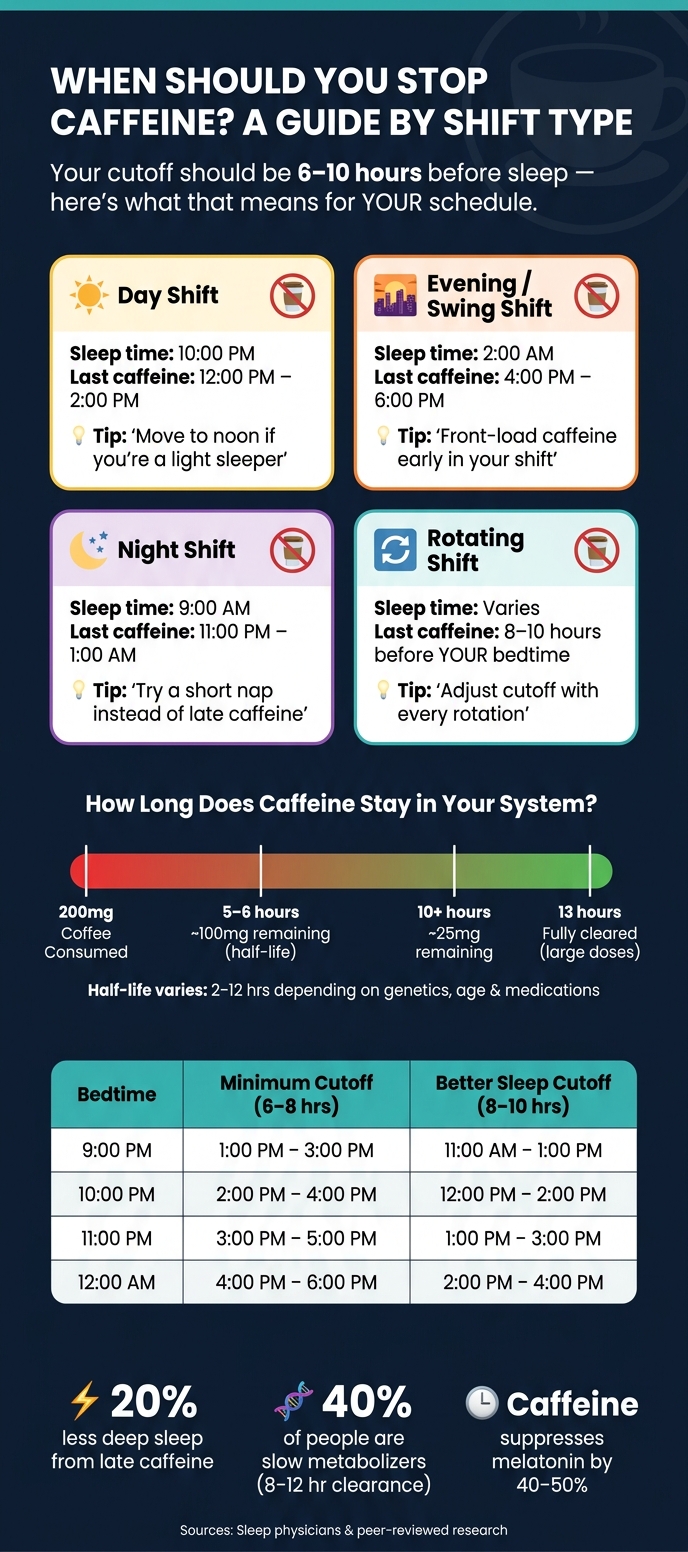
Caffeine Cutoff Times by Sleep Schedule & Shift Type
Your caffeine cutoff should match your sleep schedule. Here's how to tailor it to your specific shift pattern.
Day Shift Workers
For those on a standard day shift aiming to sleep by 10:00 p.m., the ideal caffeine cutoff is between 12:00 p.m. and 2:00 p.m.. A 2:00 p.m. cutoff generally works for most people with this bedtime. However, if you're a light sleeper or prone to waking up during the night, shifting your last caffeine intake closer to noon could make a difference.
"The simplest approach: no caffeine after 2 PM. This works for most people with a 10–11 PM bedtime and average metabolism." - Cyril Yevdokimov, Senior Product Designer & Founder, Timerjoy
To put it in perspective, drinking a 200 mg cup of coffee at 3:00 p.m. could leave about 90 mg of caffeine in your system by 11:00 p.m., potentially reducing deep sleep by up to 20%. The takeaway? Timing your caffeine intake with your sleep schedule is essential for quality rest.
Now, let’s explore how evening and night shifts impact your caffeine window.
Evening and Swing Shift Workers
If you work an evening or swing shift and sleep around 2:00 a.m., your caffeine cutoff should align with that schedule. In this case, aim to stop caffeine consumption between 4:00 p.m. and 6:00 p.m.. It's also a good idea to front-load your caffeine intake earlier in your shift to ensure it clears your system by bedtime.
Night Shift Workers
Night shifts come with their own challenges - staying alert during the early hours while ensuring good daytime sleep. If your sleep window starts at 9:00 a.m., plan to have your last dose of caffeine between 11:00 p.m. and 1:00 a.m.. Need a late-shift energy boost? Opt for a short nap instead of more caffeine.
"Caffeine is a legitimate performance tool for night shift workers, but most are using it wrong. The key discipline is a hard cut-off 6 hours before your planned sleep." - Gary, Founder, OffShift
For those who find it hard to unwind after a night shift, products like RST Sleep can help. Designed for night shift workers, it combines extended-release melatonin with ingredients like phosphatidylserine and magnolia bark to improve sleep quality when your schedule works against you. Timing caffeine intake properly is still the foundation of restful sleep.
Rotating Shift Workers
Rotating shifts bring more complexity, as your sleep window changes frequently. A fixed cutoff won't work here. Instead, adjust your caffeine cutoff with each rotation, ensuring an 8–10 hour caffeine-free window before sleep. The table below breaks down cutoff times for varying sleep schedules:
| Target Sleep Time | Standard Cutoff (6 hrs) | Better Sleep Cutoff (8–10 hrs) |
|---|---|---|
| 9:00 AM | 3:00 AM | 11:00 PM – 1:00 AM |
| 2:00 AM | 8:00 PM | 4:00 PM – 6:00 PM |
| 10:00 PM | 4:00 PM | 12:00 PM – 2:00 PM |
"Most caffeine advice gives a single rule for everyone, which is exactly why so many people follow it and still wake up tired. Your last cup should be tied to your real bedtime, not a generic suggestion." - Dr. Avinesh Bhar, Board-Certified Sleep Physician, SLIIIP
When transitioning between shifts, allow 2–3 days of reduced caffeine intake to help your body adjust. For constantly changing schedules, consider periodic resets - spending 7–10 days cutting back on caffeine during off periods. This keeps it effective when you need it most. Matching your caffeine intake to your sleep schedule remains the cornerstone of restorative sleep.
Non-Caffeine Ways to Stay Alert During Shifts
Timing your caffeine intake is important, but it’s not the only way to stay sharp during long shifts. In fact, relying too much on caffeine, especially toward the end of your shift, can mess with your sleep. Thankfully, there are other effective strategies to keep you alert and improve your sleep quality and overall energy without reaching for another cup of coffee.
Using Light Exposure to Stay Awake
Light plays a major role in helping your body regulate its internal clock. Bright, cool light (around 10,000 lux) during the first half of your shift can suppress melatonin, signaling your brain that it’s time to be awake. This is especially helpful during the circadian low - that sluggish period between 2:00 a.m. and 5:00 a.m.. If you’re working an overnight shift, a daylight lamp at your workstation can mimic natural sunlight and help you stay alert.
On the flip side, protecting your melatonin is just as important for winding down after work. Wearing dark, wraparound sunglasses during your commute home can block light exposure, making it easier to fall asleep when you get home.
Pairing this light strategy with short naps can further enhance your alertness.
Short Naps During Shifts
A quick 20- to 30-minute nap during a break can work wonders for your focus and accuracy without leaving you groggy. Just be cautious about napping for longer than 30 minutes, as this might push you into deep sleep, causing that disoriented feeling known as sleep inertia.
If you’re gearing up for a night shift, try taking a 90-minute nap beforehand. This gives your body enough time to complete a full sleep cycle, essentially “recharging” your alertness before the shift even begins. Think of it as setting yourself up for success rather than trying to play catch-up later.
Once you’ve used light and naps to stay sharp, focus on hydration and smart eating habits to maintain steady energy levels.
Hydration and Eating for Steady Energy
"Most of the time it's not caffeine withdrawal - it's dehydration." - Shift Calm
Dehydration is an often-overlooked reason for mid-shift fatigue. Drinking water consistently throughout your shift is key. If you need an extra boost, a sugar-free electrolyte drink can help keep your focus sharp without relying on stimulants.
What you eat also plays a big role in your energy levels. Since digestion slows at night, lighter, protein-packed snacks - like nuts, hard-boiled eggs, or cheese - are better choices than heavy meals. These options provide sustained energy without overwhelming your system. On the flip side, sugary snacks and greasy foods might give you a quick energy spike, but they’ll likely leave you crashing soon after. Staying hydrated and sticking to balanced, light meals can help you avoid those energy highs and lows.
When to Change Your Caffeine Cutoff
Signs Caffeine Is Affecting Your Sleep
If you find yourself lying in bed exhausted but unable to quiet your mind, caffeine might be the culprit. Other telltale signs include taking longer to fall asleep, waking up frequently during the night, feeling unrefreshed in the morning, or noticing a faster heart rate and heightened anxiety as you try to wind down. These symptoms suggest it might be time to rethink when you're having your last cup.
How to Adjust Your Cutoff Time
To improve your sleep, start by gradually tweaking your caffeine schedule. Instead of making a drastic change, try moving your last caffeine dose 30 to 60 minutes earlier every few days. This slow adjustment can help you pinpoint the timing that works best for you. A good rule of thumb is to figure out your ideal bedtime, then count back at least eight hours to establish your cutoff.
Keeping a simple sleep log for a week or two can also be helpful. Note when you last consumed caffeine and how you feel the following morning. This can reveal patterns and help you understand your personal sensitivity. Factors like your metabolism or work schedule might mean your ideal cutoff differs from others, especially if you rely on natural ingredients supporting sleep for night shift. If shifting your caffeine timing doesn’t lead to better sleep, it’s worth seeking professional advice.
When to Talk to a Doctor
If adjusting your caffeine intake doesn’t resolve your sleep troubles, it’s time to consult a doctor. Pay special attention if you experience signs like loud snoring, gasping during sleep, or feeling dangerously drowsy in situations like driving. Certain medications, such as oral contraceptives, can significantly affect how your body processes caffeine - extending its half-life by up to 50%. A healthcare professional can help you navigate these variables and check for underlying issues, such as Shift Work Sleep Disorder, to ensure you're getting the rest you need.
Conclusion: Getting Caffeine Timing Right for Better Sleep
Managing caffeine intake isn’t about giving it up entirely - it’s about being smart with your timing. The basic rule? Count back at least 6–8 hours from when you plan to sleep and stick to that as your cutoff. For example, if you take 200 mg of caffeine at 3:00 PM, you could still have around 50 mg lingering in your system by 3:00 AM. That leftover amount might seem small, but it’s enough to quietly disrupt your sleep quality.
Of course, this isn’t a one-size-fits-all situation. Your ideal caffeine cutoff depends on factors like your genetics, age, medications, and even your work schedule. Someone who metabolizes caffeine quickly and works a steady day shift will have different needs than someone who processes it slowly and rotates between night and day shifts. Think of your cutoff time as a flexible guideline that adapts to your circumstances, not a rigid rule.
For shift workers, the challenge doesn’t stop at caffeine timing. irregular hours can make it harder to recover fully, especially since caffeine can suppress melatonin production by 40–50% and reduce deep sleep by up to 20%. If you’re struggling with these effects, tools like RST Sleep offer a natural, science-backed supplement designed to improve relaxation and sleep quality for those with unpredictable schedules.
"Caffeine is a legitimate performance tool for night shift workers, but most are using it wrong. The key discipline is a hard cut-off 6 hours before your planned sleep." – Gary, Founder, OffShift
The takeaway? Small, consistent tweaks to your caffeine habits can significantly improve your sleep and overall performance. Start by setting a cutoff time, track how it impacts your rest, and fine-tune your approach from there.
FAQs
How do I find my personal caffeine cutoff time?
To figure out your ideal caffeine cutoff time, count back 6–8 hours from when you plan to go to bed. Keep in mind that how your body processes caffeine can depend on factors like genetics and any medications you’re taking. Pay attention to your caffeine consumption and how it affects your sleep quality. If you’re struggling to fall asleep or your sleep doesn’t feel restorative, try shifting your cutoff earlier by 30–60 minutes each week.
For added help, you might want to check out RST Sleep’s non-habit-forming supplement, which is designed to support healthier sleep cycles.
Does decaf coffee or chocolate still affect sleep?
Decaf coffee and dark chocolate can indeed impact sleep. While decaf coffee contains only about 2–15 mg of caffeine per cup, and dark chocolate has 20–30 mg per serving, these amounts might still affect individuals who are particularly sensitive to caffeine. Even small traces can be enough to disrupt sleep for some people. If you notice your sleep being affected, it’s worth cutting back on these in addition to regular caffeinated beverages.
For those seeking additional support, RST Sleep offers a natural supplement designed with scientifically supported ingredients to promote relaxation and maintain healthy sleep cycles.
What’s the best way to stay alert on night shift without late caffeine?
Stay sharp by keeping hydrated with electrolytes and incorporating short walks or even stair climbing into your routine to improve circulation. Exposure to bright light can naturally increase your alertness, and engaging in lively conversations can help keep your mind active. You might also try a clever trick called a 'nappuccino': drink a moderate amount of caffeine, then take a quick 20-minute nap - this can help you wake up refreshed and reduce grogginess. When it’s time to wind down after your shift, RST Sleep offers a supplement designed with calming ingredients to support restful sleep.