

Bright Light Therapy: Does It Work for Shift Workers?
Bright light therapy can help shift workers improve sleep and alertness by resetting their internal clocks. Using high-intensity light (7,000–10,000 lux), this method adjusts circadian rhythms, making it easier to stay awake during night shifts and sleep during the day. Studies show it reduces insomnia and enhances job performance when used correctly. Timing is critical - exposure before or after your body's core temperature minimum determines whether your sleep cycle shifts earlier or later. Pairing light therapy with strategies like blackout curtains, sunglasses after shifts, and fixed sleep schedules can boost its effectiveness.
Key Takeaways:
- What It Does: Adjusts sleep-wake cycles using bright artificial light.
- How It Works: Suppresses melatonin to promote alertness and realign circadian rhythms.
- Who Benefits Most: Fixed night shift workers and younger individuals.
- Proven Results: Studies report reduced insomnia and improved alertness.
- Best Practices: Use a 10,000-lux light box for 20–30 minutes at the start of your shift.
Bright light therapy isn't perfect for everyone, but when combined with other approaches, it can make shift work more manageable.
Using Light (Sunlight, Blue Light & Red Light) to Optimize Health | Huberman Lab Essentials
sbb-itb-5106bd1
Research on Bright Light Therapy for Shift Workers
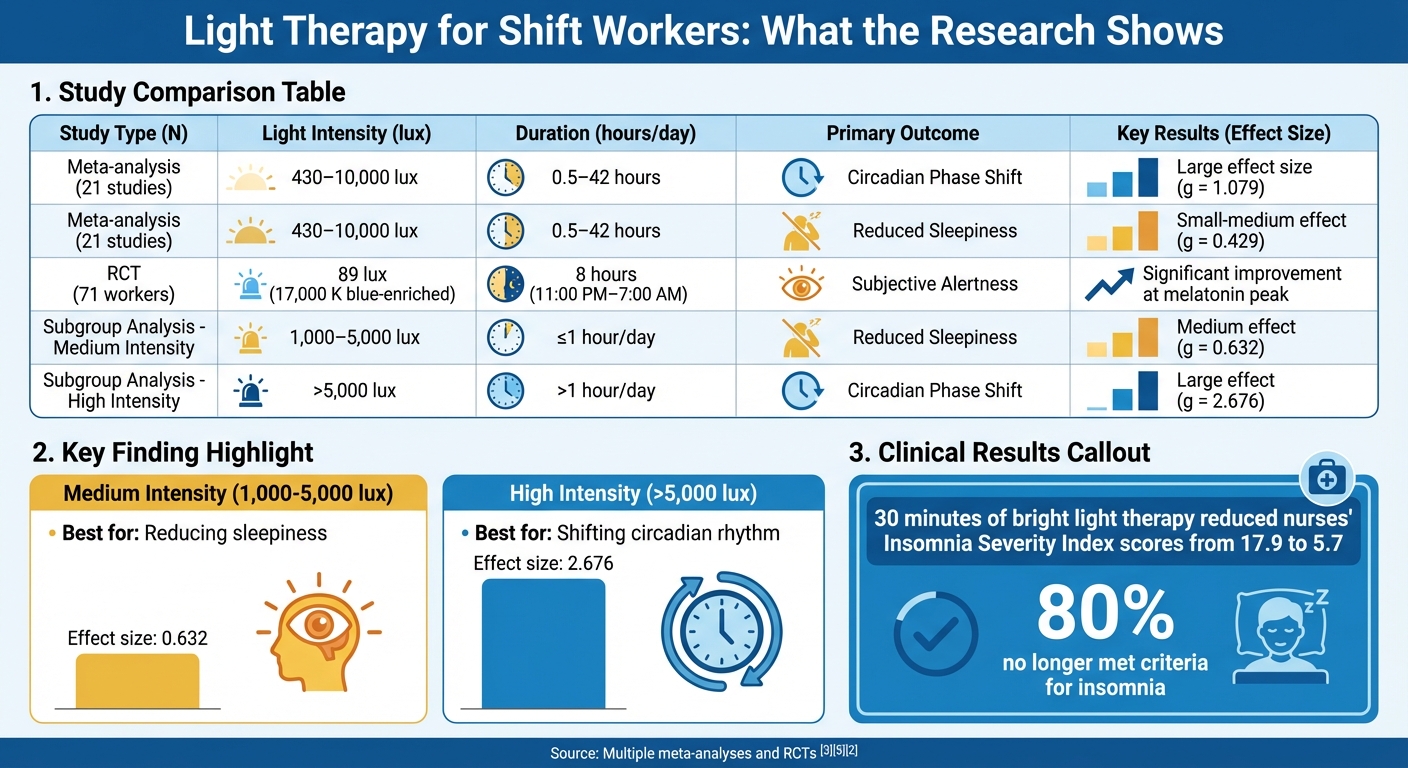
Bright Light Therapy Research Results: Intensity, Duration, and Effectiveness for Shift Workers
Key Studies and Results
Light therapy has emerged as one of the most researched non-drug approaches for improving shift workers' sleep health. A 2025 meta-analysis of 12 studies highlighted its effectiveness in enhancing alertness, sleep efficiency, and overall satisfaction.
"Light therapy - the most frequently studied intervention - showed statistically significant positive effects on various aspects of sleep health, including reduced sleepiness, improved sleep efficiency, and enhanced sleep satisfaction." – BMC Nursing
Another meta-analysis, encompassing 21 studies, showed a strong impact on circadian phase shifts and a moderate effect on reducing sleepiness. Interestingly, the intensity and duration of light exposure played a significant role in the results. Medium-intensity light (1,000–5,000 lux) for shorter durations (less than an hour) was more effective at combating sleepiness. On the other hand, high-intensity light (over 5,000 lux) showed a much stronger effect on shifting circadian rhythms, with an effect size of 2.676 compared to 0.983 for medium intensity.
Recent trials have also looked into blue-enriched light as a potential alternative to traditional bright white light. In one randomized controlled trial involving 71 night shift workers, blue-enriched white light at 17,000 K (89 lux) was compared to standard white light at 4,000 K (84 lux). The blue-enriched light significantly reduced subjective sleepiness when used during the melatonin peak, underscoring the importance of timing in maximizing the benefits of light exposure.
Study Comparison Table
| Study Type | Light Intensity | Duration | Primary Outcome | Key Results |
|---|---|---|---|---|
| Meta-analysis (21 studies) | 430–10,000 lux | 0.5–42 hours | Circadian Phase Shift | Large effect size (g = 1.079) |
| Meta-analysis (21 studies) | 430–10,000 lux | 0.5–42 hours | Reduced Sleepiness | Small-medium effect (g = 0.429) |
| RCT (71 workers) | 89 lux (17,000 K blue-enriched) | 8 hours (11:00 PM–7:00 AM) | Subjective Alertness | Significant improvement at melatonin peak |
| Subgroup Analysis | 1,000–5,000 lux | ≤1 hour/day | Reduced Sleepiness | Medium effect (g = 0.632) |
| Subgroup Analysis | >5,000 lux | >1 hour/day | Circadian Phase Shift | Large effect (g = 2.676) |
The studies reveal that light therapy's benefits can vary depending on the schedule and demographic. Fixed night shift workers often experience better outcomes compared to those on rotating shifts. Similarly, younger participants tend to show more pronounced circadian phase shifts than older workers. These differences may explain why some individuals report significant improvements, while others see only modest changes. The range of outcomes provides valuable insights into both the potential and the limitations of light therapy for shift workers.
Benefits of Bright Light Therapy
Bright light therapy offers measurable advantages for shift workers, building on a solid foundation of research.
Better Sleep and Alertness
Bright light therapy has been shown to greatly enhance sleep quality. For example, a study from July 2013 revealed that just 30 minutes of bright light therapy reduced nurses' Insomnia Severity Index scores from 17.9 to 5.7. Impressively, 80% of participants no longer met the criteria for insomnia after the therapy.
The benefits extend beyond sleep. The same study found that light therapy significantly lowered anxiety and depression scores on the Hospital Anxiety and Depression Scale. Dr. Bjorvatn highlighted the far-reaching effects of these improvements:
"The improvements in sleep and psychological health may also have large consequences in terms of higher productivity, reduced risk of accidents/errors at work, as well as reduced sickness absence."
Alertness during demanding shift hours also sees a boost. A study conducted from September 2015 to August 2019 by Mariana Figueiro at Rensselaer Polytechnic Institute tested 90 hospital workers in New York and Indiana using personal light glasses. The findings showed that red light at 630 nm significantly improved sleep quality and reduced disturbances compared to dim white light. Additionally, it enhanced performance during the challenging middle-of-the-night shifts. These results align with the goal of maintaining optimal circadian timing.
Circadian Rhythm Adjustment
Bright light therapy plays a key role in resetting the body’s internal clock. By adjusting melatonin production to align with a desired sleep schedule, it not only improves sleep but also helps maintain alertness during work hours. Exposure timing is critical - light therapy before the body’s temperature minimum delays the sleep cycle, while exposure afterward advances it, effectively realigning the circadian rhythm.
The impact of bright light therapy on circadian phase shifting is noteworthy. Research indicates a strong treatment effect, with a pooled effect size of 1.079. High-intensity light (above 5,000 lux) proves particularly effective, producing much stronger phase shifts than medium or low-intensity light sources.
Limitations of Bright Light Therapy
Bright light therapy can offer benefits, but its effectiveness varies widely between individuals. Understanding these limitations is key to setting realistic expectations and using the therapy effectively.
Why Results Vary Between Studies
Several factors influence how well bright light therapy works. Age and work schedules play a significant role. For example, younger workers and those on fixed night shifts often see better results, while middle-aged and rotating shift workers tend to benefit less. Research has shown that although light therapy can reset the biological clocks of middle-aged individuals by over 6 hours, it doesn't necessarily improve their on-duty alertness or performance. Dr. Scott S. Campbell from Cornell University Medical College highlighted the reduced phase tolerance in middle-aged subjects, raising questions about the universal effectiveness of bright light therapy.
Consistency in sleep schedules is another major factor. Even small increases in the variability of wake times - just one standard deviation - can reduce potential phase delay by 2 hours and 36 minutes. Workers with irregular sleep patterns often show minimal adaptation, even when using bright light therapy.
These challenges highlight the need to combine light therapy with other strategies for better results.
Combining Light Therapy with Other Methods
To overcome its limitations, pairing bright light therapy with additional approaches can significantly enhance circadian adaptation. For many shift workers, light therapy alone may not provide the desired results, but combining it with other methods creates a more comprehensive solution.
For instance, exposure to 2,500 lux of light can produce a 4.10-hour phase delay, while maintaining a fixed dark sleep schedule adds another 3.17-hour delay. Together, these strategies can achieve a 7.28-hour phase shift, allowing for full circadian adaptation. A study published in the American Journal of Physiology underscores the importance of scheduling both sleep and darkness to address phase misalignment caused by shift work.
Dark therapy is another crucial component. Morning sunlight during the commute home can undo the benefits of nighttime light exposure. To counteract this, shift workers can use blackout curtains or wear dark goggles after their shifts to block competing light signals that might reset their circadian clocks.
For those looking for a more holistic approach, combining light therapy with sleep supplements can address multiple aspects of sleep quality. Products like RST Sleep offer ingredients such as glycine, phosphatidylserine, and extended-release melatonin, which work to promote relaxation and improve sleep consolidation, complementing the circadian adjustments made by light therapy.
How to Use Bright Light Therapy
Best Practices for Light Therapy
If you work night shifts, using a 10,000-lux light box positioned 12–20 inches from your face for 20–30 minutes at the start of your shift can help. This practice suppresses melatonin production and boosts alertness, making it easier to stay awake during work hours.
To adjust your sleep schedule, the timing of light exposure is key. For delaying your sleep cycle, expose yourself to bright light 1–2 hours before your desired bedtime. To advance your sleep cycle, use bright light 1–3 hours after waking up. Satchin Panda, author of The Circadian Code, emphasizes this point:
"Your circadian clock is set entirely by light. The timing of when that light hits your eyes is more important than how much you get - and most people are getting it at the worst possible times."
When choosing a light therapy device, opt for a UV-filtered, full-spectrum white light model with a color temperature between 5,000 and 6,500K. Panel-style designs are recommended because they provide diffused light, which is more comfortable for extended use. Research also suggests that medium-intensity light (1,000 to 5,000 lux) can reduce immediate sleepiness, while higher-intensity light (over 5,000 lux) is better for shifting your circadian rhythm significantly.
Pairing these techniques with other strategies can make your sleep recovery even more effective.
Additional Sleep Recovery Strategies
Bright light therapy works best as part of a broader sleep recovery plan. To get the most out of your efforts, combine light therapy with other practices designed to improve sleep quality.
After finishing a night shift, wear dark wraparound sunglasses during your morning commute. This prevents exposure to sunlight, which can disrupt your circadian rhythm and undo the benefits of your light therapy session. Morning sunlight, which can reach up to 100,000 lux, should be avoided whenever possible during this time.
Create an ideal sleep environment by using blackout curtains and a sleep mask to block out light during the day. Limit screen time for 60 to 90 minutes before bed, or enable night mode settings to minimize blue light exposure. Research shows that dimming household lights to below 10 lux in the two hours leading up to bedtime can help melatonin kick in 1 to 2 hours earlier.
For additional support, you might consider a sleep supplement tailored for shift workers. RST Sleep offers a natural formula designed to help those with irregular schedules. Its ingredients - such as glycine, phosphatidylserine, magnolia bark, extended-release melatonin, and apigenin - promote relaxation, improve sleep quality, and help regulate your sleep cycle effectively.
Conclusion
Research shows that bright light therapy can significantly improve sleep and alertness for shift workers. When applied correctly, it helps adjust circadian rhythms, as studies have demonstrated. This reinforces earlier findings about the powerful connection between light and our internal clocks.
But timing is everything. The impact of light exposure depends heavily on when it's applied. Light exposure before the body’s temperature nadir delays the circadian rhythm, while exposure after advances it.
Several factors, like age and the type of shift worked, also play a role in how effective the therapy is. Medium-intensity light is effective for reducing sleepiness, while high-intensity light can drive stronger adjustments to the circadian rhythm. Meanwhile, red light therapy is gaining attention as a promising alternative. It enhances sleep quality and alertness without suppressing melatonin, potentially offering a safer option for long-term use.
FAQs
How do I time light therapy for my shift schedule?
To help your body adjust to shift work, try syncing your circadian rhythm with your schedule. At the start of your night shift, expose yourself to bright light to stay alert. Once your shift ends, reduce light exposure by wearing dark sunglasses outside and sleeping in a completely dark room. When you wake up, let natural light in - it can help reset your internal clock. During your shift, brief exposure to bright light can also enhance alertness and regulate melatonin levels, making it easier to adapt.
What side effects or risks should I watch for?
Bright light therapy can sometimes lead to eye strain, headaches, or even disrupt your circadian rhythm if it's used at inappropriate times. To reduce these risks, it’s crucial to use the therapy as directed and stick to the recommended timing. While these side effects are usually mild, keeping an eye on them is important.
Can I combine light therapy with melatonin or RST Sleep?
Yes, bright light therapy can work alongside melatonin, but it’s important to proceed carefully and seek professional guidance. Melatonin isn’t appropriate for everyone - for instance, it’s not recommended for those who are pregnant or individuals handling heavy machinery. Always check with a healthcare provider before trying any new sleep aids or treatments.