

Best Times to Exercise for Night Shift Workers
If you work nights, the best time to exercise is usually before your shift, not right before bed. That’s the short answer.
I’d boil the article down like this:
- Best pick for most people: work out 2 to 3 hours before your shift
- If you’re short on time: do a short, moderate session 60 to 90 minutes before work
- If your energy drops overnight: add light movement during the shift, especially around 1:00 AM to 3:00 AM
- After work: keep it light only, because hard training too close to sleep can make falling asleep harder
- On days off: time your workouts based on your goal - either keep your night schedule steady or move back toward daytime hours
A few facts stand out. Night shift workers often get 20% to 30% less deep sleep than day workers. And hard intervals close to sleep were linked to a 7.39% drop in sleep efficiency and a 10% increase in wake time after sleep starts. So timing matters more than most people think.
My main takeaway: put sleep first, keep hard workouts away from your sleep window, and use exercise as a tool for both alertness and recovery.
How to Stay Fit as a Shift Worker (What Actually Works)
sbb-itb-5106bd1
Quick Comparison
| Workout window | Best use | Intensity | Sleep impact |
|---|---|---|---|
| 2–3 hours before shift | Main workout | Moderate | Usually easiest on sleep |
| 60–90 minutes before shift | Fast energy boost | Moderate | Often fine if kept short |
| During shift | Fight overnight slump | Light to moderate | Usually low impact |
| Right after shift | Light recovery only | Light | Can delay sleep if too hard |
| Days off | Keep schedule steady or shift body clock | Varies | Depends on timing goal |
If I were choosing one rule to follow, it would be this: avoid hard exercise in the last 90 minutes before sleep. That one move does a lot to protect daytime sleep while still leaving room to train.
What Night Shift Workers Should Know Before Choosing a Workout Time
There’s no one best workout time for every night shift worker. What works for you depends on your shift, your commute, when you eat, how late you use caffeine, and when you actually plan to sleep. Those are the things to weigh as you look at the five workout windows below.
People with a fixed overnight schedule usually have an easier time building a steady routine than people on rotating shifts. That gap matters most when you’re trying to train on a regular basis. If your schedule rotates, it often works better to keep your training days as steady as possible from week to week.
Your own response to exercise matters too. Some people finish a hard workout and feel fine. Others feel wide awake for hours. If intense training leaves you wired, put more distance between your workout and your sleep window.
One rule applies to pretty much everyone: avoid hard training in the last 90 minutes before sleep. Vigorous exercise lifts core body temperature, and your body needs that temperature to come down before sleep starts. Very light movement is less likely to get in the way. Once you keep that in mind, comparing the five workout windows gets a lot simpler.
1. Early Evening Before a Night Shift
If you want a workout window that gives you some flexibility without cutting into sleep, early evening is usually the best place to start. For many night shift workers, training 2–3 hours before the shift begins is a solid option. So if your shift starts at 11:00 PM, aim for about 8:00 PM to 9:00 PM. If it starts at 7:00 PM, aim for about 4:00 PM to 5:00 PM. That gap gives your body time to cool down before work and later sleep.
A 20- to 30-minute moderate workout can help you feel more alert without leaving you too revved up before sleep.
The key here is moderation. Think brisk walking, light cycling, or a moderate strength workout with compound moves like squats or presses. Stop short of failure. Skip HIIT, and don’t go all-out. Try to finish at least 60 to 90 minutes before work so you have enough time to cool down, shower, and eat.
This timing tends to work well for people on fixed overnight shifts, like 11:00 PM–7:00 AM, and it can also fit rotating schedules. You get the alertness bump from exercise without drifting too close to your sleep window. It also gives you some recovery time before the shift begins.
If training before work isn’t possible, the next best move is a very light session during the shift.
2. Short Session Right Before the Night Shift Starts
If a full 2–3 hour pre-shift workout just isn’t happening, this shorter window can still do the job. Training 60–90 minutes before your shift works well when you want a quick alertness bump but don’t have room for a longer session.
This timing can help you feel sharper. In one study, NASA flight controllers did 10-minute aerobic sessions at or below 65% of max heart rate. Their reaction times improved from 611.0 ms to 543.7 ms.
The key here is moderate intensity. Aim for steady exercise at about 70–75% of max heart rate. That’s often enough to help you stay switched on during the shift without making it harder to sleep later.
Hard intervals are a different story. One high-intensity interval session was linked to a 7.39% drop in sleep efficiency and a 10% increase in wake after sleep onset. So if you’re working nights, this is probably not the best slot for an all-out effort.
This approach tends to fit best with fixed overnight shifts. It can also work on rotating schedules if you want the same pre-shift routine each time. But listen to your body. If you feel shaky, nauseated, or strangely wired and exhausted before work, skip the session. And if even moderate exercise feels like too much, go with light movement during the shift instead.
3. Light Movement During the Night Shift
If pre-shift exercise isn't practical, planned movement during the shift can help fill that gap. This isn't about squeezing in a workout. It's about helping offset the usual overnight dip in alertness and circulation.
Timed movement can boost alertness by 42% overnight. The roughest stretch is often 1:00 AM to 3:00 AM, when alertness and body temperature are at their lowest. During that window, physical output can drop by 8% to 12%.
Keep the effort light to moderate, around 50% to 70% of your maximum heart rate.
In plain terms, that can look like:
- 2 to 3 minutes of stair climbing
- Dynamic stretching
- A 10- to 20-minute walk
- 5- to 7-minute breaks every 2 to 3 hours
The goal is simple: move enough to wake yourself up a bit, not so much that you feel drained.
There is one catch. If you slept 5 hours or less, frequent movement breaks can make you sleepier near the end of the shift because they use extra energy. In that case, keep the breaks shorter and take them less often.
If even light movement feels disruptive, the next option is working out right after your shift ends.
4. Working Out Right After the Night Shift Ends
If a bit of movement during your shift doesn’t do the trick, a short workout after your shift can help. There’s just one catch: if you exercise too close to bedtime, it can make sleep harder. Your core body temperature usually drops back to normal within 30 to 120 minutes after exercise, and that time can vary based on how hard you trained.
The main thing to watch is intensity. A 15- to 30-minute walk, light yoga session, or some mobility work can help you settle down. But it’s smart to skip HIIT, CrossFit, and heavy lifting within an hour of bed. Those workouts are more likely to leave you feeling wired when you should be easing into sleep.
This timing makes sense when you want to fit in some exercise and still have enough time to cool off before bed. It tends to work best for workers who have a set block of time off after their shift. If exercise tends to fire you up, push it earlier so it happens before your sleep window. And if bedtime is right around the corner, it’s better to pass on the workout.
5. Exercising on Days Off to Reset or Maintain Your Sleep Schedule
On days off, the job changes a bit. You’re either trying to hold your current night schedule steady or shift back toward daytime hours. Those days are often the best spot for longer workouts, but timing still matters. Why? Because exercise can nudge your body clock in one direction or the other.
The best workout window depends on what you want your schedule to do.
If you work permanent night shifts and want to stay on that rhythm, keep your workout timing on days off close to your workday timing. That consistency helps you stay in sync. If you suddenly switch workout times on off-days, you can end up with social jet lag, which makes it tougher to settle back into night shifts.
If you’re on a rotating schedule and want to move back toward daytime hours, shift your workouts earlier. Morning exercise around 7:00 AM or mid-afternoon sessions around 1:00 PM to 4:00 PM can move your body clock earlier.
That matters because exercise timing can push your clock in different ways:
- 7:00 AM or 1:00 PM to 4:00 PM can cause a phase advance, which helps shift you earlier
- 7:00 PM to 10:00 PM can cause a phase delay, which pushes you later
For rotating shift workers, that gives you a simple lever to pull when your schedule changes. It won’t make the switch effortless, but it can make it feel a bit less rough.
Use this table to match your off-day training window to your shift pattern:
| Shift Pattern | Goal on Days Off | Best Workout Window |
|---|---|---|
| Permanent Nights | Maintain night-oriented rhythm | Similar timing to workday schedule |
| Rotating Shifts | Reset clock for the next shift | 7:00 AM or 1:00 PM–4:00 PM to advance; 7:00 PM–10:00 PM to delay |
| 12-Hour (4-on/4-off) | Stabilize hormonal and metabolic health (often supported by melatonin regulation) | Similar timing on off-days; full-length sessions on the first three days off |
That gives you a simple way to line up off-day training with the kind of shift schedule you work.
Quick Comparison of the 5 Workout Time Windows
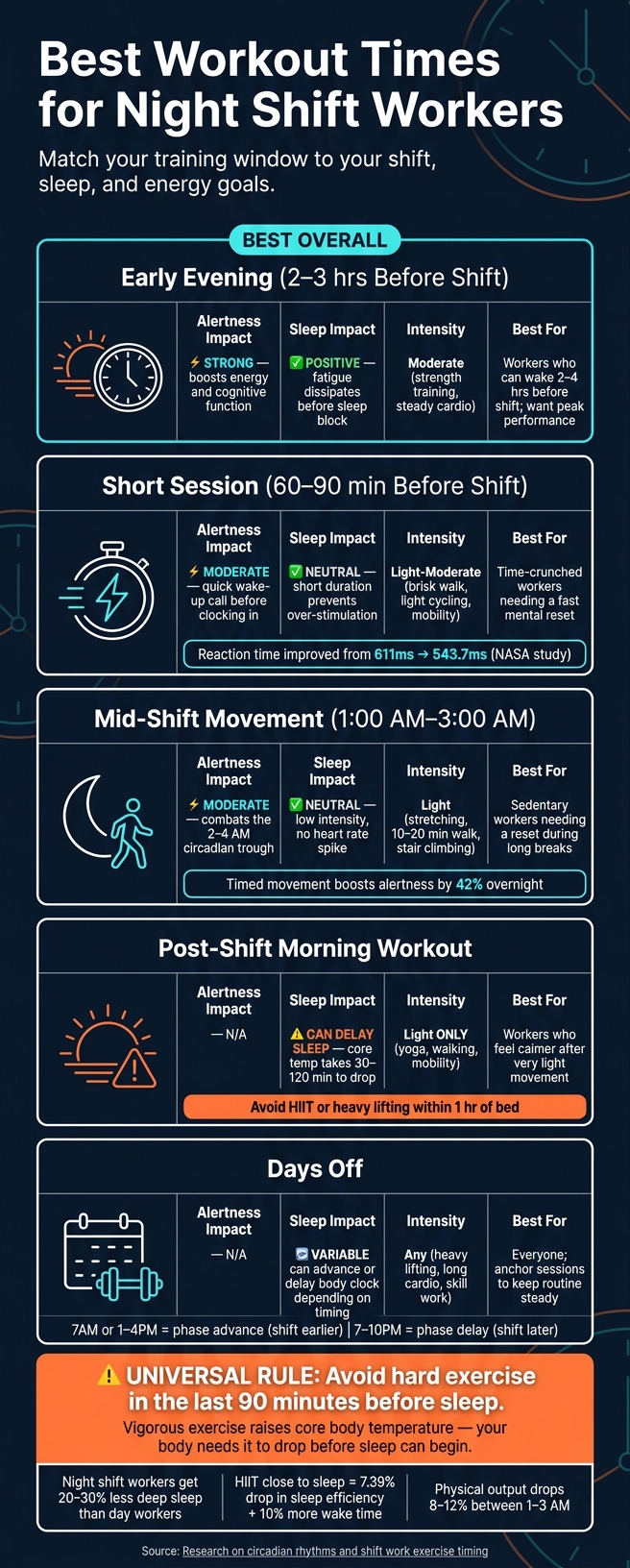
Best Workout Times for Night Shift Workers: 5 Windows Compared
Here’s the side-by-side view of the five workout windows. Use this quick snapshot to compare alertness, sleep impact, and workout intensity.
| Workout Window | Impact on Shift Alertness | Effect on Daytime Sleep Onset | Best Workout Types | Best For |
|---|---|---|---|---|
| Early Evening (Pre-Shift, After Waking) | Strong - boosts energy and cognitive function for the start of the shift | Positive - fatigue dissipates before the morning sleep block | Moderate strength training, steady cardio | Those who can wake 2–4 hours before their shift and want peak performance |
| Short Session Right Before Shift | Moderate - provides a quick wake-up call right before clocking in | Neutral - short duration prevents over-stimulation | Brisk walk, light cycling, mobility | Time-crunched workers or those with long commutes needing a quick mental reset |
| Mid-Shift Movement | Moderate - combats the 2:00–4:00 AM circadian trough | Neutral - low intensity doesn't spike heart rate long-term | Light cardio, stretching, mobility work | Sedentary workers or those in high-stress roles who need a reset during a long break |
| Post-Shift (Morning) | Not applicable | Can delay sleep | Yoga, light walking, low-intensity mobility work | Workers who feel calmer after light movement |
| Days Off | Not applicable | Variable - maintains rhythm or shifts it earlier, depending on your goal | Heavy lifting, long-duration cardio, skill work | Everyone; best used as anchor sessions to keep the routine intact regardless of shift changes |
A simple way to read this: if you want your BEST training before work, early evening tends to be the strongest fit. If you just need a fast boost before heading out, a short pre-shift session can do the job. And if your energy crashes in the middle of the night, mid-shift movement can help you get through that 2:00–4:00 AM dip.
On the other hand, post-shift morning workouts are a mixed bag. They may feel calming for some people, but they can also push sleep later. Days off give you the most room for harder sessions, longer cardio, or skill work, which makes them a good place to keep your routine steady even when your schedule shifts.
Next, match the window to your shift start, sleep block, and commute.
How to Pick the Right Workout Window for Your Schedule
Use the comparison above to narrow your choices, then match that workout window to your body and your day-to-day life. Start with two simple questions: are you more of a night owl or an early riser, and what does exercise do to your sleep?
If a workout leaves you feeling wired, put your harder sessions earlier in the day. If training helps you unwind, evening workouts may still fit just fine.
Permanent night workers can often stick with a steady pre-shift routine. Rotating workers should lock in two fixed sessions on days off. And if your job is physical, you may need 20% to 30% less weekly training volume .
Commute time matters too, and it can rule out certain windows fast. If you have a long drive, a pre-shift gym session or some mid-shift movement may make more sense than training after work. Wearing dark sunglasses on the drive home can also help protect your sleep window .
A good way to sort this out is to test one workout window for 7 days, then switch. Pay attention to sleep onset, total sleep time, sleep quality, and how alert you feel on your next shift. If your daily readiness score drops below 6 for three days in a row, cut volume by 20% to 30%.
| Metric | What It Tells You | Red Flag |
|---|---|---|
| Time to Fall Asleep | Whether the workout is too stimulating | Taking longer than 30–60 minutes to fall asleep |
| Hours Slept | Whether you're managing cumulative sleep debt | Dropping below 5–6 hours for 2+ consecutive days |
| Alertness at Work | Cognitive impact of your current schedule | Making errors or feeling foggy during your shift |
| Readiness Score (1–10) | Physical readiness for the next session | Scoring below 6 for three days straight |
After that, optimizing your sleep after night shifts matters just as much as timing.
Sleep Habits That Help Exercise Timing Work Better
Once you’ve picked your workout window, a few sleep habits can help that schedule pay off.
Workout timing does not do much on its own if your sleep setup makes it hard for your body to cool down and settle. Keep your room cool - around 61°F to 66°F - since sleep tends to start more easily when core body temperature drops by 1–2°F. Block light with blackout curtains and a sleep mask, and cut daytime noise with white noise or earplugs.
After your shift, wear dark sunglasses on the drive home. Then dim the lights and stay off bright screens for 30 minutes before bed. That simple change can make it easier for your brain to switch gears.
Caffeine and late meals can also throw things off. Avoid caffeine within 6 hours of bedtime, since it can cut total sleep time by about 1 hour. And skip large meals within 2 hours of bed. A small protein snack is a better pick. This hits hardest after pre-shift or post-shift exercise, when stimulants and digestion can keep you awake longer than you want.
For night shift workers who want extra sleep support, RST Sleep includes extended-release melatonin, glycine, apigenin, magnolia bark, and phosphatidylserine in a non-habit-forming, GMP-certified formula.
A 30-minute wind-down can help tie all of this together. Light stretching, dim lights, and no screens can help you fall asleep faster. Add that routine right after work or after your workout so bedtime feels less like slamming on the brakes and more like easing into sleep.
Conclusion
There’s no one-size-fits-all workout time for night shift workers. The right choice depends on your sleep window, when your shift starts, and how your body handles exercise at different times.
In most cases, the best options look like this:
- Early evening for tougher workouts
- A short pre-shift session for a fast energy boost
- Light movement during the shift to stay alert
- Low-intensity exercise after work only
The big point is simple: don’t cut into your main sleep block just to squeeze in a workout. Put sleep first, then pick the workout window that works with your shift and your sleep schedule.
FAQs
How do I time workouts if my shifts rotate?
Base your workout timing on when you wake up, not on a fixed clock time. A good target is 2–6 hours after waking, when your body is often more ready to train.
If your shifts change from week to week, keep two steady anchor workouts on your days off or at fixed points in your schedule. Then slot in shorter 20–60 minute sessions based on your sleep and energy that day.
What if exercise keeps me awake after work?
Time your workouts with care. Training within 4 hours of bedtime can bump up body temperature and cortisol, which may make it harder to fall asleep and can hurt sleep quality.
A better move is moderate exercise about 2–3 hours before you plan to sleep. If you still feel wired afterward, dial back the intensity or shorten the session. You can also shift your workout to earlier in your shift or save harder training for a day off.
Should I skip workouts when I’m sleep-deprived?
Generally, no - you don’t need to skip workouts just because you’re short on sleep.
That said, if exercise seems to make your sleep worse - especially if it leaves you feeling wired or makes it harder to fall asleep - it makes more sense to put sleep first and shift your workout to a different time.