

Best Natural Ingredients for Sleep Debt Recovery
If I had to boil it down to one point, it’s this: shift-work sleep debt usually needs more than one tool. From the article, the ingredient list splits into three jobs: melatonin for sleep timing, glycine for sleep quality, and phosphatidylserine, magnolia bark, and apigenin for winding down after a long or late shift.
Here’s the short version in plain English:
- Sleep debt adds up over days, not just one bad night.
- Daytime sleep is harder because light can delay melatonin and push sleep later.
- Melatonin may help when I need to sleep at the “wrong” time, like after an overnight shift.
- Glycine is aimed more at making a short sleep window feel deeper and less rough the next day.
- Phosphatidylserine, magnolia bark, and apigenin are more about calming that tired-but-still-alert feeling after work.
- A formula built for shift workers should cover both the body clock and sleep pressure, not only one side of the problem.
One fact the article leans on: as time awake stretches, the body builds more sleep pressure, which can shift sleep toward deeper NREM sleep. It also notes that melatonin can help with circadian timing after night work. So the core idea is simple: timing, wind-down, and sleep depth each do a different job.
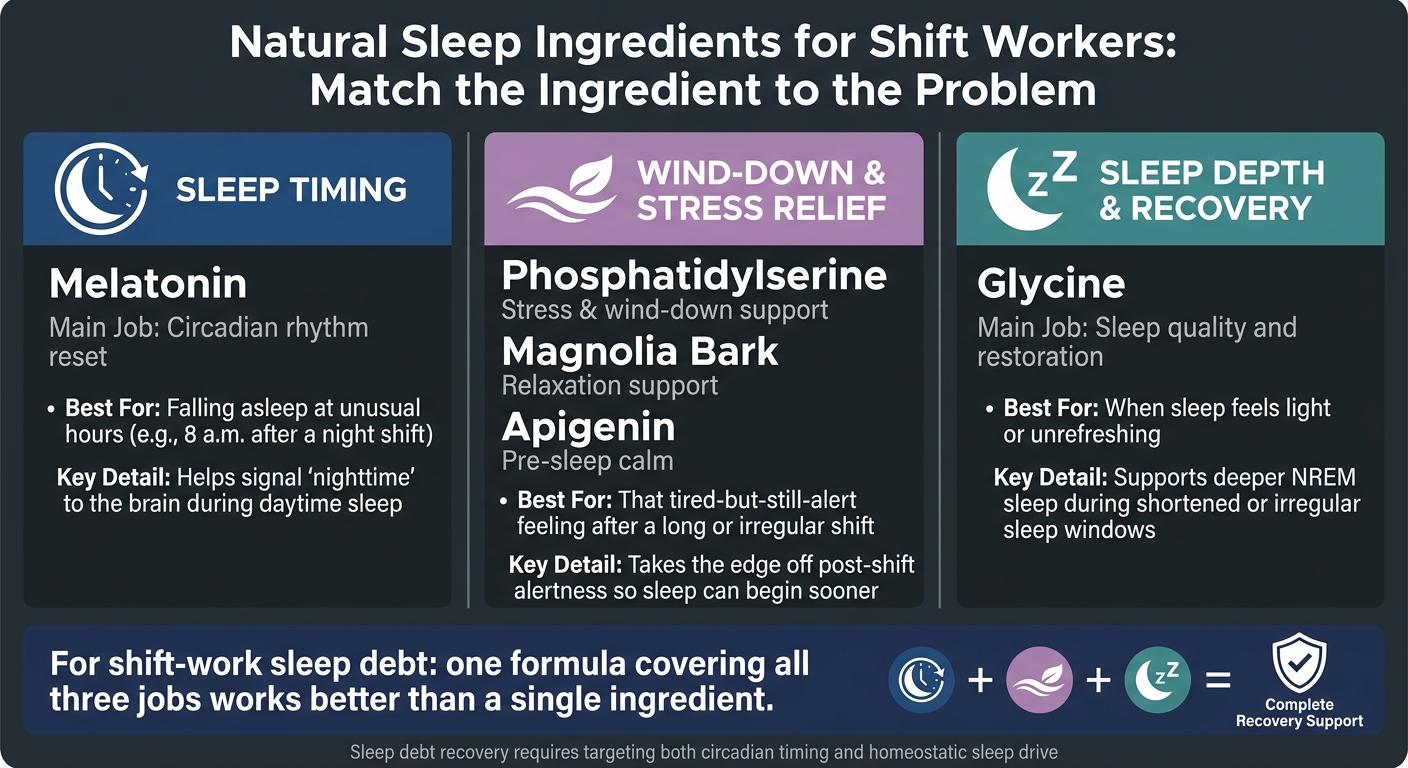
Natural Sleep Ingredients for Shift Workers: Match the Ingredient to the Problem
Quick Comparison
| Ingredient | Main job | Best fit |
|---|---|---|
| Glycine | Sleep recovery support | When sleep feels light or not restorative |
| Melatonin | Sleep timing support | Falling asleep during the day or at odd hours |
| Phosphatidylserine | Stress and wind-down support | After a long or tense shift |
| Magnolia bark | Relaxation support | Settling down before sleep |
| Apigenin | Wind-down support | Pre-sleep calm after irregular hours |
If I were reading this article to get a fast answer, that would be it: match the ingredient to the sleep problem, and if you can't sleep after night shifts, a mix can make more sense than a single ingredient.
sbb-itb-5106bd1
Best Natural Ingredients for Sleep Debt Recovery
For shift workers, sleep debt recovery needs to do two things at once: help reset the sleep clock and help you get better sleep in the hours you have. As time awake stretches on, sleep pressure builds, and the body leans more toward deeper NREM sleep.
Glycine for Deeper Sleep and Next-Day Recovery
Glycine fits the recovery side of the equation. It can help sleep feel more restorative after a thrown-off schedule, which matters when you’re trying to bounce back from odd hours instead of just logging time in bed.
Melatonin for Schedule Shifts and Daytime Sleep
Melatonin is the clearest ingredient for timing. It tells the brain that it’s night and can help with daytime sleep after overnight shifts.
Its main use case is simple: helping you fall asleep at odd hours, like 8:00 a.m. after a 12-hour overnight shift.
| Melatonin | |
|---|---|
| Best for | Falling asleep at unusual hours, daytime sleep after night shifts |
| Not ideal for | Recovering sleep debt on its own |
Phosphatidylserine, Magnolia Bark, and Apigenin for Stress and Wind-Down
Phosphatidylserine, magnolia bark, and apigenin are more about settling down. After a long shift or an irregular one, they may help the body ease into sleep mode. In a multi-ingredient formula, they pair well with melatonin for timing and glycine for recovery-focused sleep.
Quick guide: use the table below to match each ingredient to the job it does best.
| Ingredient | Best Role | Best Use Scenario |
|---|---|---|
| Glycine | Recovery support | When you want the sleep window to feel more restorative |
| Melatonin | Timing support | Falling asleep at unusual hours |
| Phosphatidylserine | Wind-down support | After a long or stressful shift |
| Magnolia Bark | Relaxation support | When you need help settling down before sleep |
| Apigenin | Wind-down support | Before daytime sleep or a post-shift wind-down |
How These Ingredients Work Together After Irregular Sleep
After irregular sleep, shift workers usually need three things at the same time: help with timing, a smoother wind-down, and better sleep quality. That’s why these ingredients make more sense together than on their own. Shift-work sleep debt doesn’t show up in just one way, so one single fix often isn’t enough.
Matching Each Ingredient to a Recovery Scenario
That wiped-out-but-still-wide-awake feeling after a long overnight shift is where phosphatidylserine, magnolia bark, and apigenin come in. They’re meant to take the edge off post-shift alertness so sleep can begin sooner.
Once you’re asleep, glycine helps support deeper, more restorative sleep, which is often the part shift workers miss most.
Melatonin handles the timing side of the formula. It helps reset sleep timing when daytime light makes it harder to fall asleep after a night shift.
Why a Combination Formula Can Make Sense for Shift Workers
That overlap is exactly why a combination formula can be a better fit for shift workers. Instead of juggling separate products for timing, wind-down, and sleep depth, one formula can cover all three.
RST Sleep combines glycine, phosphatidylserine, magnolia bark, apigenin, and extended-release melatonin in one formula for irregular sleep schedules. It targets timing, wind-down, and sleep quality in one dose.
Next, check which formula details matter most for day sleep and rotating shifts.
What to Look for in a Sleep Support Formula
For shift workers dealing with sleep debt, formula design matters just as much as the ingredient list. That’s the next thing to check.
Formula Design That Fits Night Shifts and Daytime Sleep
A long list of ingredients doesn’t mean a product is better. What matters is whether each ingredient has a clear role.
For people with irregular schedules, a well-built formula should work on two separate systems at the same time:
- Circadian rhythm: your body’s internal clock
- Homeostatic sleep drive: the sleep pressure that builds the longer you stay awake
Sleep loss increases homeostatic pressure, while melatonin helps support circadian timing after night shifts. Deeper sleep helps with recovery. If a formula only works on one of these systems, there’s probably a missing piece.
Put simply, a useful formula should help with both sleep timing and sleep depth, not just one.
Quality and Safety Details Worth Checking
Ingredients aren’t the whole story. Before you buy, it’s smart to check a few practical details: GMP-certified manufacturing, allergen-conscious labeling, and non-habit-forming formulas.
Why do these matter? Because shift workers often need something they can use again and again for daytime sleep after irregular shifts. In that case, predictability matters a lot.
RST Sleep meets these criteria: GMP-certified, allergen-conscious, and non-habit-forming.
Those are the main filters for choosing a formula that fits shift-work sleep recovery. Once those basics are covered, the next step is finding the ingredient mix that matches your schedule.
Conclusion: Choosing the Right Ingredients for Sleep Debt Recovery
Match the ingredient to the problem: glycine for light, unrefreshing sleep because it may help with sleep depth; melatonin for sleeping at the wrong time of day because it helps with timing; and phosphatidylserine, magnolia bark, and apigenin for that post-shift wind-down when your body feels tired but your brain is still on the clock.
Each ingredient plays a different role. So if you're dealing with more than one sleep issue at once - which is common with shift work - single-ingredient options can miss part of the picture. In those cases, one formula that covers those overlapping needs can make more sense.
That’s why a multi-target approach often fits shift-work sleep debt recovery better.
For a single formula, RST Sleep combines glycine, extended-release melatonin, phosphatidylserine, magnolia bark, and apigenin in a non-habit-forming formula made for night shift workers and other people with irregular schedules.
FAQs
Can one ingredient fix sleep debt?
No. Sleep debt is complex. It involves more than one body system and several brain processes, so a single ingredient can’t fix it.
Better sleep usually comes from a broader plan. RST Sleep is made to support healthy sleep cycles for night shift workers and people with irregular schedules, but it works best as part of that bigger picture.
When should I use melatonin after a night shift?
Melatonin can shift your circadian rhythm based on when you take it. After a night shift, it usually works best when you time it to match your planned sleep window, instead of taking it at the same clock time every day.
RST Sleep includes extended-release melatonin to help support irregular schedules and improve sleep quality.
How do I know if I need timing or wind-down support?
You may need timing or wind-down support if falling asleep feels harder than it should, or if your brain doesn’t switch easily from “go” mode to rest.
If it often takes you more than 30 minutes to fall asleep, or your sleep schedule gets thrown off by shift work or other commitments, a set wind-down routine can help tell your body it’s time to slow down. RST Sleep is made to support relaxation and healthy sleep cycles.