

Best Nap Lengths for Shift Workers
If I need the safest default, I pick a 10–20 minute nap first. It gives me the fastest boost in alertness with the lowest risk of waking up groggy. If I have more time and fatigue is high, I move to about 90 minutes, because that often lines up with one full sleep cycle.
Here’s the whole article in plain English:
- 10–20 minutes: best for a fast reset and low grogginess
- 30–60 minutes: more recovery, but a higher chance of sleep inertia
- Around 90 minutes: more complete recovery and often smoother waking
- More than 90 minutes: best for off-duty catch-up sleep, but grogginess risk goes up
A key point runs through all of this: timing matters as much as length. After many hours awake, sleep pressure builds. That can make a nap feel better - or make waking up feel worse - depending on when I take it and what I need to do next.
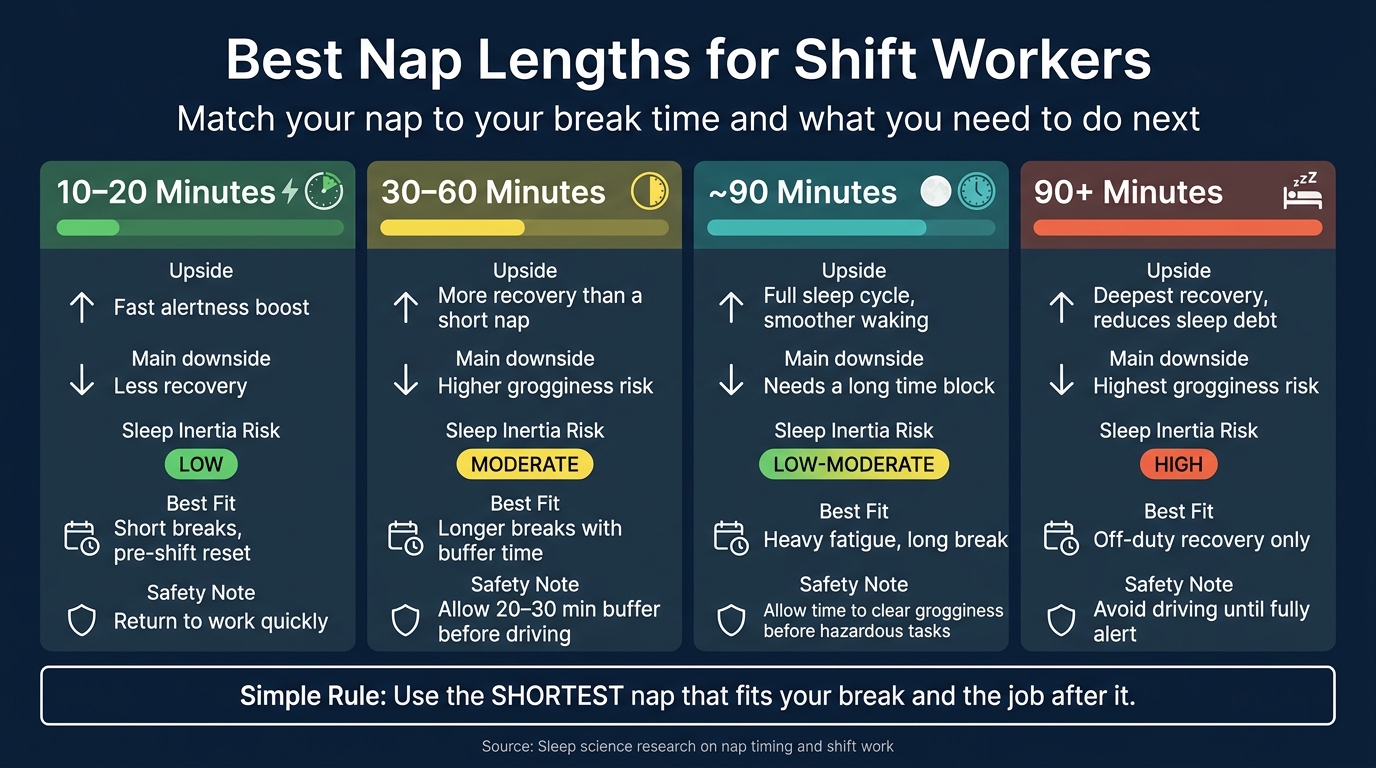
Best Nap Lengths for Shift Workers: Quick Comparison Guide
Optimal Nap Length: Unlock Peak Performance & Creativity
sbb-itb-5106bd1
Quick Comparison
| Nap length | Main upside | Main downside | Best fit |
|---|---|---|---|
| 10–20 min | Fast alertness | Less recovery | Short breaks, pre-shift reset |
| 30–60 min | More recovery than a short nap | More grogginess risk | Longer breaks with buffer time |
| ~90 min | Full-cycle sleep, sleep quality and duration for better recovery | Needs a long block of time | Heavy fatigue, long break |
| 90+ min | Helps with sleep debt | Highest grogginess risk | Off-duty recovery |
My simple rule: use the shortest nap that fits the break and the job after it. If I may need to drive, use equipment, or make fast decisions, I leave 20–60 minutes after longer naps for the fog to clear.
This guide compares all four nap lengths, shows where each one works best, and helps match nap time to night shifts, rotating shifts, early starts, and split schedules.
1. Short Naps (10–20 Minutes)
Short naps work best when speed matters more than full recovery. A 10–20 minute nap can ease fatigue without much sleep inertia, which makes it a smart pick when your body clock is out of sync with your shift. You’re giving up deeper recovery for something faster and less likely to leave you foggy.
Alertness Boost
A short nap can give you a fast alertness boost during a long or irregular shift. Think of it as a quick reset: 10–20 minutes can cut fatigue, sharpen focus, and keep grogginess low.
Sleep Inertia Risk
Its main edge is low sleep inertia. That means you’re less likely to wake up feeling heavy, slow, or out of it.
Best Shift Timing
Short naps fit best when you need a quick reset before the next work block.
If you need more recovery time, the next option is a longer nap.
2. Moderate Naps (30–60 Minutes)
A 30–60 minute nap gives you more recovery than a short nap. But there’s a trade-off: you’re also more likely to wake up groggy. That’s why this nap length sits in the middle. It’s more than a quick reset, but not as smooth or predictable as a shorter nap.
Alertness Boost
The main upside of a 30–60 minute nap is stronger recovery than a short nap. It can cut fatigue and help bring back alertness and focus. Still, the result isn’t always consistent. Some days you’ll wake up sharper. Other days, you may need a little time to get going.
Sleep Inertia Risk
A longer nap gives your brain more time to move into deeper NREM sleep. And if you wake up from deeper sleep, sleep inertia is more likely - especially as you get closer to 60 minutes. That groggy, heavy-headed feeling can stick around for a bit.
If you plan to drive or do anything safety-critical, leave 20–30 minutes after waking before you jump in. If you want the recovery of a longer nap with a lower chance of grogginess, the 90-minute nap is the next option.
Recovery Value
Moderate naps can take a real bite out of the sleep pressure that builds up during a long shift. That can help with alertness and focus, especially if you nap several hours into the shift. In plain English: when fatigue starts piling up, this nap length can give you more of your brain back.
Best Shift Timing
For night shift workers, the best window is about 5–6 hours after waking. Try not to take a moderate nap in the last 2–3 hours before your shift ends. If you do, it may be harder to fall asleep once you get home.
That timing helps you recover during the shift without making post-shift sleep harder.
3. Long Naps (Around 90 Minutes)
When a short nap won’t cut it, 90 minutes is the next clean choice. That length usually lines up with one full sleep cycle, which means you’re more likely to wake up during lighter sleep instead of getting dragged out of the middle of a deeper stage.
Alertness Boost
A 90-minute nap usually restores alertness better than a shorter nap when fatigue is already high. It tends to help more once tiredness has piled up during a long shift.
Sleep Inertia Risk
Because a 90-minute nap is more likely to end at the end of a sleep cycle, it usually leads to less grogginess than waking up mid-cycle. In plain terms, it’s often a smoother option than a 30–60 minute nap when you need to get moving and function fast after waking.
Recovery Value
This nap length gives you the most recovery without turning into a full sleep block.
Best Shift Timing
Try to place a 90-minute nap about 5–6 hours into your shift, after fatigue has had time to build.
Longer naps can give you more recovery, but they’re also harder to fit into a shift.
4. Extended Naps (More Than 90 Minutes)
Extended naps can cover one or more full sleep cycles. This option works best when you have enough time to wake up fully before your next task.
Alertness Boost
A longer nap can give you deeper recovery than a short nap. But there’s a catch: you’re more likely to wake up feeling groggy.
Sleep Inertia Risk
This is the main downside for shift workers. Sleep inertia can leave you groggy and unfocused. If you need to sleep longer than 90 minutes, give yourself 30 to 60 minutes before work or driving.
Recovery Value
These naps can help pay back sleep debt after several shifts in a row.
Best Shift Timing
Use them after a shift (or learn how to sleep better after working nights) or during a long off-duty block. Then leave 30 to 60 minutes for the grogginess to wear off before you drive or start work.
Pros and Cons of Each Nap Length
Every nap length comes with a give-and-take. For shift workers, the riskiest moment is often right after waking up. If your body clock is out of sync, that can mean grogginess, slower focus, and irritability.
That’s why nap length matters so much. Some naps are easy to squeeze into a break and let you get back to work fast. Others offer more recovery, but they can leave you foggy for a while. The table below lays out the main trade-offs so you can match your nap to the time you have and what you need to do next.
| Nap Length | Main Pros | Main Cons | Best Use Case | Safety Note |
|---|---|---|---|---|
| Short Naps (10–20 Minutes) | Quick reset; easy to fit into a break | Limited recovery | When you only have a short break | Low grogginess risk; return to work quickly |
| Moderate Naps (30–60 Minutes) | More recovery than a short nap | Higher chance of waking groggy | When you have extra time to rest | Allow a 20–30 minute buffer before driving or demanding tasks |
| Long Naps (About 90 Minutes) | Full sleep cycle; smoother waking than 30–60 min | Requires a longer break | When you can nap during a longer off-duty block | Allow time to clear grogginess before driving or other hazardous tasks |
| Extended Naps (More Than 90 Minutes) | Deepest recovery; helps pay back sleep debt | Highest grogginess risk | When you have a long off-duty period | Avoid driving or other hazardous tasks until grogginess has cleared |
The next section matches each nap length to common shift schedules.
Nap Length Recommendations by Shift Schedule
Match your nap length to the break you have and what you need to do after you wake up. The table below helps you line up nap time with the window you actually have.
| Nap Category | Best Use | Primary Benefit | Key Risk | Best Fit |
|---|---|---|---|---|
| Short (10–20 min) | Short break | Fast alertness boost | Little recovery | Workers with limited break time |
| Moderate (30–60 min) | Longer break | Stronger recovery | Greater grogginess on waking | Workers who can rest longer |
| Long (~90 min) | Long break | Best recovery from fatigue | Requires a large time block | Workers with a long off-duty block |
| Extended (90+ min) | Off-duty recovery | May reduce sleep debt | Highest grogginess risk | Workers with heavy sleep debt |
Use the chart to choose the shortest nap that fits your shift window. That simple rule works well because it gives you a boost without taking more time than you can spare.
Here’s how that looks across common schedules:
- 12-hour night shifts: use a short nap for a quick reset; use a 90-minute nap only if you have a long break
- Rotating shifts: go with the shortest nap that fits the break
- Early-morning starts: take a short nap before the shift; take a longer nap only if you still have enough time to recover before work
- Split schedules: a moderate or long nap can work if the gap between shifts is big enough
The best nap length comes down to three things: how long your break is, when your shift falls, and how soon you need to be sharp again.
FAQs
What if I wake up groggy from a nap?
Waking up groggy after a nap is called sleep inertia. It’s that hazy, slow-to-start feeling that can hit right after you wake up. For a short period, it may dull your alertness and make it harder to perform at your usual level.
RST Sleep offers a natural supplement made for night shift workers and people with irregular schedules. The goal is simple: to help support sleep quality and promote healthier sleep cycles.
Should I nap before or during my shift?
A nap during your shift can help manage fatigue and improve alertness. In many cases, a 10- to 20-minute nap in a quiet, dark place can cut sleepiness and help you perform better when you get back to work.
One thing to watch for: you may feel temporary grogginess right after waking. That feeling is called sleep inertia.
How often should shift workers nap?
Shift workers should nap during breaks when they need to. It’s a simple way to cut fatigue and stay sharper, especially during long shifts or overnight work.
A 10- to 20-minute nap tends to work best. It can boost alertness without leaving you groggy from sleep inertia. If possible, nap in a quiet, dark spot where you can recline.