

5 Benefits of Extended Release Melatonin for Shift Workers
Extended-release melatonin can help shift workers manage sleep challenges caused by irregular schedules. Unlike standard melatonin, which wears off after a few hours, extended-release versions provide a steady release over 6–8 hours, supporting longer and more restorative sleep. Key benefits include:
- Longer Sleep Duration: Helps you stay asleep during daytime rest by maintaining consistent melatonin levels.
- Body Clock Support: Gradually aligns your circadian rhythm to irregular schedules.
- Improved Sleep Quality: Promotes deeper stages of sleep, aiding physical and mental recovery.
- Health Benefits: Reduces risks linked to disrupted sleep, such as cardiovascular and metabolic issues.
- Non-Habit Forming: Safe for long-term use with minimal side effects and no dependency risks.
For best results, take it 30–60 minutes before sleep, use blackout curtains, and avoid bright light exposure. Consult a doctor if you're on medications or have specific health concerns.
1. Staying Asleep Longer During Daytime Sleep
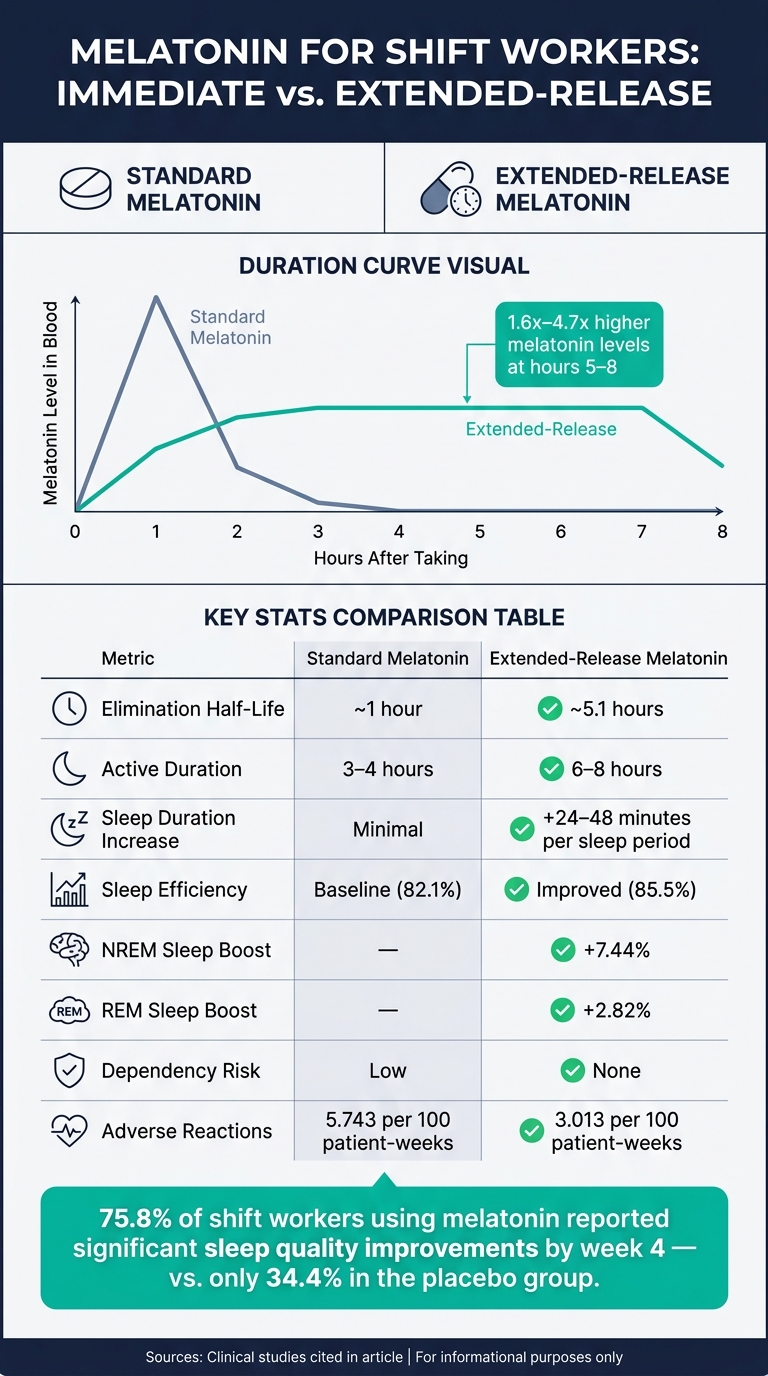
Extended-Release vs. Immediate-Release Melatonin for Shift Workers
For shift workers, the challenge often isn’t falling asleep - it’s staying asleep. When you’re trying to sleep at 8 AM, your body’s natural rhythms are fighting against you. Cortisol levels rise, body temperature increases, and sunlight signals your brain to stay awake. While standard immediate-release melatonin can help you fall asleep initially, its effects wear off after 3–4 hours, leaving you wide awake when you should still be resting.
This is where extended-release (ER) melatonin steps in. With an elimination half-life of about 5.1 hours - compared to just 1 hour for immediate-release melatonin - it keeps therapeutic melatonin levels in your bloodstream much longer. This sustained presence means your body gets the support it needs throughout your entire sleep period, not just at the start.
A 2024 study highlighted the benefits: sustained-release melatonin maintained hormone levels 1.6 to 4.7 times higher at the 5-, 6-, 7-, and 8-hour marks compared to immediate-release versions. The result? A longer, uninterrupted sleep period and improved alertness when you wake up.
"Sustained-release formulations are expected to provide elevated plasma melatonin levels for a longer duration of time, thus allowing it to exert its action for a longer duration and thus facilitating healthy sleep." - Shefali Thanawala, Nutriventia Limited
This consistent melatonin support promotes deeper, restorative sleep, including REM and slow-wave stages - essential for physical and mental recovery. Studies show melatonin use can extend total sleep time by 24–48 minutes per period for shift workers, with sleep efficiency improving from 82.1% to 85.5%. These improvements translate to sharper focus, quicker recovery, and fewer on-the-job mistakes. Plus, this extended sleep support lays the groundwork for better circadian alignment, which we’ll explore next.
sbb-itb-5106bd1
2. Aligning Your Body Clock with an Irregular Schedule
Your body operates on a 24-hour circadian rhythm, managed by the suprachiasmatic nucleus (SCN). This internal clock relies on cues like light, temperature, and hormones to determine when you should be awake or asleep. However, working night shifts disrupts these natural signals, making it tough for your body to stay in sync.
Melatonin plays a key role here - not just by making you feel sleepy but also by acting as a signal to your internal clock about the time of day. Taking extended-release (ER) melatonin before your daytime sleep can help communicate to your SCN that it’s time to rest. Over time, this consistent signal helps adjust your body’s rhythm.
"Melatonin's primary role is circadian signalling - it tells the body clock what time of day it is, rather than directly causing sleep." - OffShift
ER melatonin is particularly effective because it releases gradually over 6–8 hours, closely replicating your body’s natural nighttime melatonin cycle. This steady release provides a more reliable adjustment to your SCN compared to the quick spike caused by immediate-release melatonin.
"Melatonin-SR resulted in higher and sustained plasma melatonin concentrations for an extended period... mimicking the endogenous melatonin profile." - Shefali Thanawala, Nutriventia Limited
To get the most out of ER melatonin, take it 30–60 minutes before you plan to sleep. This ensures the peak release aligns with when you’re trying to fall asleep. Pair this with blue-light blockers during your morning commute to reinforce the darkness your body associates with rest. These steps are especially crucial during the first 5–7 days of a new shift, when your circadian rhythm is at its most disrupted. Even on your days off, sticking to the same dosing schedule can help prevent confusion and keep your body clock on track.
3. Better Sleep Quality and Physical Recovery
Extended-release melatonin doesn’t just help you sleep longer - it also improves the quality of your sleep.
Why does sleep quality matter so much? It’s not just about clocking in hours of rest. What truly counts is how much time your body spends in deep NREM and REM sleep. These stages are essential for repairing muscles, strengthening your immune system, and consolidating memories. For shift workers, though, daytime sleep often gets interrupted, making it tough to fully benefit from these restorative cycles.
The real hurdle isn’t always falling asleep - it’s staying asleep long enough for your body to recover. As mentioned earlier, immediate-release melatonin wears off quickly, often leading to early awakenings that disrupt the deep sleep your body desperately needs.
This is where extended-release melatonin shines. By maintaining higher melatonin levels during the most critical recovery periods, it helps your body stay in those vital sleep stages longer. Unlike sedatives, which can interfere with REM and deep sleep, melatonin works naturally with your body’s sleep rhythms. Studies even show that sustained-release melatonin can boost NREM sleep duration by 7.44% and REM sleep by 2.82%. For shift workers, it has been shown to improve overall sleep efficiency from 82.1% to 85.5%.
Getting more deep and REM sleep doesn’t just help your body recover faster - it also supports your ability to adapt to irregular schedules.
RST Sleep’s formula combines extended-release melatonin with other supportive ingredients like phosphatidylserine and magnolia bark. These additions are specifically chosen to enhance restorative sleep stages, making it ideal for anyone dealing with disrupted sleep patterns. Better sleep quality ultimately leads to better recovery and improved overall health.
4. Long-Term Health Support for Night Shift Workers
Getting consistent, high-quality sleep is essential for protecting your health over time. For night shift workers, this becomes even more critical.
Research shows that night shift workers face a 40% higher risk of cardiovascular disease, with each additional five years of shift work adding another 7% to that risk. The World Health Organization (WHO) has even labeled night shift work as "probably carcinogenic" due to the chronic disruption it causes to the body’s natural rhythms. Additionally, 63.8% of shift workers show signs of metabolic syndrome, compared to 56.7% of non-shift workers.
The root of these risks lies in chronodisruption - a condition where your internal body clock falls out of sync with your daily schedule. This misalignment can lead to insulin resistance, inflammation, and hormonal imbalances. One way to counteract this is through regular melatonin use, which helps signal your body to adjust to a night-oriented routine. This adjustment is key to reducing long-term health risks.
"Melatonin acts as a systemic circadian signal, conveying 'darkness' information to tissues and helping synchronize peripheral oscillators with the environmental day–night cycle." - Jarosław Nuszkiewicz, Department of Medical Biology and Biochemistry
A 2024 clinical trial found that using melatonin consistently for just four weeks significantly improved scores on the Occupational Cognitive Failure Questionnaire, showing better memory, attention, and executive function. Beyond cognitive benefits, melatonin also supports cardiovascular and metabolic health. As Sajad Khanjani explained:
"Melatonin was safely and tolerably superior to placebo in treating patients with sleep disorders following shift work in the short term. Evidence also shows its effects on improving occupational cognitive performance in the medium term."
Melatonin is safe for long-term use, and extended-release formulations are particularly effective. These versions maintain steady melatonin levels, promoting deeper, more restorative sleep. For night shift workers, extended-release melatonin offers a practical way to sustain overall health and well-being over time.
5. Non-Habit Forming with a Good Tolerability Profile
For shift workers, finding a sleep aid that avoids dependency and minimizes side effects is essential.
Extended-release melatonin stands out because it doesn’t carry the risk of dependency associated with drugs like benzodiazepines or Z-drugs (e.g., zolpidem). According to StatPearls:
"No evidence suggests that patients develop tolerance to melatonin."
Not only does it improve sleep duration and quality, but its safety has been backed by research. A 6-month randomized, placebo-controlled trial using 2 mg prolonged-release melatonin demonstrated that sleep benefits were sustained - or even improved - over time, without requiring an increased dose.
The tolerability of melatonin is also impressive. Clinical trials involving 1,931 patients showed fewer adverse reactions with melatonin (3.013 per 100 patient-weeks) compared to placebo (5.743). Side effects like headache or nausea are rare and typically mild. Unlike traditional sleep aids, extended-release melatonin works by gently suppressing wake-promoting signals through MT1 and MT2 receptors, reducing the grogginess often experienced with other options.
However, melatonin may interact with certain medications, such as blood thinners and anti-seizure drugs. To ensure quality and accuracy, it’s important to choose supplements from GMP-certified manufacturers. For instance, RST Sleep offers a supplement specifically designed with extended-release melatonin and other research-supported ingredients, providing a dependable, non-habit forming solution for those with irregular schedules.
This combination of safety, effectiveness, and a low risk of dependency makes extended-release melatonin a practical option for shift workers looking for reliable sleep support.
How to Use Extended Release Melatonin as a Shift Worker
To get the most out of extended-release melatonin, take it 30–60 minutes before your planned sleep time. For instance, if your shift ends at 7 AM and you aim to be asleep by 8:30 AM, take the supplement around 8 AM. This timing allows the melatonin to kick in before you settle into bed.
Getting the dosage right is just as important. The American Academy of Sleep Medicine suggests starting with 1–3 mg for managing shift work sleep disorder. Although many over-the-counter options offer higher doses, anything over 5 mg usually doesn’t add extra benefits and might leave you feeling groggy. A better strategy is to start with a low dose - 0.5–1 mg - and adjust as needed. These guidelines apply whether you have a fixed or rotating schedule.
For rotating shift workers, staying consistent with melatonin use during the first 5–7 days of a new schedule can help your body adjust and reset its internal clock. But here’s a key tip: avoid taking melatonin within 6–8 hours of your next shift. This precaution is especially important if you’ll be driving or handling machinery, as residual drowsiness can be dangerous.
Creating the right sleep environment can amplify melatonin’s effects. Scott Hilliard from LiveWorkSleep explains:
"Attempting to sleep in a bright room while relying solely on melatonin works against the supplement's mechanism. The hormone tells your brain it's time to sleep, while the light streaming through your windows says the opposite."
Bright light can interfere with melatonin’s effectiveness, so make your sleep space as dark and relaxing as possible. Use blackout curtains, keep the room cool (below 68°F), and block out noise with earplugs or a white noise machine. To prevent sunlight exposure on your way home, consider wearing amber-tinted glasses to avoid suppressing your body’s natural melatonin production.
For a more comprehensive approach, RST Sleep offers a supplement that combines low-dose extended-release melatonin with other sleep-supporting ingredients like apigenin, magnolia bark, glycine, and phosphatidylserine. This blend addresses not just falling asleep but also staying asleep and managing cortisol levels.
Conclusion
Extended-release melatonin offers a practical way to address the challenges of disrupted sleep cycles, especially for shift workers. It encourages longer, more restful sleep during the day, helps adjust your internal clock to irregular schedules, and promotes better sleep patterns - all without the grogginess or dependency linked to traditional sedatives.
Research backs its effectiveness: about 75.8% of shift workers using melatonin reported significant improvements in sleep quality by the fourth week, compared to just 34.4% in the placebo group. These results highlight its potential to make a real difference for those with unconventional schedules.
That said, melatonin isn't a universal solution. Factors like individual metabolism, current medications, and overall health can influence how your body responds to it. Dr. Charmane Eastman from Rush University Medical Center emphasizes:
"The timing of melatonin administration matters more than whether you take it at all."
Before starting melatonin, especially if you're on medications like beta-blockers or antidepressants, it's crucial to consult your doctor. Use this information to fine-tune your sleep plan, and work with a healthcare provider to find the approach that fits you best.
FAQs
What’s the best dose of extended-release melatonin for shift work?
Research indicates that the ideal melatonin dose for shift workers usually falls between 1 and 5 mg. For extended-release melatonin, starting with 1 to 3 mg is commonly suggested. This approach helps maintain sleep throughout the night and reduces the chances of waking up mid-sleep. Taking higher doses often doesn’t improve results and might lead to more side effects. RST Sleep adopts a low-dose, extended-release formula designed to sync with the body’s natural rhythms and limit morning grogginess.
Can extended-release melatonin make me groggy during my next shift?
Extended-release melatonin is designed to release melatonin gradually over 6 to 8 hours, helping with sleep maintenance. However, this slow release can sometimes lead to grogginess or lingering sedation. To avoid these effects, it's best not to take it within 6 to 8 hours before starting a night shift, as it could impact your alertness. Starting with a lower dose is another way to reduce the chances of feeling drowsy the next day.
Who should avoid melatonin or check with a doctor first?
Consult your healthcare provider before taking melatonin, particularly if you think you might have a sleep disorder. If you have an autoimmune condition, steer clear of melatonin as it could aggravate your symptoms. For children and teens, pediatrician approval is essential, while older adults should avoid controlled-release versions because of their extended effects. Be careful if you need to stay alert, as melatonin can make you drowsy. Always check with your doctor before beginning any new supplement.