

How to Adjust Sleep for Rotating Shifts
Rotating shifts can throw off your sleep fast, but the fix is pretty simple: aim for 7–9 hours of sleep every 24 hours, move your sleep time by 15–20 minutes per day before a shift change, use light and naps with care, and keep your room dark, quiet, and 60–67°F.
If I were dealing with rotating shifts, I’d focus on four things:
- Set one sleep anchor for each shift block
- Shift sleep little by little before the new schedule starts
- Use bright light and caffeine at the right times
- Add short naps or split sleep when one long block doesn’t work
A few numbers stand out. Adults should still target 7–9 hours of total sleep a day. A 15–30 minute nap can help with alertness. And for night shifts, a 90-minute nap before work may help reduce sleep loss.
| Focus area | What I’d do |
|---|---|
| Total sleep | 7–9 hours in each 24-hour period |
| Before shift changes | Move sleep by 15–20 minutes daily |
| Night-shift support | Sleep after work, then add a late-afternoon nap |
| Short naps | 15–30 minutes |
| Bedroom setup | Dark, quiet, cool (60–67°F) |
| Light timing | Bright light when I need to be awake, less light before sleep |
The short version: I’d treat rotating-shift sleep like a schedule problem, not just a tiredness problem. Once I line up sleep timing, light, naps, and my room setup, the routine gets much easier to hold.
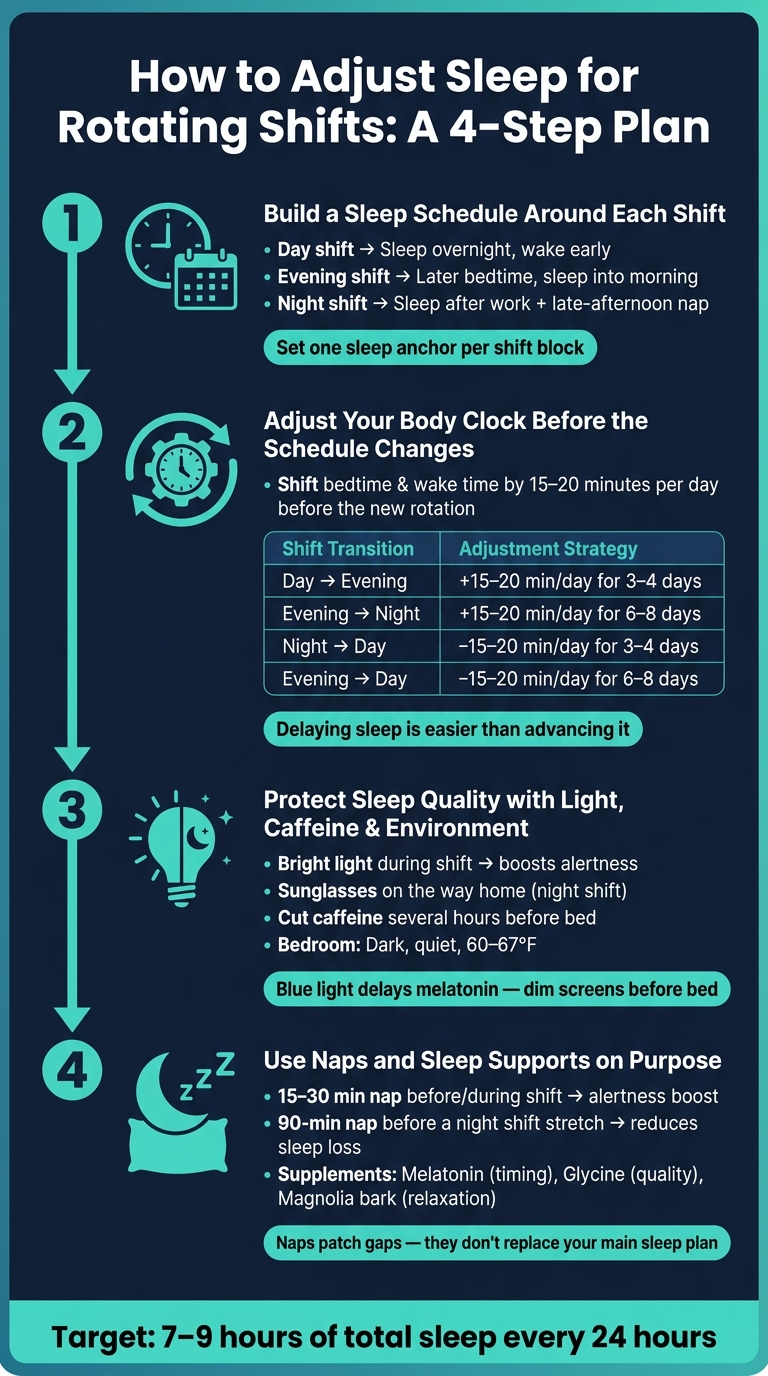
How to Adjust Sleep for Rotating Shifts: A 4-Step Plan
How to Defeat Jet Lag, Shift Work & Sleeplessness | Huberman Lab Essentials
sbb-itb-5106bd1
Step 1: Build a Sleep Schedule Around Each Shift
Start with one sleep anchor you can keep during each rotation. That anchor can be a fixed wake time or a protected core sleep window. From there, build the rest of your sleep around each shift.
Map Sleep Times for Day, Evening, and Night Shifts
After you set the anchor, adjust the rest of your sleep to fit the hours you work. Each shift needs a different sleep window:
- Day shift: Sleep at night and wake up early in the morning, using a standard overnight sleep block.
- Evening shift: Move bedtime later to line up with your later work hours, then sleep into the morning.
- Night shift: Sleep during the day after your shift ends. Then add a short pre-shift nap in the late afternoon to help you stay alert before work.
How to Use Split Sleep When One Block Is Not Realistic
If one long sleep block just isn't going to happen, split it up. Use a core sleep period plus a planned nap. Keep that core sleep block as steady as the rotation allows.
Next, shift your body clock before the rotation changes.
Step 2: Adjust Your Body Clock Before the Schedule Changes
Don’t wait until the first day of a new rotation to make the switch. That usually makes the change feel rougher than it needs to. Start with the core sleep block from Step 1, then move it bit by bit before the next rotation begins.
Shift Sleep Gradually Before a New Rotation Starts
Move your bedtime and wake time by 15–20 minutes in the direction you need each day for several days before the new rotation starts. In most cases, shifting to a later schedule is easier than shifting to an earlier one. That’s because delaying sleep tends to line up better with the body clock than trying to fall asleep earlier than usual.
Here’s a practical way to handle the most common shift changes.
| Transition Type | Daily Bedtime & Wake Adjustment | Total Adjustment Period |
|---|---|---|
| Later (Day → Evening) | 15–20 mins later per day | 3–4 days |
| Later (Evening → Night) | 15–20 mins later per day | 6–8 days |
| Earlier (Night → Day) | 15–20 mins earlier per day | 3–4 days |
| Earlier (Evening → Day) | 15–20 mins earlier per day | 6–8 days |
It also helps to pair those shifts with morning light exposure at your new target wake time. Natural sunlight can help you feel more alert when you wake up on the new schedule.
Stick with the same sleep anchor from Step 1, then slide it over little by little as your rotation changes.
What to Do on the Day Between Shift Blocks
The day between shift blocks can slip away fast. Try not to stay awake all day just to force the new schedule. That often backfires.
Instead, protect your core sleep block. Treat the changeover day like recovery time, not a hard reset. Once the new rotation begins, use light, caffeine, meals, and your sleep setup to keep the new timing in place. You can also support your transition with natural ingredients for night shift sleep to help your body adjust more effectively.
Step 3: Protect Sleep Quality with Light, Caffeine, and Your Sleep Environment
Use the sleep anchor from Step 2, then guard it with the right light, caffeine timing, and bedroom setup. That’s what helps hold the sleep window you built for each rotation.
Control Light to Stay Alert at Work and Sleepy at Home
Use bright light during your shift to help you stay alert and push back sleepiness. If you work nights, wear sunglasses on the way home to cut down morning light exposure.
When you get home, dim the lights and stay off screens. Blue light in the evening can delay melatonin and make sleep harder. Blackout curtains can help. So can a sleep mask if you need one.
Once light is under control, the next piece is simple: don’t let stimulants or late activity wreck that sleep window.
Set Caffeine, Meals, Exercise, and Bedroom Conditions
Stop caffeine several hours before bed. Skip heavy meals and alcohol close to sleep. Finish hard exercise several hours before bed too.
Your bedroom should be dark, quiet, and cool, ideally 60–67°F. If daytime noise is a problem, use earplugs or white noise.
Step 4: Use Naps and Natural Sleep Supports on Purpose
Once you’ve handled light exposure and your sleep setup, naps and sleep supports can help cover the rest. Think of them as tools to patch the weak spots in your sleep plan, not replace the plan itself.
Time Naps to Boost Alertness Without Hurting Main Sleep
A short nap can do a lot. A 15–30 minute nap before or during a shift may help with alertness without leaving you too groggy. And if you’re heading into a stretch of night shifts, a 90-minute nap beforehand can help cut down on lost sleep.
Use supplements to support the sleep window you already set up. That part matters.
How Melatonin, Glycine, and Magnolia Bark May Help
Melatonin works best as a timing signal. Take it before your target sleep window, especially since light at night can push that timing later.
Glycine has been studied for sleep quality support after rotating schedules and is often taken 30–60 minutes before sleep. Magnolia bark may help with relaxation and make it easier to fall asleep and stay asleep during daytime sleep after night shifts. Apigenin, a compound from chamomile, is linked to calming effects that may support sleep onset.
RST Sleep combines extended-release melatonin, glycine, magnolia bark, apigenin, and phosphatidylserine to support sleep timing and relaxation for irregular schedules.
Conclusion: A Simple Plan for Managing Sleep on Rotating Shifts
Rotating shifts can throw sleep off balance fast. The target is still the same: aim for 7–9 hours of sleep in each 24-hour period.
The best way to make that work is to match your plan to the shift you're working. Build a sleep routine for each shift type, then move your sleep time in small 15–20 minute steps before each rotation change.
After your schedule is in place, protect it. Get bright light soon after you wake up to help support alertness, and cut off caffeine well before bedtime.
Naps can help fill in the gaps before or during a shift. At the same time, try to keep your main sleep window as steady as your rotation allows.
If you want extra support for an irregular schedule, RST Sleep is made for night shift workers and people with uneven sleep patterns. That routine may help your body clock adjust faster from one rotation to the next.
FAQs
How long does it take to adjust to a new shift?
Getting used to a new shift usually takes at least a few days. And getting back to normal can take more than one chance to sleep. In many cases, it takes several nights because a shift change can throw off your sleep quality, shorten how long you sleep, and disrupt your body clock.
If you’re heading back to work, many employers try to give workers at least 12 hours off between shifts so there’s enough time for proper sleep. That said, one night off still may not be enough, especially after your body clock has been thrown out of sync or after a long stretch on duty.
What if I can’t get 7–9 hours in one block?
If you can’t get 7–9 hours in one stretch, protect anchor sleep that lines up with your usual circadian rhythm. Then use shorter recovery sleep periods to fill the gap.
In most cases, nighttime sleep gives you the best sleep quality. But life and work don’t always cooperate. When that’s not possible, shorter segmented naps can still help.
It also helps to leave enough time between shifts so you can recover across more than one sleep period.
When should I use melatonin for shift work sleep?
Use melatonin to help shift your sleep schedule for shift work. Take it in the evening to make you feel sleepier and help your body get ready for sleep when you need it.
If you're trying to move your sleep schedule earlier, you can also take it in the morning to create a phase delay. The main job of melatonin is to adjust timing, not to keep you asleep for your entire sleep period.